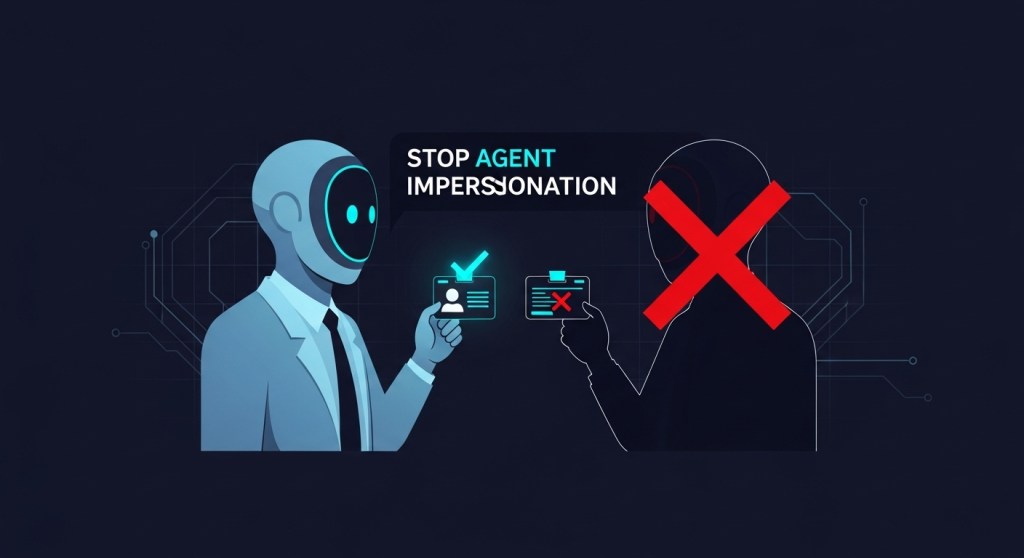
TL;DR: Agent adoption is exploding in 2025, but so are real security risks—especially impersonation. This guide gives you a practical 12‑control checklist to harden identity, actions, and data for AI agents across web, chat, browser, and back‑office workflows.
Why this matters right now
Funding and enterprise rollouts are accelerating—customer‑facing agents are moving into production with bold claims of high resolve rates. A recent $100M Series A for Wonderful is one signal that support agents are going mainstream. citeturn0search1
At the same time, new research shows agents are manipulable in realistic, competitive settings, and can bias toward the first response they see—exactly the conditions of production marketplaces. Microsoft’s Magentic Marketplace results highlight susceptibility to manipulation and first‑proposal bias under scale. Read the paper and blog summary. citeturn2search0turn2search3
Security leaders are also warning about impersonation—agents acting as someone or something they’re not. Cohere’s CAIO called impersonation the agent equivalent of hallucination and a top risk for sensitive systems. Details here. citeturn0news13
Who this is for
- Startup founders deploying sales, support, or ops agents
- E‑commerce teams piloting browser/web agents, Shopify/WooCommerce assistants
- Platform and security engineers responsible for guardrails and governance
The 12‑control security checklist to stop agent impersonation
- Strong agent identity: Assign a cryptographic identity per agent/bot. Store keys in an HSM or managed KMS, rotate regularly, and sign agent manifests/configs. Enforce mTLS for service calls and verify signatures on inbound agent messages.
- Least‑privilege access and scoped tokens: Use granular OAuth scopes per task. Issue ephemeral tokens tied to a single workflow with short TTLs. Avoid broad API keys in prompts or tools.
- Human‑in‑the‑loop for risky actions: Require approvals for wire transfers, refunds, PII exports, privilege changes, or bulk actions. Log who approved, what changed, and why.
- Message integrity + audit trails: Sign tool‑call payloads and user‑visible messages. Persist trace IDs and immutable logs (WORM) so you can prove who did what—pair this with AgentOps/observability. See our AgentOps playbook.
- Data firewalling and redaction: Enforce data‑loss prevention rules, PII masking, and purpose‑binding. Break glass for rare overrides; record them.
- Browser and network sandboxing: For web/browse agents, run in isolated containers with URL allowlists, download blocks, and screenshot‑only modes when feasible. Our 14‑day browser‑agent guide covers safe defaults. Read it here.
- Inter‑agent protocol hygiene: As interop grows (Google’s A2A; Microsoft and others aligning), validate agent identities and enforce allowlists for which external agents your agents may talk to. Prefer signed capabilities exchanges over free‑form prompts. A2A context. citeturn2search4
- Vendor controls in your agent platform: If you use OpenAI AgentKit or Salesforce Agentforce 360, enable Evals/guardrails and admin connectors; restrict tools to known safe backends; and require enterprise SSO with scoped roles. AgentKit, Agentforce 360. citeturn0search0turn0search2
- Adversarial testing in simulation: Before production, red‑team your workflows in a safe environment. Use synthetic marketplaces (e.g., Microsoft’s Magentic) to measure manipulation resistance, discovery bias, and negotiation behavior. Research. citeturn2search0
- Policy‑as‑code for prompts and tools: Maintain centrally versioned policies for allowed tools, domains, and verbs. Blocklist dangerous verbs (delete, transfer) by default; require explicit capability grants with approvals.
- Budgets, rate limits, and kill‑switches: Impersonation often shows up as odd spend or bursty calls. Enforce per‑agent budgets, per‑tool rate limits, and instant revocation of tokens and webhooks.
- Transparent UX: Disclose that users are engaging an agent, provide an escalation path to a human, and display the agent’s current capabilities and constraints.
How today’s platforms help (and where they don’t)
OpenAI AgentKit adds building blocks like Agent Builder, ChatKit, and Evals for Agents—use them to prove your guardrails work before go‑live. citeturn0search0
Salesforce Agentforce 360 ships Agent Script and a centralized Builder; pair that with Slack controls and enterprise SSO to constrain actions inside your CRM stack. citeturn0search2
Interop standards are emerging. Alongside Google’s A2A, Microsoft and others back broader protocols (e.g., MCP) so agents can collaborate securely—great for scale, but it expands your trust boundary. Bake identity and allowlists into your design. citeturn2search4turn2news13
30‑60‑90 day rollout plan
Days 0–30: Prove control
- Pick one workflow (e.g., order status replies) and implement Controls 1–6 end‑to‑end.
- Stand up AgentOps and dashboards; define SLOs and incident playbooks. See: Agent observability guide.
- Run basic Evals/red‑team cases for impersonation and prompt‑injection.
Days 31–60: Expand safely
- Add a second workflow (e.g., returns or cancellations) with approvals and budgets.
- Harden browser agents in a sandbox; follow our 14‑day browser agent playbook.
- Adopt policy‑as‑code; create an external‑agent allowlist.
Days 61–90: Interop + scale
- Pilot A2A/MCP interop in a lab; verify identity handshakes and scoped capabilities across vendors. citeturn2search4turn2news13
- Simulate a mini‑market with Magentic Marketplace to test manipulation resistance before expanding. citeturn2search0
- Move to production behind approvals and budgets; align procurement questions with our 20‑point RFP checklist.
Watch‑outs from the field
- Confidently wrong agents: Even sophisticated setups may fabricate status or progress. A recent Wired feature on an all‑agent “startup” illustrates how convincingly agents can make things up—don’t grant privileges without verification. Story. citeturn1news12
- First‑proposal bias: Agents may over‑weight the first acceptable option they see—relevant for pricing and vendor selection. Simulate this before go‑live. citeturn2search0
- Regulated data paths: Keep PII and payments behind service facades; never expose raw secrets or customer data to prompts.
FAQ
Isn’t this overkill for a small pilot? No—Controls 1–4 are lightweight and prevent the most painful incidents. Add Controls 5–12 as you scale.
What about fully autonomous, multi‑agent systems? Promising, but today’s research suggests they’re brittle without oversight. Start with constrained autonomy and grow gradually. citeturn2search0
Next: put this into practice
Ready to pilot safely? Start with a single workflow, wire in identity + approvals, and test in simulation. If you’re rolling out a storefront assistant, see our 7‑day Shopify/WooCommerce agent playbook.
Call to action: Want a pre‑hardened setup and faster ROI? Try HireNinja for agent design, guardrails, and rollout support, or subscribe for weekly agent playbooks.
 HireNinja: Blog
Leave a comment