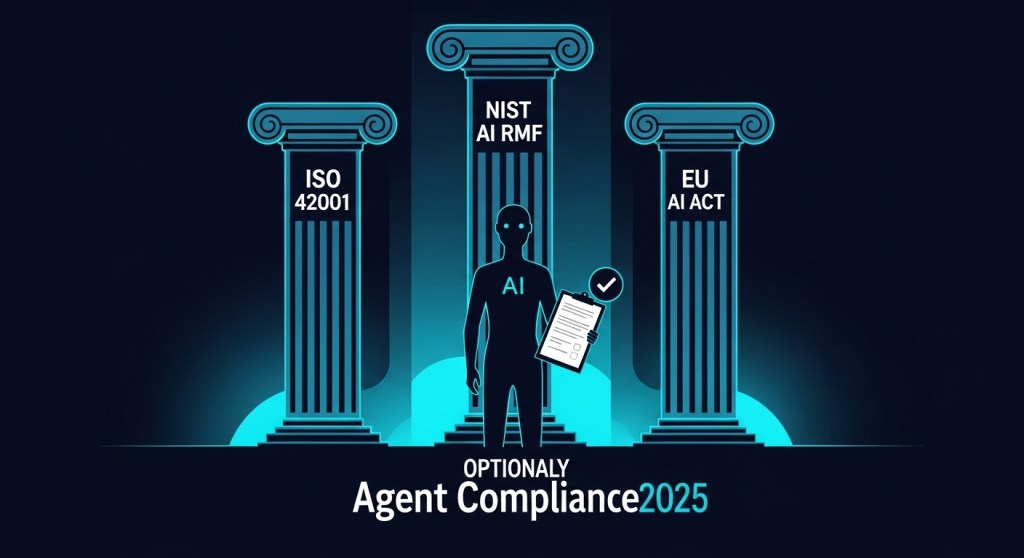
Plan for this article: We scanned competitor coverage from the past few days, reviewed audience needs, mapped our site’s gaps, verified sources, and turned ISO 42001 + NIST AI RMF + EU AI Act requirements into a practical, agent‑specific checklist with links to deeper playbooks.
AI Agent Compliance Checklist for 2025: Map ISO 42001, NIST AI RMF, and the EU AI Act to Runtime Controls
TL;DR: Compliance for AI agents isn’t a PDF—it’s runtime behavior plus evidence. This guide shows how to stand up 12 controls that map ISO/IEC 42001 (AIMS), NIST AI RMF, and the EU AI Act’s phased deadlines into operational safeguards you can ship this quarter.
Why now? The EU AI Act entered into force Aug 1, 2024, with prohibitions and AI literacy obligations applying from Feb 2, 2025; GPAI obligations from Aug 2, 2025; and broader enforcement starting Aug 2, 2026 (with embedded high‑risk systems by Aug 2, 2027). If you serve EU users, you need a plan today. citeturn3search1
In parallel, ISO/IEC 42001:2023 introduced the first AI management system standard (AIMS), while NIST’s AI RMF remains the U.S. baseline for voluntary AI risk management with a Generative AI profile and living playbook. citeturn1search0turn3search4
Meanwhile, the market is moving fast—enterprises are rolling out platforms like AgentKit and Agentforce 360, and researchers keep surfacing agent failure modes in realistic simulations. Governance is not optional. citeturn0search0turn0search3turn0search5
Who this is for
- Startup founders and product leaders shipping agent capabilities.
- E‑commerce operators deploying agents for support, marketing, and checkout recovery.
- Tech and compliance teams formalizing an AI management system before audits.
Not legal advice. Use this as a practical baseline and consult counsel for your jurisdiction.
The 12‑Control Checklist (with mappings)
-
Agent identity and anti‑impersonation (ISO 42001: Clause 8, 9; NIST RMF: Govern/Map; EU AI Act: transparency). Enforce verified caller IDs, per‑agent keys, and signed action requests for every external call. Bake in name+role+scope banners on all channels (voice, chat, email). Track and block spoof attempts. U.S. regulators are tightening rules on AI‑driven impersonation; design for it. citeturn2search1
-
Consent, purpose limitation, and sensitive‑content escalation (ISO 42001: planning/operations; NIST: Measure/Manage). For user‑generated media, add rapid takedown workflows and model prompts tuned to refuse NCII requests. The U.S. “Take It Down Act” criminalizes distribution of non‑consensual intimate imagery—including AI deepfakes—raising your liability bar. citeturn2news12
-
Tamper‑evident audit trails (ISO 42001: monitoring; NIST: Measure). Log every tool call with inputs/outputs, authority checks, and user approvals. Hash traces to an append‑only store; attach trace IDs to user‑visible transcripts. This turns compliance from narrative to evidence.
-
Pre‑deployment evaluation gates (NIST: Map/Measure; ISO 42001: risk management). Stand up red‑team scenarios and synthetic markets (pricing changes, mismatched intents, adversarial prompts). Microsoft’s recent “synthetic marketplace” results show how agents fail in surprising ways without structured evals. citeturn0search5
-
Agent observability (AgentOps) (ISO 42001: monitoring; NIST: Measure/Manage). Instrument traces, latency, success/failure, and policy violations across agents. Set SLOs (task success, escalation rate, CSAT). Alert on drift and hallucination risk.
Related: Agent Observability in 2025.
-
Memory governance (ISO 42001: data governance; EU AI Act: transparency/fairness principles). Implement TTLs, purpose tags, and provenance on memories; auto‑redact PII; and require user consent for persistent retention. See our practical playbook for patterns that prevent quiet data creep.
Related: Agent Memory That Doesn’t Leak.
-
Runtime policy enforcement (NIST: Manage). Move beyond static docs to machine‑readable constraints (e.g., Policy Cards) and a governance control plane that can allow/deny actions in real time—even across multi‑agent flows. Research prototypes point the way. citeturn4academia19turn2academia15
-
Risk classification and documentation pack (EU AI Act). Determine if you’re GPAI, a deployer of a high‑risk system, or neither. Assemble technical documentation, system cards, data sheets, and risk assessments aligned to Act requirements. Timelines: prohibitions/AI literacy (Feb 2, 2025), GPAI obligations (Aug 2, 2025), most rules enforceable (Aug 2, 2026), embedded high‑risk (Aug 2, 2027). Open templates and law‑firm summaries can accelerate. citeturn3search1turn1search2turn1search5
-
Supplier/platform due diligence (ISO 42001: third‑party management). If you build on OpenAI AgentKit, Salesforce Agentforce 360, or browser/GUI agents, document where guardrails run, how credentials are scoped, and what logs you can export for audits. citeturn0search0turn0search3turn0search4
Related: Interoperability Playbook (AgentKit, Agentforce 360, Copilot Studio).
-
Human‑in‑the‑loop and escalation (NIST: Manage). Design clear boundaries where humans approve, override, or take over. Require user‑visible confirmation on sensitive transactions (refunds, cancellations, PII access).
-
Channel‑specific constraints. Voice agents: enforce disclosure (“This is an AI assistant.”), record legal bases, and capture consent; see our 10‑day launch plan. Web: use schema and MCP/A2A to constrain the agent’s action space. citeturn3search4
Related: Voice AI Agents in 10 Days and Make Your Website Agent‑Ready.
-
Business continuity and go‑live gates. Define go/no‑go criteria, rollback plans, and incident response. Align SLOs to business goals (AHT, FCR, CSAT, revenue recovered). Test with canaries before full rollout.
Related: Buyer’s Guide to AI Support Agents and Checkout Recovery Agent (7‑day plan).
How the frameworks fit together (fast mapping)
- ISO/IEC 42001 = your AI Management System (governance, risk, ops, monitoring). It’s certifiable and system‑level—great for auditors. citeturn1search0
- NIST AI RMF = voluntary, outcome‑oriented activities (Govern, Map, Measure, Manage) you can apply across the lifecycle—and already used by many U.S. orgs. citeturn3search4
- EU AI Act = risk‑based obligations and deadlines (plus GPAI transparency) with substantial penalties for non‑compliance; plan against the 2025–2027 application dates. citeturn3search1
Tip: Document a crosswalk trace that shows each control above, where it executes (agent vs. gateway), what evidence it emits (log fields), and how it maps to ISO 42001 clauses, NIST activities, and AI Act articles.
Evidence you’ll need for audits
- Signed action traces with user approvals and policy decisions attached.
- Evaluation reports (red‑team scenarios, fail patterns, mitigations), especially after recent findings on synthetic marketplaces and real‑world agent failures. citeturn0search5turn0news12
- Technical documentation and model/data/system cards; consider open templates to accelerate. citeturn3academia21
- Supplier due‑diligence records for agent platforms (capabilities, guardrails, exportable logs). citeturn0search0turn0search3
- Policies covering impersonation and harmful content handling; align with evolving U.S. rules and takedown obligations. citeturn2search1turn2news12
Quick start: 30‑60‑90 day adoption path
Days 0–30: Baseline and block risks
- Enable identity signing for agents; ship “I am an AI assistant” disclosures on voice and chat.
- Turn on full agent tracing; start hashing logs to an append‑only store.
- Stand up top‑10 failure evals; kill obvious jailbreaks; add approve/deny policy layer.
Days 31–60: Make it measurable
- Define SLOs (task success, escalation, CSAT). Wire alerts and dashboards.
- Finish your ISO 42001/NIST/AI Act crosswalk; compile documentation.
- Run a canary rollout in one channel (e.g., email support agent) with HITL.
Days 61–90: Prove value and scale
- Expand to voice or web actions; keep guardrails in the control plane.
- Run a mini‑audit; fix gaps; prepare for external attestations.
- Publish a one‑page policy for customers on how your agents operate and are governed.
Real‑world example: Checkout recovery agent
For e‑commerce, apply the controls above to a cart‑abandonment agent: identity signing, consent prompts, PCI‑aware memory TTLs, sandboxed refund actions, and SLOs around recovered revenue—then validate the runbook with our 7‑day checkout recovery playbook.
Key dates (don’t miss these)
- Feb 2, 2025: EU AI Act prohibitions + AI literacy apply. citeturn3search1
- Aug 2, 2025: GPAI obligations apply; governance structures in place. citeturn1search2
- Aug 2, 2026: Most AI Act rules enforceable; national/EU enforcement starts. citeturn1search2
- Aug 2, 2027: High‑risk AI embedded in regulated products. citeturn1search2
Further reading
- EU AI Act overview and tools (GPAI guidance, summary template). citeturn3search1
- ISO/IEC 42001 standard page. citeturn1search0
- NIST AI RMF, Playbook, and Roadmap. citeturn3search4turn2search3turn2search4
- Agent platform news: OpenAI AgentKit; Salesforce Agentforce 360; Anthropic’s Chrome agent. citeturn0search0turn0search3turn0search4
- Agent reliability: Microsoft’s synthetic marketplace study; Wired’s agent‑only startup cautionary tale. citeturn0search5turn0news12
Call to action: Want a fast path to “audit‑ready agents”? Book a 30‑minute session with HireNinja to map these 12 controls to your stack—or subscribe for weekly blueprints you can ship in under 10 days.
 HireNinja: Blog
Leave a comment