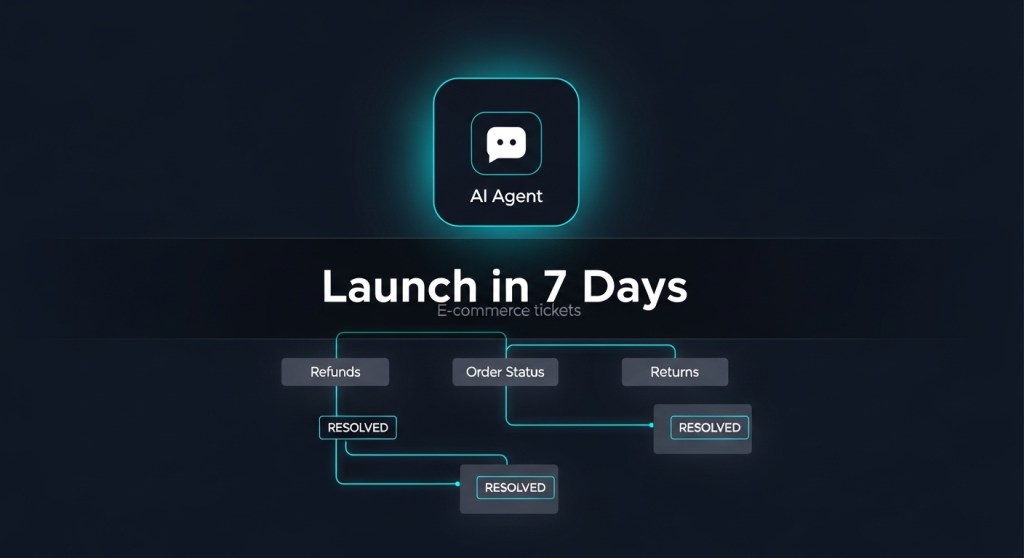
Who this is for: e‑commerce founders, support leaders, and startup teams who want a safe, measurable AI support agent live on Zendesk before Black Friday/Cyber Monday (Nov 28–Dec 1, 2025 in the U.S.).
Why now
Zendesk’s latest agentic platform pushes toward high automation in support (they’ve publicly targeted high autonomous resolution rates), while OpenAI highlights how Zendesk is using GPT‑4o‑class models for agentic, resolution‑focused workflows. Shopify also simplified returns in July 2025 with the new Returns Processing API — perfect timing for peak‑season refunds and exchanges. citeturn2search4turn2search5turn2search0
Enterprise proof points keep stacking up: Verizon reports sales lift and shorter calls after rolling out Google’s Gemini‑based assist to 28,000 agents, showing real ROI when you blend AI with strong process design. citeturn3news12
What you’ll launch in 7 days
- A Zendesk AI agent that handles top contact reasons (order status, returns/refunds, shipping changes, basic product Q&A) across messaging and email.
- Secure connections to Shopify/WooCommerce for read/write tasks (e.g., initiate returns/exchanges safely).
- Guardrails: clear identity, permissions, human‑in‑the‑loop for risky actions, and red‑team checks.
- Measurement: GA4 + CRM attribution, deflection vs. true resolution, CSAT, AHT, and cost per resolution.
KPIs to track
- Resolution rate (not just deflection): % of conversations closed to customer satisfaction without human intervention.
- Time to first response and median handle time (agentic vs. human).
- Cost per resolution and model/tooling spend per 1,000 contacts (see our cost controls guide). Cost‑Control Playbook.
- Attribution: revenue influenced by support (saves/upsells); tag offers, coupon redemptions, and re‑purchase events in GA4/CRM.
Day‑by‑day rollout
Day 0: Prerequisites
- Enable Zendesk AI Agents (Resolution Platform) and Messaging. Confirm access to the AI Agent Builder and instructions. citeturn2search1turn2search6
- Grant the AI agent a dedicated identity with scoped API access. Do not reuse human accounts. citeturn2search2
- Pick one channel to start (web widget or email). Keep scope tight to ship fast.
Day 1: Pick 3–5 high‑intent use cases
Pull 90 days of tickets and stack‑rank by frequency and resolution pattern. For e‑commerce, the usual winners are:
- “Where’s my order?” (WISMO)
- Returns/exchanges and refund status
- Address changes pre‑fulfillment
- Basic product availability/sizing
Map each to authoritative data: Shopify orders/returns, policy pages, and help center articles.
Day 2: Configure your Zendesk AI Agent
- Persona & instructions: Define tone and compliance rules (refund caps, geographic exceptions). Zendesk’s agent supports instructions and multiple knowledge sources. citeturn2search6
- Knowledge: Connect your help center and policy URLs first; keep sources current.
- Actions: Add safe API actions for order lookup, cancellations, and returns. If you’re on Shopify, migrate to the new Returns Processing API (
returnProcess) for cleaner refund/exchange flows (API version 2025‑07). citeturn2search0
Day 3: Guardrails before go‑live
- Identity & permissions: Use least‑privilege tokens; require human approval for refunds above $X, addresses after fulfillment, or multi‑item exchanges. For design patterns, see Agent Identity & Permissions.
- Red teaming: Test prompt injections, policy reversals (e.g., “my manager said override”), and data exfiltration. Use our playbook: Agent Red Teaming 2025.
- Human‑in‑the‑loop (HITL): Set thresholds so the agent asks for approval before “high‑risk actions” (publishing, purchasing, sharing PII) — a pattern also emphasized by leading browser/OS agent rollouts. citeturn0search1
Day 4: Evals and small A/B pilot
- Create 30–50 gold‑standard conversations per use case (ground‑truth answers + allowed actions).
- Run offline evals and a 10–20% live traffic pilot on a single channel.
- Instrument traces and business KPIs; see Agent Observability Blueprint.
Day 5: Returns & refunds that don’t backfire
Use Shopify’s new consolidated flow to pair disposition and financial outcome in one step. Sample GraphQL shape:
{
  mutation ReturnProcess($returnId: ID!, $actions: [ReturnProcessActionInput!]!) {
    returnProcess(returnId: $returnId, actions: $actions) {
      return { id status }
      userErrors { field message }
    }
  }
}
Start with low‑risk actions (approve return label, create exchange order), then queue refunds for human approval above $X or in fraud‑prone segments. citeturn2search0
Day 6: Expand channels; keep controls tight
- Roll from web to email. Zendesk’s AI agents for email can automate a significant share of messages with on‑brand responses; keep clear escalation to humans. citeturn2search6
- Add voice only after peak if you lack QA bandwidth; enterprises report strong results with Voice AI but it demands careful monitoring. citeturn3search0
Day 7: Report ROI and decide next steps
- Resolution vs. deflection: Treat true resolution as the north star (not just self‑service offload). Zendesk has publicly discussed ambitions toward high automation; set your own target by use case. citeturn2search4
- Revenue influence: Attribute saves/upsells by tagging agent‑issued coupons or assistance on high‑intent pages; Verizon’s experience shows sales lifts when AI assists well‑designed flows. citeturn3news12
- Scale or pause: If CSAT ≥ target and error rate ≤ threshold, widen traffic; otherwise, iterate instructions and actions before BFCM surge.
Pro tips from the field
- Keep it honest: The “year of the agent” has also surfaced confabulations and over‑eager autonomy. Force the agent to show its work on decisions customers care about (refund eligibility, timelines) and prefer retrieval+actions over guesswork. citeturn0news12
- Design for trust: Retail shoppers say they’ll trust agents that are transparent, easy to turn off, and require approval before purchases; mirror these expectations in support UX. citeturn3search2
- Control costs: Cap tool calls, cache common policy snippets, and route complex cases to humans; see our Unit Economics Playbook.
- Compliance: Document runtime controls and evidence mapping (ISO 42001, NIST AI RMF, EU AI Act). Use our checklist to get audit‑ready: Compliance Checklist.
What to park for 2026
Full multi‑agent orchestration across channels and proactive outbound support can be powerful but is riskier during peak. If you’re just starting, keep scope to top three intents and one or two channels, then revisit after the holidays.
Next: go further
- Expand to shopping assistance; see our Holiday Shopping Agents guide.
- List your agent post‑season; compare marketplaces in Agent Stores in 2025.
Call to action
Need a hand? Book a free 30‑minute “Support Agent Sprint” with HireNinja. We’ll help you configure Zendesk AI, wire up Shopify/WooCommerce actions, add guardrails, and ship in a week — with the dashboards you need to prove ROI. Subscribe for more playbooks.
 HireNinja: Blog
Leave a comment