TL;DR checklist
- Verify what’s new: AP2 mandates for agent payments; MCP for tool/identity; emerging agent observability standards.
- Define your threat model: agent spoofing, mandate abuse, and tool misuse.
- Ship a 14‑day rollout: identity + mandates + telemetry + red team.
- Track KPIs: impersonation rate, false‑rejects, chargebacks, time‑to‑contain.
Why this matters now
Agent‑led commerce is moving fast. Google announced the Agent Payments Protocol (AP2) to standardize how agents get permission to pay on a user’s behalf, with support from major payments players. AP2 introduces mandates (cryptographically signed instructions) so merchants and issuers can trust agent‑led purchases. [Source: Google Cloud blog.] Learn more.
At the same time, the Model Context Protocol (MCP) is becoming the common way to connect agents to tools and data across vendors, with active roadmaps and enterprise integrations from hyperscalers. [Sources: Reuters; MCP roadmap; AWS MCP proxy.] Reuters · MCP roadmap · AWS MCP proxy.
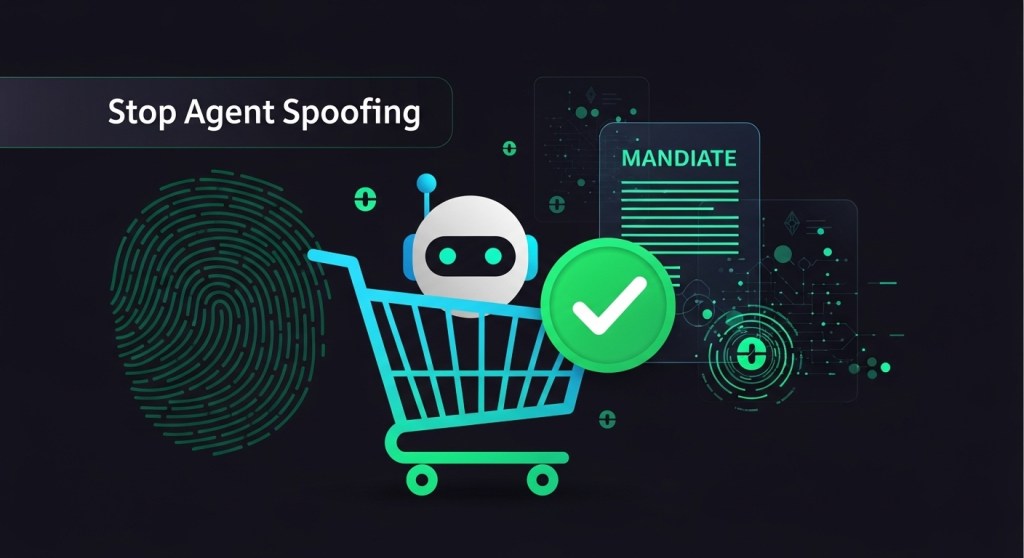
Security leaders are warning about impersonation as one of the biggest agent risks. You need verifiable agent identity, user‑signed permissions, and end‑to‑end auditability—before your agents place orders or issue refunds. [Source: Business Insider.] Read the warning.
The core controls (in plain English)
- Agent identity you can verify. Use MCP to standardize how agents connect to your systems and expose capabilities, then pin the agent you trust using allowlists, keys, and registries. This makes it harder for a random bot to pretend to be “your” agent. [MCP roadmap/AWS MCP proxy.] Roadmap · AWS.
- User‑signed mandates for payments. AP2 defines Intent, Cart, and Payment mandates as verifiable credentials. Instead of an agent just saying “trust me,” the user signs a mandate with constraints (budget, items, TTL). Merchants and issuers can verify the mandate before charging. [Google Cloud/AP2 spec.] AP2 intro · Spec.
- End‑to‑end telemetry. Instrument agents with OpenTelemetry so every step is traceable: the prompt, plan, tool calls, and the mandate verification. This turns incidents into auditable trails and accelerates fixes. [OTel blog; Microsoft Learn.] OTel AI agent observability · Tutorial.
Your 14‑day rollout plan
Days 1–2: Map the blast radius
- Inventory every place an agent can act (checkout, refunds, discounts, inventory updates, customer messaging).
- Create an agent allowlist by name, key, and entrypoint (MCP server/client IDs, IPs, app IDs).
- Define SLOs (e.g., Impersonation Rate < 0.1%, Time‑to‑Contain < 10 minutes).
Days 3–5: Standardize identity with MCP
- Require all commerce‑touching agents to connect via MCP endpoints (or a proxy) with mutual TLS and key rotation. Example.
- Publish a capabilities manifest (read‑only vs. write, payment initiation, refund scope). Deny anything not in the manifest by default.
- Log agent identity attributes into your data lake for correlation (agent_id, client_hash, key_id).
Days 6–8: Pilot AP2 mandates in sandbox
- Implement Cart Mandate for human‑present flows (user confirms the exact basket), and Intent Mandate for human‑not‑present flows (budget + constraints). Spec.
- Bind mandates to: payer, payee, payment token, TTL, risk signals, and agent identity. Reject if any binding mismatches.
- Gate production behind feature flags; start with $ limits and a narrow SKU list.
- If you sell on marketplaces, keep users in human‑present mode until your fraud and telemetry hit targets.
Days 9–10: Add OpenTelemetry traces
- Adopt AI/agent semantic conventions so spans cover parse → plan → tool call → mandate verify → payment. Guide.
- Emit attributes for
agent.id,mandate.type,mandate.ttl,payment.token_provider,decision.reason, andrisk.score. Tutorial. - Set alerts for spikes in mandate‑mismatch, high‑risk overrides, and refund‑without‑mandate.
Days 11–12: Red team and chaos test
- Simulate a spoofed checkout bot, a man‑in‑the‑middle mandate edit, and a stale key reuse. Verify all are blocked and traced.
- Follow our AI Agent Red Teaming Playbook for test ideas and go‑live gates.
Days 13–14: Operationalize
- Publish an Agent Incident Playbook with auto‑contain (revoke keys, disable write scopes, flip to human‑present only). See AgentOps in 2025.
- Expand your Agent Attribution dashboard to include mandate type, risk review time, and spoofing blocks. Pair with our Attribution Playbook.
KPIs to watch
- Impersonation rate = blocked spoof attempts / total agent sessions.
- False rejects = good mandates incorrectly denied (keep < 0.5%).
- Chargeback rate on agent‑led orders (target below your card‑not‑present baseline).
- Time‑to‑contain spoofing incidents (alert → scope reduced → keys rotated).
- Agent‑led revenue with verified mandates (to keep security aligned to growth).
Shopify/WooCommerce quick start
- Expose a dedicated MCP endpoint (read‑only first) for product/price/availability; require signed client IDs.
- Implement AP2 Cart Mandates for agent‑assisted checkout; use short TTLs and SKU whitelists in week one. AP2 overview.
- Tag agent orders with
agent_id+mandate_id; send both to your BI and fraud tools. - Instrument agent flows with OpenTelemetry; start with console exporter, then ship to your APM.
What competitors and standards bodies are signaling
Vendors keep shipping agent capabilities (OpenAI AgentKit) and enterprises are rolling out agent control planes. Standards like MCP and AP2 are maturing. The opportunity: implement guardrails now and turn agent trust into a growth advantage. AgentKit.
Bottom line
Agent impersonation is solvable with today’s building blocks: verifiable agent identity (MCP), user‑signed permissions (AP2 mandates), and end‑to‑end telemetry (OpenTelemetry). Start small, trace everything, and scale scope as your KPIs stabilize.
Need help? HireNinja can stand up this 14‑day plan for your store and leave you with dashboards, playbooks, and measurable ROI.
 HireNinja: Blog
Leave a comment