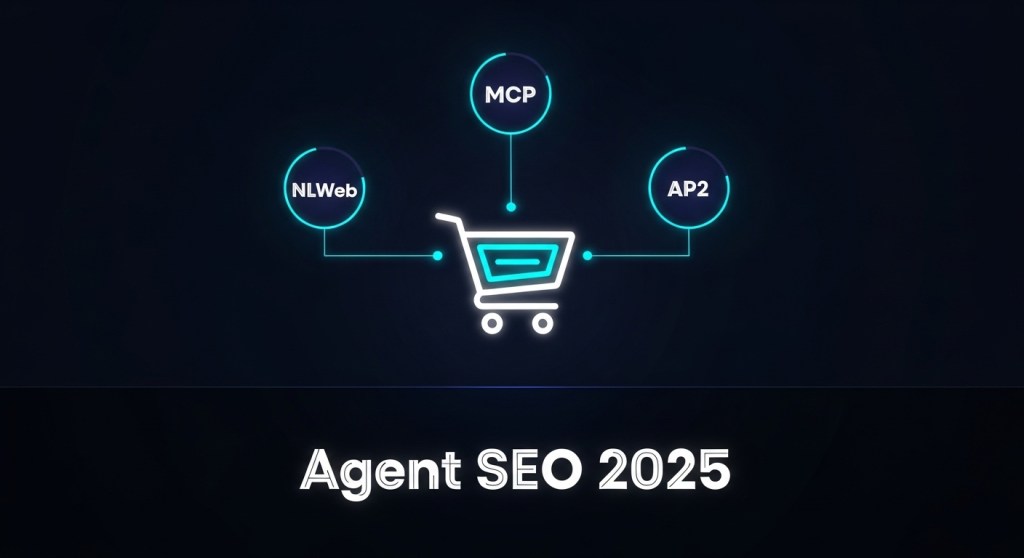
TL;DR: AI shopping agents are coming fast—but most stores aren’t agent‑readable or agent‑transactable yet. This guide shows how to ship “Agent SEO” (AEO) in 14 days using Microsoft’s NLWeb for content exposure, Anthropic’s Model Context Protocol (MCP) for secure first‑party data access, and Google’s Agent Payments Protocol (AP2) to authorize purchases safely—plus the KPIs and guardrails that prove ROI.
Why AEO matters now
Investors and platforms are doubling down on agents (OpenAI AgentKit; Salesforce Agentforce), and Google’s AP2 aims to make agent‑led purchases auditable and interoperable across providers. At the same time, reporting suggests fully hands‑off holiday shopping won’t be mainstream in 2025, so the winners will be the brands that make their data and flows agent‑ready today. citeturn0search0turn0search4turn5search0turn1search4
The three building blocks of Agent SEO (AEO)
- Expose content with NLWeb — NLWeb lets you add a simple natural‑language API to your site and re‑use your Schema.org markup. Each NLWeb endpoint can also act as an MCP server, making your catalog queryable by agents. Start with read‑only product/category Q&A and availability lookups. citeturn4search1turn4search0
- Connect first‑party data via MCP — MCP standardizes how agents securely reach into your PIM, CMS, inventory, and order data. Use least‑privilege MCP servers (read for catalog and stock; write only for draft carts or RMA intents) and log everything. citeturn3search0turn3search1
- Transact safely with AP2 — AP2 is an open protocol for agent‑initiated payments that adds identity, roles, and verifiable audit to the checkout path. Use it alongside your existing PSPs and card rails; start in sandbox with budget caps and allow‑lists. citeturn5search0
14‑day AEO launch plan (Shopify/WooCommerce examples)
Days 1–2: Baseline
- Run an AEO audit: confirm Product schema coverage, freshness of
priceandavailability, FAQ depth, and internal linking to key categories. - Instrument attribution: create UTMs and webhook endpoints to capture agent referrals and intent events (e.g., agent_viewed_product, agent_created_cart).
Days 3–5: NLWeb endpoint
- Deploy an NLWeb instance that reads your existing product feed and exposes ask endpoints for: “Compare X vs Y,” “Find gifts under $50,” “Is size M in stock?”
- Return JSON aligned to Schema.org and link back to product PDPs with canonical URLs. Add a rate‑limit and an API key for pilot agents. citeturn4search1
Days 6–8: MCP servers for live data
- Create MCP servers for Inventory (read), Orders (read), and Returns (write: RMA intents). Map roles to service accounts and log via OpenTelemetry.
- Test end‑to‑end: an agent asks NLWeb, fetches live stock via MCP, and assembles a draft cart.
Days 9–11: AP2 sandbox checkout
- Integrate AP2 with a $1 test SKU, require per‑transaction limits and merchant allow‑lists. Capture mandates, transaction IDs, and agent identity claims in your data warehouse. citeturn5search0
- Define human‑in‑the‑loop rules: price deltas >10%, high‑risk SKUs, or address mismatch require approval.
Days 12–14: Content and answer coverage
- Publish concise, answer‑first content for high‑intent queries: sizing, compatibility, shipping cut‑offs, warranties, returns, and care instructions. Agents favor short, unambiguous answers; keep one fact per paragraph when possible. citeturn4search16
- Add product‑led comparisons and bundles (“Under‑desk treadmills under $500,” “iPhone 16 Pro camera accessories”).
What good looks like (KPIs and dashboards)
- Coverage: % of top 100 questions answerable via NLWeb within 1 response; % of catalog with complete Product schema.
- Attribution: agent‑referral sessions, draft carts, and orders; mandate approvals vs. denials; refund rate on agent‑originated orders.
- Reliability: success rate of agent asks; AP2 error codes; MCP timeouts; mean time to human‑review.
- Unit economics: blended agent CAC vs. paid search; conversion rate on agent‑referred sessions; support tickets deflected by agent Q&A.
Architecture and safety guardrails
Adopt a layered design: NLWeb for answers, MCP for controlled data access, and AP2 for approvals and payments. Enforce identity (agent keys + MCP roles), least privilege, budget caps, and an audit trail. Add “tripwires” for spoofing or unusual sequences, and default to human approval on risky actions. Industry leaders have warned that impersonation and autonomy risks are real; protect your brand before peak season. citeturn0news13
Also remember: despite rapid progress, full autonomy isn’t here yet. Set expectations with leadership and stage your rollout: assistive first (recommendations, comparisons), then semi‑autonomous (draft carts, RMAs), then autonomous purchases under strict AP2 policies. citeturn1search4
Real‑world example: gifts under $50
“A shopper asks an agent: ‘Find eco‑friendly gifts under $50 that ship in 2 days.’” Your agent hits NLWeb to retrieve candidate products, validates stock and SLAs via MCP, returns a short ranked list with reasons, and—if approved—creates a draft cart. If the user says “Buy #2,” AP2 authorizes the payment within limits and logs the mandate + receipt for attribution.
How this fits with your stack
- Already evaluating browser vs. API agents? See our guide on Browser Agents vs API Agents.
- Hardening production agents? Use our Agent Spoofing Playbook and AgentOps SLOs & Evals.
- Need to prove revenue? Start with our Agent Attribution Playbook and Agent‑Ready Store Checklist.
Implementation notes and gotchas
- Content: prefer compact paragraphs; include explicit specs (materials, compatibility), and keep price/availability synchronized with your feed.
- Technical: treat MCP servers like microservices—versioned, tested, instrumented. Trace all NLWeb → MCP → AP2 spans with OpenTelemetry.
- Legal: surface terms, returns, and warranty in the agent response. Store mandates/consents alongside order IDs for audits.
- Scaling: as agent platforms mature (e.g., AgentKit, Agentforce), expect more agent traffic. Rate‑limit, cache popular answers, and watch unit economics. citeturn0search0turn0search4
Bottom line
You don’t need fully autonomous agents to win this season. Make your catalog answerable (NLWeb), your data reachably secure (MCP), and your checkout auditable (AP2). Then measure coverage, attribution, and conversion like you would any high‑intent channel. Ship the foundation now; expand autonomy as reliability and policy catch up. citeturn4search1turn3search0turn5search0
Call‑to‑action: Want help standing up NLWeb + MCP + AP2 in 14 days? Subscribe or book a free 30‑minute Agent Readiness consult with HireNinja.
 HireNinja: Blog
Leave a comment