Editorial checklist
- Scan competitor coverage and recent standards updates (MCP, AgentKit, OTel GenAI).
- Define audience needs: founders and operators shipping production agents.
- Identify gap: practical, secure long‑term agent memory.
- Do light SEO: target “AI agent memory” and related terms.
- Provide a 7‑day build plan with code/metrics and guardrails.
- Cite credible sources; link to relevant HireNinja guides.
Why agent memory—why now?
Agent platforms are graduating from demos to daily ops. Microsoft’s Agent 365 and similar tools promise to manage fleets of bots, underscoring that persistent memory is no longer optional when agents own customer conversations and workflows. citeturn0news12
At the same time, platform tooling like OpenAI’s AgentKit brought built‑in evals and deployment workflows to mainstream developers, while Microsoft has publicly pushed for better multi‑agent memory and standards like the Model Context Protocol (MCP). Together, this points to 2026 as the year memory design becomes a core competency—not an afterthought. citeturn0search0turn3news12
What “agent memory” actually means
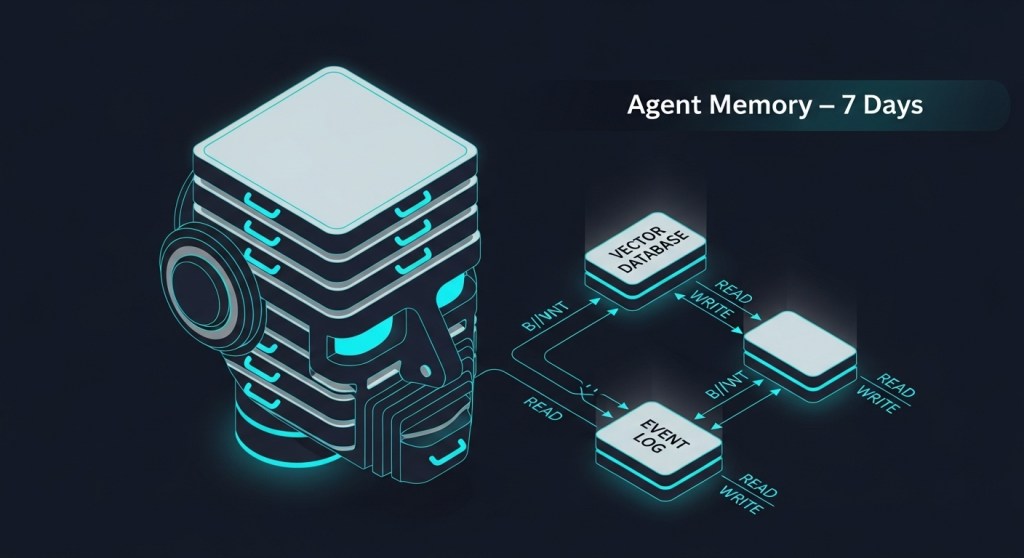
Think in layers: short‑term context (what’s in the current prompt), episodic memory (what happened across sessions), and semantic memory (facts and preferences). Most production systems combine a retrieval‑augmented generation (RAG) store with an event log so agents can recall prior steps and outcomes. citeturn3search1
Architecture at a glance
- MCP connectors for safe data access (tickets, orders, docs) with a registry and permissions. citeturn2news13turn2news12turn2search1
- RAG memory in a vector DB (dense + keyword hybrid) for facts, policies, product data.
- Episodic event store (append‑only) to track steps, decisions, approvals.
- Observability with OpenTelemetry GenAI metrics/traces to measure hit rates, latency, cost, and errors. citeturn2search0
- Policy & security: write filters, PII handling, and memory‑poisoning defenses. citeturn3academia13
The 7‑day plan
Day 1 — Define memory SLOs and the data map
- Pick SLOs: memory hit rate ≥ 70% on eval questions; P95 recall latency < 600 ms; freshness < 24h for inventory/pricing; $ per memory call budget.
- Data map: what agents may read/write (orders, tickets, user prefs) and who approves writes.
- Start a reference eval set (20–50 Q&A) the agent must answer using memory.
Day 2 — Stand up RAG memory
- Choose a vector DB (e.g., pgvector, Qdrant, Weaviate). Ingest FAQs, policies, product catalog.
- Enable OpenTelemetry GenAI metrics to track token usage and operation duration per retrieval or generation. Example metric names:
gen_ai.client.token.usage,gen_ai.client.operation.duration. citeturn2search0
// pseudo-OTel labels (attach to spans/metrics)
attributes = {
  "gen_ai.operation.name": "retrieve",
  "gen_ai.provider.name": "openai",
  "gen_ai.request.model": "gpt-4.1-mini",
  "db.system": "vector",
  "resource.name": "memory.rag"
}
Day 3 — Add episodic memory via an event store
- Create an append‑only store:
agent_id,user_id,timestamp,action,inputs,outputs,approval,cost,trace_id. - Correlate each event with OTel
trace_idto replay agent behavior during incidents. citeturn2search0
Day 4 — Secure the write path
- Introduce a memory write policy: dedupe, profanity/PII filters, and source attributions.
- Require approvals for high‑impact writes (refund rules, pricing). Add kill‑switches and canaries using your existing agent CI/CD. See our 7‑day CI/CD and Agent Firewall posts for patterns. Agent CI/CD • Agent Firewall.
Day 5 — Retrieval quality + anti‑poisoning
- Use hybrid retrieval (dense + BM25), re‑rank top‑k with a small reranker, and cache frequent answers.
- Defend against memory poisoning by validating records, using consensus checks, and separating “lessons learned” from raw logs as proposed in recent research. citeturn3academia13
Day 6 — Evals that matter
- Run offline evals nightly on your memory Q&A set; compare accuracy with/without memory.
- Automate evals in CI using your platform’s tooling; OpenAI’s AgentKit, for example, includes Evals for Agents to grade step‑by‑step traces. citeturn0search0
Day 7 — Productionize with guardrails
- Enforce SLOs with alerts on P95 retrieval latency, accuracy deltas, and cost regressions.
- Enable A/B or shadow traffic for new memory strategies; roll back via kill‑switch if SLOs breach.
See our FinOps playbook for cost guardrails and model routing. Agent FinOps.
How MCP streamlines memory
MCP standardizes how agents connect to tools and data, so your memory layer can log and attribute what was read/written per connector. With Windows support and an updated spec due November 2025, expect faster adoption and better governance hooks. citeturn2news12turn2search1
Instrument like you mean it: an observability checklist
- Latency:
gen_ai.client.operation.durationon retrieve/generate. citeturn2search0 - Cost:
gen_ai.client.token.usageby model and provider; map to dollars. citeturn2search0 - Quality: memory hit rate on eval set; factuality deltas vs. ground truth.
- Safety: write‑path rejection rate; poisoning detections; approval latency. citeturn3academia13
Example: e‑commerce support agent
Goal: reduce “Where is my order?” tickets and upsell accessories.
- MCP connectors: OMS, Shopify catalog, logistics API. citeturn2news13
- Memory: vector store for policies and product knowledge; event store for prior resolutions.
- SLOs: P95 recall < 600 ms; ≥ 80% answer accuracy on top 50 intents; ≤ $0.01 per memory access.
- Guardrails: approvals for refunds/discounts; PII redaction before writes.
Pair this with our BFCM automation ideas to ship results in days, not months. BFCM 2025 agent automations.
Compliance quick notes
Keep an audit trail for memory sources and writes. The EU AI Act phases in most obligations by August 2026, with some high‑risk product rules applying through 2027. ISO/IEC 42001 provides an AI management system baseline you can map to your agent memory governance. citeturn1search1turn1search0turn1search6
What’s next
The big players are aligning around standards (MCP) and enterprise controls (Agent 365). Memory will be the differentiator for agents that don’t just chat—but close loops and learn safely over time. citeturn0news12
Resources
- OpenTelemetry GenAI semantic conventions for metrics and traces. citeturn2search0
- Research on defending agent memory from poisoning (design ideas for Day 5). citeturn3academia13
- Microsoft on structured retrieval augmentation and agent memory. citeturn3news12
- MCP spec update and Windows support. citeturn2search1turn2news12
- Agent evals in OpenAI AgentKit. citeturn0search0
Call to action
Want a working memory layer in a week? Book a working session with HireNinja. We’ll help you wire MCP connectors, set SLOs, and instrument OpenTelemetry—then ship with CI/CD guardrails. Subscribe for the template pack and dashboards.
 HireNinja: Blog
Leave a comment