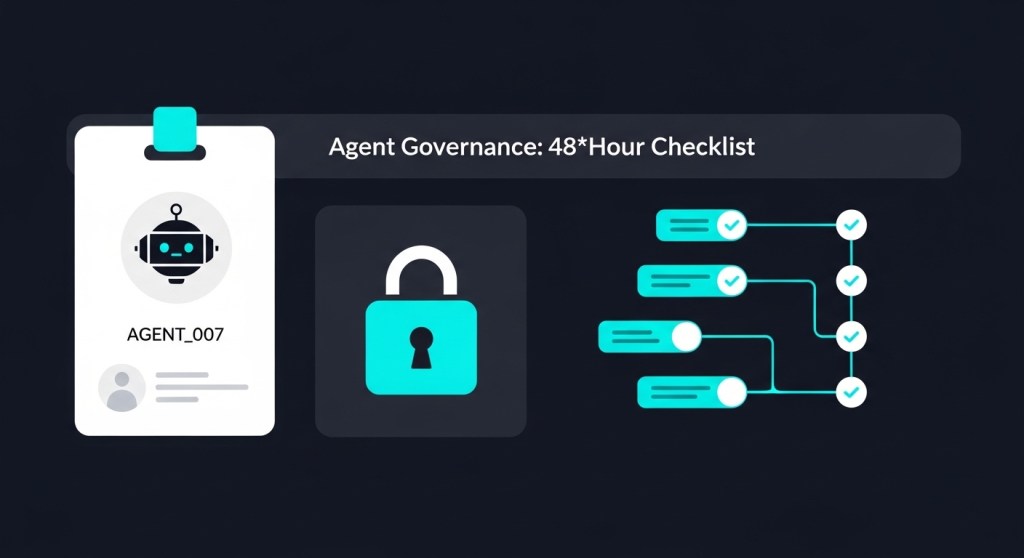
Why now: Enterprise agent deployments are accelerating fast—Microsoft just introduced Agent 365 to inventory and manage bot workforces—while researchers continue to surface agent reliability and safety gaps. EU AI Act obligations phase in through 2026–2027, and buyers increasingly ask for SOC 2 and ISO/IEC 42001 evidence. If you’re piloting agents for support, growth, or ops, this 48‑hour checklist gets you from ad‑hoc to audit‑ready with minimal disruption. citeturn3view0turn4view0turn1search2
Who this is for
- Startup founders and product leaders spinning up AI agents for GTM, support, or back‑office automation.
- E‑commerce operators preparing holiday/seasonal volume with autonomous workflows.
- Engineering, data, or security teams asked to make agents safe, observable, and compliant—yesterday.
What you’ll have in 48 hours
A living agent inventory, baseline access and policy controls, end‑to‑end tracing, change‑management guardrails, and a mapped set of controls aligned to NIST AI RMF, ISO/IEC 42001, and the EU AI Act timeline—plus links to deeper playbooks you can ship next week. citeturn1search0turn1search4turn1search2
Day 1 (Hours 0–24): Inventory, Access, and Policy
1) Stand up an agent registry and inventory
Create a single source of truth for every agent: purpose, owner, version, model, tools, credentials, data scopes, and risk rating. If you’re in the Microsoft stack, begin cataloging with Agent 365; otherwise, use your CMDB or a lightweight table now and migrate later. Our detailed guide and templates will save you hours: Build an Agent Registry for MCP/A2A and Agent 365. Also note the industry move toward agent interop standards (A2A) that your registry should capture. citeturn3view0turn6view0
2) Lock down access, secrets, and scopes with policy‑as‑code
Adopt OPA (Open Policy Agent) to codify what an agent may do, where, and under which approvals (Rego policies for tool access, PII redaction, and human‑in‑the‑loop overrides). Pair with a brokered secrets store and time‑boxed credentials. Our 7‑day plan here: Ship an Agent Firewall in 7 Days. For OPA concepts and integration patterns, see the official docs. citeturn2search0
3) Add end‑to‑end traces with OpenTelemetry
Instrument each agent action (tool call, external API, human approval) as a trace with spans and attributes (agent_id, policy_decision, cost_estimate). Stream to your existing telemetry backend via the OTel collector. This enables SLOs, incident timelines, and SOC 2 evidence. Dive deeper with our Agent Reliability Lab, and the Tracing API spec. citeturn2search1
Day 2 (Hours 24–48): Change, Risk, and Compliance Mapping
4) Put agents under CI/CD with shadow and canary releases
Require pull requests for prompt/tool changes; gate merges on evals and cost budgets; ship via shadow → canary → general with automatic rollback and a kill switch. Our step‑by‑step: Agent CI/CD in 7 Days. Microsoft’s recent research on agent failures in a synthetic marketplace underscores why staged releases and safeguards matter. citeturn4view0
5) Map controls to NIST AI RMF and ISO/IEC 42001
Use NIST AI RMF’s GOVERN, MAP, MEASURE, MANAGE functions to structure your control set, then tag your evidence to ISO/IEC 42001 clauses. Start with a minimal set: registry (roles, ownership), policy‑as‑code (authorizations), tracing (accountability), change control (safety), incident runbook (response). Reference: NIST AI RMF 1.0 and the Generative AI Profile; ISO/IEC 42001 for AIMS requirements. citeturn1search0turn1search3turn1search4
6) Triage EU AI Act applicability and deadlines
Perform a quick EU AI Act triage: Are you a GPAI model provider, a downstream deployer, or a high‑risk use case? Note the staggered dates: prohibitions and AI literacy apply from February 2, 2025; GPAI obligations and governance from August 2, 2025; most rules (including high‑risk Annex III) from August 2, 2026; high‑risk AI embedded in regulated products by August 2, 2027. Capture which agents and markets are in scope and what transparency logs you’ll need. citeturn1search1turn1search2
7) Plan for interop safely (A2A/MCP)
As multi‑agent workflows cross tools and clouds, adopt allow‑lists, scoped credentials, and cross‑agent contracts (what goals/actions may be exchanged) in your policy layer. Track these in your registry and CI/CD so you can audit every external invocation. Microsoft’s adoption of Google’s A2A spec signals an ecosystem convergence—design for it now, with guardrails. See our registry playbook and A2A coverage. citeturn6view0
Evidence you can produce by Monday
- Inventory & Ownership: Agent list with owners, purposes, models, tools, scopes (registry templates).
- Policies: OPA policies for tool access, PII handling, and approval thresholds (agent firewall).
- Traces: OTel spans for actions and tool calls; sampling and retention documented (reliability lab). citeturn2search1
- Change Controls: PRs, eval results, canary logs, and rollback procedures (agent CI/CD).
- Risk Register & Mapping: NIST/ISO/AI Act mapping table with owners and dates. citeturn1search0turn1search4turn1search2
Minimal Agent Risk Register (starter)
Agent ID | Owner | Use Case | Data Scope | Tools | Risks | Controls | SLOs | Last Review
A‑CS‑01  | CX Ops| Returns | PII (EU)  | Shopify API, Email | Impersonation, Prompt Injection | OPA-PII-1, FW-PR-2 | 99.9% success | 2025‑11‑21
A‑FIN‑02 | Finance| AP Ops   | PII (US)  | ERP, Email         | Over‑payment, Data Leak        | OPA‑PAY‑1, OTel‑TX‑1 | <2% failed runs | 2025‑11‑21
Tip: Add Impersonation and Prompt Injection as standard risks for any agent that reads the web or executes tools; both are active threat vectors reported in recent research and news. citeturn7view0turn8view0
Cost and FinOps hooks
Attach per‑span cost estimates and route high‑cost tasks to cheaper models when acceptable. Enforce budget SLOs in CI/CD to prevent regressions. Our 14‑day playbook shows how to cut 20–40%: Agent Cost‑Control Playbook.
Common pitfalls (and how to avoid them)
- Agent sprawl without ownership: Solve with registry + DRI per agent and quarterly reviews. Start here. citeturn3view0
- Unobserved actions: No span, no credit—instrument everything via OTel. citeturn2search1
- Unsafe web execution: Use allow‑lists, sandboxes, and approvals; see our safe browser‑agent guide. Recent studies show agents fail in open environments; mitigate with canaries and policies. citeturn4view0
- Regulatory surprises: Track EU AI Act dates per market and keep a public‑facing summary of your transparency controls. citeturn1search2
What to do next week
- Roll out human‑in‑the‑loop approvals for high‑risk actions (payments, refunds, data exports).
- Finalize your incident playbook for agent misbehavior (contain, disable credentials, export traces, notify owners).
- Expand interop safely: adopt A2A/MCP patterns with scoped contracts and testing sandboxes. citeturn6view0
Bottom line
With a registry, OPA policies, OpenTelemetry traces, CI/CD, and a basic risk map, you’ll have credible evidence for SOC 2, a running start on ISO/IEC 42001, and a clear path to EU AI Act readiness. Start small—ship in 48 hours—then iterate with guardrails as your agent footprint grows. citeturn1search4turn2search1
Call to action: Want templates and a working demo environment? Book a 30‑minute session with HireNinja’s team—get the registry schema, OPA starter policies, and OTel pipelines wired up for your stack. Or subscribe to the blog for weekly playbooks.
 HireNinja: Blog
Leave a comment