Planned steps
- Scan competitor trends and standards shaping agent governance.
- Clarify audience, use cases, and compliance pain points.
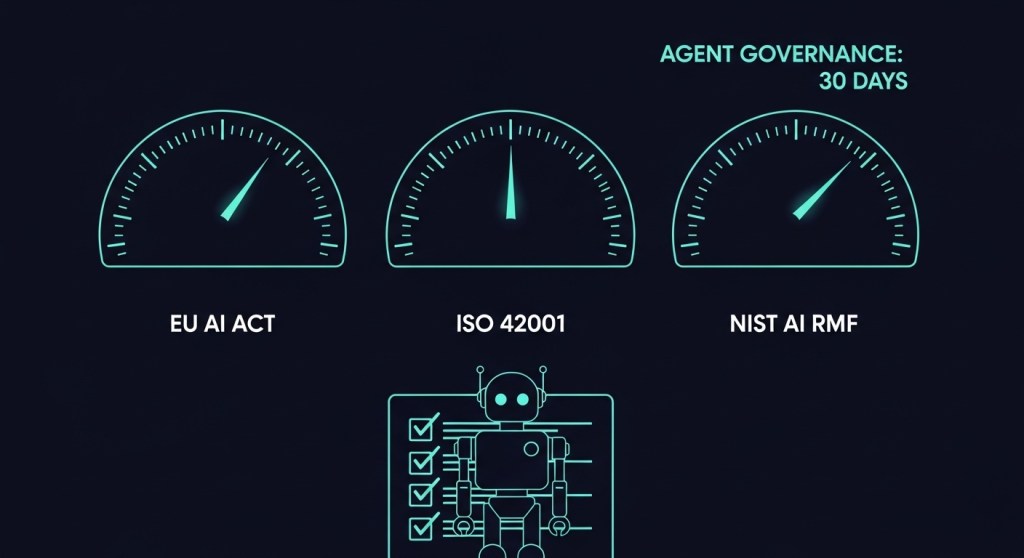
- Map required controls to EU AI Act, ISO/IEC 42001, and NIST AI RMF.
- Propose a vendor‑agnostic 30‑day rollout with measurable checkpoints.
- Instrument telemetry, evals, and audit trails; prepare for audits.
- Offer templates and internal links for deeper execution.
Why this matters right now
Enterprise agent platforms and interop standards have accelerated in the past few months: OpenAI shipped AgentKit with Agent Builder, ChatKit, and evals; Microsoft introduced Agent 365 to manage agent fleets; Salesforce launched Agentforce 360; and A2A emerged as a cross‑vendor protocol for agent‑to‑agent collaboration. Together, these moves signal that governance has to graduate from slideware to systems. citeturn3search0turn3search1turn2search0turn2search1turn2news12turn4search0
Regulators are also moving. The EU AI Act’s staged obligations began on February 2, 2025, expand on August 2, 2025, and most high‑risk rules bite on August 2, 2026 (with some extensions to 2027). If your agents touch EU users or markets, you need a plan now. citeturn5search0turn6search2
Who this guide is for
- Startup founders standing up first production agents and needing quick but credible guardrails.
- E‑commerce operators deploying agents for checkout recovery, returns, and CX workflows.
- Tech leaders tasked with turning policies (NIST, ISO, EU) into practical controls.
Outcomes you’ll achieve in 30 days
- A minimal but auditable Agent Governance Stack (registry, IAM, policies, logs, evals).
- A control map covering EU AI Act milestones, ISO/IEC 42001 (AIMS), and NIST AI RMF.
- Operational dashboards and OpenTelemetry-based traces for every agent action.
- A lightweight assurance pack (runbooks, SLOs, DPIA notes, and an audit trail export).
The Agent Governance Stack (reference architecture)
- Agent Registry + Identity & Access: Central inventory, unique agent identities, least‑privilege access, key rotation, and out‑of‑band approvals for risky tools. Microsoft’s Agent 365 frames this well, even if you’re multi‑vendor. citeturn2search0
- Standards Interop: Adopt MCP for tool connectivity and A2A for agent‑to‑agent workflows to reduce bespoke glue code and enable governance at the protocol layer. citeturn4search12turn4search0
- Telemetry & Audit: End‑to‑end traces of thoughts, tool calls, inputs/outputs, approvals, and data lineage using OpenTelemetry GenAI conventions. Pair with budget and risk limits.
- Evals & Guardrails: Pre‑deployment and runtime evals for task success, safety, PII handling, and prompt‑injection resilience. OpenAI’s AgentKit adds built‑in evals and guardrails you can reuse. citeturn3search0turn3search1
- Change Management: Versioned prompts, tools, and policy bundles with rollback.
- Incident Response: Runbooks, containment switches, and post‑mortems that capture evidence.
Map controls to frameworks
EU AI Act (dates you must know)
- Feb 2, 2025: Prohibitions and AI literacy provisions apply (e.g., bans on manipulative AI and certain biometric uses). citeturn5news12
- Aug 2, 2025: Governance in place; GPAI model obligations apply; national authorities designated. citeturn5search0turn6search1
- Aug 2, 2026: Most high‑risk system rules enforced; enforcement ramps at EU and national levels. Some embedded high‑risk systems extend to Aug 2, 2027. citeturn6search2
What to implement: risk classification for each agent use case; human‑in‑the‑loop for high‑risk decisions; event logging, transparency notes, and a DPIA‑style risk record; vendor/agent contracts reflecting Act obligations.
ISO/IEC 42001 (AIMS)
Treat AI like security management (ISO 27001) but for AI: establish policies, roles, risk processes, monitoring, and continual improvement cycles. Use this as your certifiable management backbone across vendors. citeturn5search1
NIST AI RMF
Map your activities to Map–Measure–Manage–Govern and add the 2024 Generative AI profile for concrete controls (evals, data governance, red‑teaming). citeturn5search2turn5search4
The 30‑day rollout (vendor‑agnostic)
Week 1 — Inventory + Risk + Access
- Stand up an agent registry with unique IDs, owners, and purpose tags (map to ISO 42001 scope and NIST RMF Map).
- Define risk tiers by use case (payments, PII, decisions) and attach required controls (HITL, dual‑approval, eval thresholds).
- Enforce least privilege and approval flows for destructive tools; rotate secrets.
- If you’re on Microsoft, enable Agent 365 early access for inventory and policy baselines; on Salesforce, document how your Agentforce 360 agents authenticate and what data they see. citeturn2search0turn2search1
Week 2 — Telemetry + Evals + Budgets
- Instrument OpenTelemetry traces: goal → plan → tool calls → outputs → approvals → side effects. Add PII and model metadata tags.
- Adopt AgentKit evals (or your framework’s equivalent) for task success, safety, PII masking, and prompt‑injection; set pass/fail gates for deploys. citeturn3search0
- Set spend SLOs and dynamic routing for cost control; alert on anomaly spikes.
Week 3 — Policies + Interop + Change control
- Codify policy bundles (allow/deny lists, escalation thresholds, DPIA notes) and attach them to agents via your registry.
- Adopt MCP for standardized tool access and A2A for cross‑agent workflows; this reduces custom glue and lets you govern at the protocol layer. citeturn4search12turn4search0
- Introduce versioned releases for prompts/tools with rollbacks and a change‑advisory checklist.
Week 4 — Assurance pack + Exercises
- Run a tabletop exercise for data‑leak or tool‑abuse scenarios; verify kill‑switches and comms plans.
- Assemble an assurance pack: registry export, policy bundle, eval results, OpenTelemetry trace samples, SLOs, and incident runbooks—mapped to EU AI Act articles, ISO 42001 clauses, and NIST AI RMF functions.
- Schedule a quarterly audit and a monthly red‑team/eval refresh.
Real‑world alignment to your stack
- OpenAI AgentKit: Use Agent Builder for versioned workflows, Guardrails for PII and jailbreak defenses, and Evals for pass/fail gates. Embed with ChatKit to ensure UX consistency and provenance. citeturn3search0
- Microsoft Agent 365: Treat it as the “user→agent” extension of Entra/Purview/Defender—great for registry, identity, and data governance in M365‑heavy shops. citeturn2search0
- Salesforce Agentforce 360: Leverage the platform’s governance and Slack‑native collaboration; document how agents use Customer 360 data and set evals before enabling proactive actions. citeturn2search1turn2news12
Documentation you need for audits
- Agent Catalog: purpose, owners, data access, tools, jurisdictions.
- Risk & Controls Register: EU AI Act mapping (+ DPIA notes), ISO 42001 clauses, NIST RMF functions.
- Evaluation Dossier: datasets, metrics, pass/fail history, red‑team notes.
- Telemetry Archive: OpenTelemetry trace samples with data lineage and approvals.
- Incident File: runbooks, drills, lessons learned, and corrective actions.
FAQ
Do I need to rebuild everything to comply?
No. Start with registry + identity + eval gates. Most controls are process and telemetry, not model surgery. ISO 42001 gives you a management scaffold; NIST AI RMF provides operational detail. citeturn5search1turn5search2
What about cross‑vendor agents?
Adopt MCP and A2A early to avoid bespoke adapters; they’re gaining broad industry support and simplify governance. citeturn4search12turn4search0
What dates should I communicate to leadership?
Feb 2, 2025 prohibitions, Aug 2, 2025 governance/GPAI obligations, Aug 2, 2026 high‑risk enforcement, with some extensions to Aug 2, 2027. Build your internal roadmap against these. citeturn5search0turn6search2
Go deeper with these how‑tos
- Agent Reliability Engineering: SLOs, Runbooks, and Incident Response (MCP + OpenTelemetry)
- The 30‑Day AI Agent Security Hardening Plan (MCP + OpenTelemetry)
- Ship an AI Agent Registry + IAM in 7 Days
- Agent FinOps: Cut AI Agent Costs (30‑60‑90 Day Playbook)
- Browser Agents vs APIs: When to Use Each
Call to action: Need hands‑on help to become audit‑ready in 30 days? Subscribe for templates and book a working session with the HireNinja team.
 HireNinja: Blog
Leave a comment