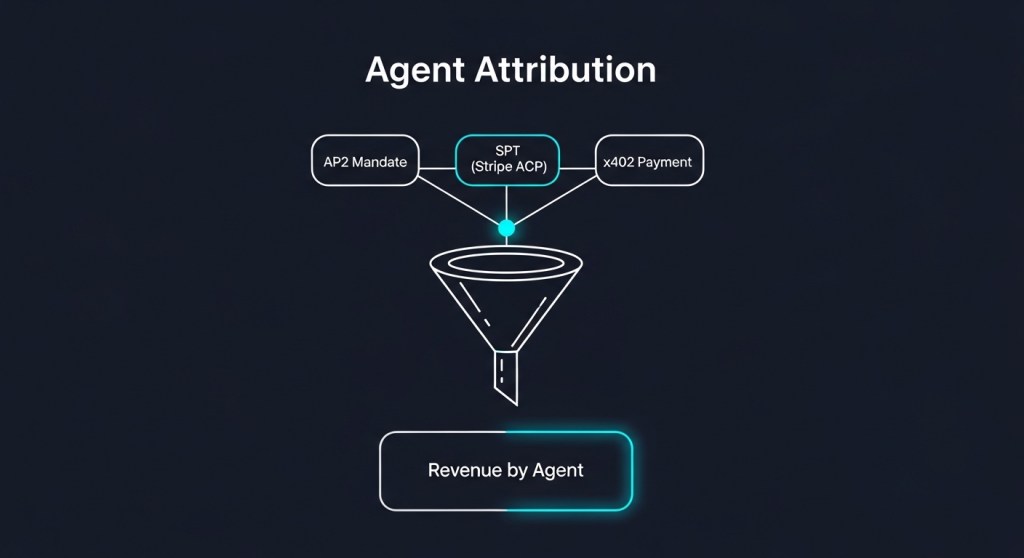
Agent Attribution for 2026: How to Track Revenue From AI Agents (AP2, Stripe ACP, and x402)
Who this is for: founders, e‑commerce leaders, and product/ops teams preparing for agent‑led checkout and wondering, “How do we actually measure revenue driven by AI agents?”
What we’ll do in this guide
- Explain why agent attribution matters now.
- Map the new building blocks: AP2 mandates, Stripe ACP’s SharedPaymentToken (SPT), Visa’s TAP, and Coinbase x402.
- Design a cross‑protocol attribution model (IDs, headers, events).
- Implement tracking with OpenTelemetry + server‑side events.
- Ship dashboards (ROAS by agent, LTV by mandate, blended CPA).
Why attribution for agents matters right now
Agentic shopping is moving from demo to deployment. Google began rolling out agentic checkout in U.S. Search (AI Mode) with merchants like Wayfair and Chewy on November 13, 2025—so an AI can track prices and, with your confirmation, purchase on your behalf via Google Pay. That’s a new referral + checkout path you must measure. citeturn7search1turn7search2
At the protocol layer, Google’s AP2 (Agent Payments Protocol) formalizes “mandates”—cryptographically signed, verifiable intents that authorize agent‑led purchases; Stripe’s ACP (Agentic Commerce Protocol) exposes a standard checkout surface and supports secure payment credential handoff via SharedPaymentToken (SPT); Visa’s Trusted Agent Protocol (TAP) focuses on agent identity and safe retail bot traffic; and Coinbase’s x402 revives HTTP 402 to enable agent micropayments, which spiked in October 2025. All four create measurable touchpoints you can tie back to revenue. citeturn3search4turn2search5turn2search4turn1search2
Analysts expect agentic commerce to materially impact retail traffic and conversion over the next 12–18 months—retail AI referrals are surging and enterprise interest is high—so putting attribution in first unlocks budget, prioritization, and guardrails. citeturn7search0
The new building blocks you’ll use
- AP2 Mandates (Cart + Payment). Attach a unique
mandate_idand agent identity to each transaction; the cart mandate is signed by the user, and the payment mandate informs networks/issuers that an agentic transaction is in flight. Capture both for attribution. citeturn3search4 - Stripe ACP + SPT. ACP standardizes how agents initiate and complete checkout. When you receive an SPT, bind it to a session and attribute the order to its
agent_id/application_id. citeturn2search5 - Visa TAP. Use agent cryptographic signatures and metadata to distinguish legitimate shopping agents from bad bots and to enrich attribution with
agent_assurancesignals. citeturn2search4 - Coinbase x402. If you price content/APIs or accept stablecoin payments, log each 402 exchange (facilitator, payment hash, amount) and map to your agent session. October’s volume spike underscores why this telemetry matters. citeturn1search2
- OpenTelemetry (OTel) GenAI. Adopt the GenAI semantic conventions for agent spans, model calls, and metrics to connect pre‑purchase conversations with downstream orders. citeturn4search0turn4search5turn4search6
A simple cross‑protocol attribution model
Think of agent attribution as four linked IDs carried from browse → negotiate → pay → fulfill:
- agent_id — from AP2 (A2A/MCP context), ACP app ID, Visa TAP identity, or x402 client; store it as the primary attribution key. citeturn3search0turn5search0
- mandate_id — AP2 cart/payment mandate IDs. citeturn3search4
- payment_token — Stripe’s SPT or a network token reference (TAP). citeturn2search5turn2search4
- settlement_ref — PSP order ID, Google Pay txn, or x402 payment hash. citeturn1search2
Augment with standard marketing fields (utm_source=agent, utm_medium=[gemini|chatgpt|copilot|claude|perplexity], utm_campaign=[flow]) and feature flags (is_agent=true).
Implementation: 7 steps in 48–72 hours
- Instrument conversation and actions with OpenTelemetry GenAI semantic conventions. Emit spans for
agent.create, planning, tool calls, and checkout handoff. Includeagent_id, user/session, and target merchant. citeturn4search0turn4search5 - Capture AP2 mandates at negotiation and purchase. On cart creation, persist
mandate_id+ cryptographic proof in your order context. On payment, link the payment mandate to PSP transaction. citeturn3search4 - Integrate Stripe ACP in parallel checkout. When ACP returns an SPT, bind it to the order and persist
agent_id/application_idfor reporting. citeturn2search5 - Enrich with Visa TAP data
- Verify agent intent and populate
agent_assuranceor similar trust fields to segment performance by assurance level. - Feed TAP agent identity into your fraud + attribution models so “good agents” aren’t penalized as bots. citeturn2search4
- Log x402 payments if you monetize content/APIs or accept stablecoins. Store facilitator, transaction hash, and service name; roll up micropayments to session/order where relevant. citeturn1search2
- Send server‑side purchase events (GA4, Meta CAPI, Segment) including
agent_id,mandate_id, and payment references—avoid relying on front‑end scripts that agents may bypass. - Build dashboards by joining OTel traces + commerce DB:
- Revenue, orders, AOV by
agent_id. - ROAS by
agent_source(Gemini, ChatGPT, Copilot, Claude, Perplexity). - Refund/chargeback rate by
agent_assurance(TAP) andmandate_type(AP2). - Micropayment revenue (x402) by service and facilitator.
- Revenue, orders, AOV by
Reference architecture (merchant‑side)
Edge/Gateway (Cloudflare/Akamai) → Checkout (ACP endpoint + traditional web) → Payments (PSP + Google Pay) → Ledger (orders, x402, refunds) → Telemetry (OTel collector → your warehouse). Ensure all four IDs flow in request headers or cookies and are persisted on the order row.
KPIs and alerting
- ROAS by agent = Revenue attributed to agent / agent distribution cost. Alert if below threshold for 3 days.
- Assisted conversions where agent handled price tracking or negotiations (AP2 cart mandate exists) but final click was human—still credit partial revenue to the agentic channel.
- Trust delta: conversion rate difference between TAP‑verified vs. unverified agents; use to tune allowlists and promo eligibility. citeturn2search4
- Micropayment ARPU for x402 services/APIs driving top‑of‑funnel value. citeturn1search2
Risk, governance, and reliability
Adopt the same discipline you use for fintech systems: instrument, budget, and govern. We published vendor‑agnostic playbooks you can reuse:
- Agent Reliability Engineering (MCP + OTel)
- Agent FinOps (30‑60‑90)
- Agent‑Led Payments Playbook (AP2 + A2A + MCP)
- Build an Agent Control Plane
Real‑world signals and what they mean for 2026 planning
- Google’s U.S. rollout of agentic checkout elevates “agent as channel.” Budget a distinct line for agentic referrals in FY26. citeturn7search1
- AP2 mandates + ACP SPT make agent purchases traceable end‑to‑end—use them to settle debates over attribution. citeturn3search4turn2search5
- x402 growth indicates a parallel micro‑commerce rail—great for paid content, APIs, and post‑purchase services. citeturn1search2
FAQ
Q: Do I need crypto to benefit from agent attribution?
No. You can start with AP2/ACP/TAP and your existing PSP. x402 adds value for micropayments, APIs, or content, but it’s optional. citeturn2search5turn2search4
Q: What about privacy and audits?
AP2 mandates are verifiable credentials, and OTel traces can exclude PII while preserving attribution fields. Work with legal to align data retention and consent. citeturn3search4turn4search0
Next steps
- Ship OTel GenAI spans this week and add
agent_idto your order table. citeturn4search0 - Enable ACP private preview or join the waitlist; model your SPT + mandate joins. citeturn2search5
- Stand up an Agent Attribution dashboard; review ROAS weekly.
Call to action: Want help designing your agent attribution model and dashboards? Subscribe for our weekly agent‑ops brief or contact HireNinja for a 45‑minute workshop.
 HireNinja: Blog
Leave a comment