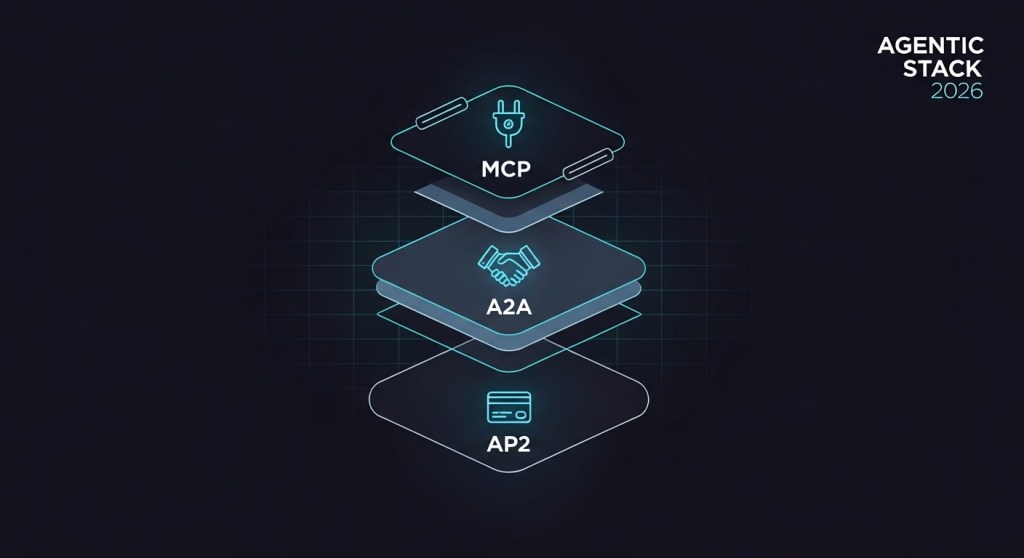
The 2026 Agentic Interop Stack: MCP + A2A + AP2 (and where Agent 365, Agentforce 360, and Operator fit)
Editorial checklist for this post
- Scan TechCrunch, Wired, and vendor blogs for the last 30–60 days to pinpoint trends (Agent 365, Agentforce 360, Operator; MCP, A2A, AP2).
- Clarify audience and intent: founders, e‑commerce owners, and tech pros who need a practical, vendor‑agnostic blueprint.
- Identify the gap: a single interop map tying platforms to open protocols with a 30‑day rollout.
- Do SEO pass: target “Model Context Protocol,” “A2A protocol,” “AP2,” and platform names for discoverability.
- Deliver value: concrete architecture, build vs. buy guidance, risks, internal playbooks, and external references.
Enterprise AI agents are moving from prototypes to production. Microsoft unveiled Agent 365, Salesforce is pushing Agentforce 360, and OpenAI launched Operator. In parallel, open standards are maturing: the Model Context Protocol (MCP) for agent‑to‑tool connectivity, Agent‑to‑Agent (A2A) for cross‑vendor agent messaging (also backed by the Linux Foundation), and Google’s emerging Agent Payments Protocol (AP2) for agent‑led transactions. The upshot: you can design a stack that interops across vendors instead of locking into one.
What changed this quarter (and why you should care)
- Agent managers went mainstream: Microsoft’s Agent 365 and Salesforce’s Agentforce 360 promise centralized policy, identity, and oversight for swarms of agents.
- Interop standards crossed the chasm: MCP is showing up across ecosystems (even in Windows AI Foundry, per The Verge), while Microsoft and the Linux Foundation are advancing A2A as a common language for multi‑agent apps.
- Agent‑led payments got a spec: Google’s AP2 repo signals how agents will authenticate, authorize, and settle purchases via signed mandates.
- Vendors acknowledge the need to play nicely: Reuters captured Microsoft’s call for agents that collaborate across vendors and retain memory responsibly, not expensively (source).
The Agentic Interop Stack (2026‑ready)
Think in layers. You can adopt this progressively and swap parts without rewriting your whole program:
- Identity & IAM for agents: Give every agent an identity, role, and least‑privilege access. Start with an internal registry and scoped credentials. See our 7‑day build: Agent Registry + IAM.
- Agent‑to‑Tool via MCP: Standardize how agents call internal tools, SaaS, and data. MCP reduces one‑off plugins and helps you audit who can do what.
- Agent‑to‑Agent via A2A: Let your procurement, finance, and CX agents coordinate tasks across apps, clouds, and vendors—observably and securely.
- Payments via AP2: Add cryptographically signed “mandates” so agents can request and execute purchases, refunds, or payouts with human‑in‑the‑loop checks.
- Observability & controls: Use OpenTelemetry for GenAI metrics, evals, and guardrails. Start with our Agent Reliability and Security Hardening playbooks.
Where the big platforms fit
- Microsoft Agent 365: A control plane to inventory, permission, and monitor agents—complementing MCP/A2A rather than replacing them. Wired.
- Salesforce Agentforce 360: Agent builder + governance for Salesforce/Slack ecosystems, with growing hooks to reasoning models. TechCrunch.
- OpenAI Operator: A browser‑capable agent that can act on websites with confirmation gates; useful where APIs are thin. TechCrunch.
Build vs. buy vs. hybrid
Buy a platform if you want rapid governance and inventory for many teams, and your stack is already Microsoft/Salesforce‑centric. Build on open protocols when you need deep integration with proprietary tools, data residency, or multi‑cloud portability. Hybrid is common: use Agent 365 or Agentforce 360 as the organizational “glass,” and run MCP servers, A2A messaging, and AP2 payments underneath for portability.
30‑day rollout (minimal viable agentic stack)
This roadmap is vendor‑agnostic and references our deeper tutorials where relevant.
- Days 1–7: Registry + IAM. Create an agent registry with identities, roles, and secrets; wire in least privilege. Follow our 7‑day guide: Registry + IAM. Add basic OpenTelemetry spans for every tool call.
- Days 8–14: MCP your top 3 workflows. Expose the 3 most valuable internal actions (e.g., “create refund,” “open support case,” “post to Slack”) via MCP servers. Capture inputs/outputs and red‑team with injection tests using our security plan.
- Days 15–21: Add A2A choreography. Connect 2–3 agents (Support + Billing + CX Ops) using A2A so they can pass tasks/state. Log agent‑to‑agent messages for audit and SLOs—see our control plane for policies.
- Days 22–30: Pilot AP2 (read‑only → test → guarded write). Start with mandate previews and dry‑runs; then enable low‑risk transactions with spending limits and human confirmation. For e‑commerce, follow our AP2 e‑commerce playbook and our 48‑hour returns agent.
Security, reliability, and compliance checkpoints
- Guardrails and evals: Include jailbreak and tool‑abuse tests in CI; fail closed when prompts or tool outputs are suspicious.
- Observability: Track request rates, tool latency, refusal rates, cost per successful task, and human takeover rate. Use our SLO + runbook guide.
- Governance: Map controls to the EU AI Act, ISO/IEC 42001, and NIST AI RMF with our 30‑day governance starter.
Real‑world use cases you can ship now
- Post‑purchase CX: Returns/exchanges over WhatsApp connect via MCP to Shopify and via A2A to billing; AP2 authorizes partial refunds with a mandate trail. Start here: 48‑hour returns agent.
- Invoice triage → pay: A2A hands off from AP to Finance; MCP fetches approvals from ERP; AP2 executes capped payments with human confirmation.
- Agentic marketing ops: MCP connects analytics + CMS; A2A coordinates campaign tasks; AP2 funds small‑budget experiments with strict spend limits.
Quick SERP snapshot (and the gap we fill)
Most high‑ranking coverage today focuses on announcements: Agent 365, Agentforce 360, Operator, plus explainers on A2A and MCP. What’s missing is a hands‑on interop plan that blends platforms with open protocols, tied to security, observability, and payments. That’s this guide.
Decision checklist before you scale
- Do we have an agent registry and least‑privilege IAM?
- Are our top workflows exposed via MCP with audit trails?
- Can our agents talk over A2A with message logging and SLOs?
- Have we piloted AP2 mandates with spend caps and human sign‑off?
- Are SLOs, runbooks, incident response, and guardrails in place?
- Which vendor UI (Agent 365 / Agentforce 360) will serve as our control glass—and what remains portable via MCP/A2A/AP2?
Key links and further reading
- Microsoft Agent 365 (Wired coverage)
- Agentforce 360 (TechCrunch)
- OpenAI Operator (TechCrunch)
- Microsoft on A2A
- Linux Foundation A2A
- MCP overview and Windows support (The Verge)
- Microsoft’s cross‑vendor vision (Reuters)
- Google’s AP2 repos
Note: If your next step is tooling selection, grab our 2026 AI Agent Platform RFP Checklist.
Call to action
Want a hands‑on walkthrough of this stack for your product or store? Subscribe for weekly playbooks, or contact us to pilot an MCP + A2A + AP2 workflow in 30 days.
 HireNinja: Blog
Leave a comment