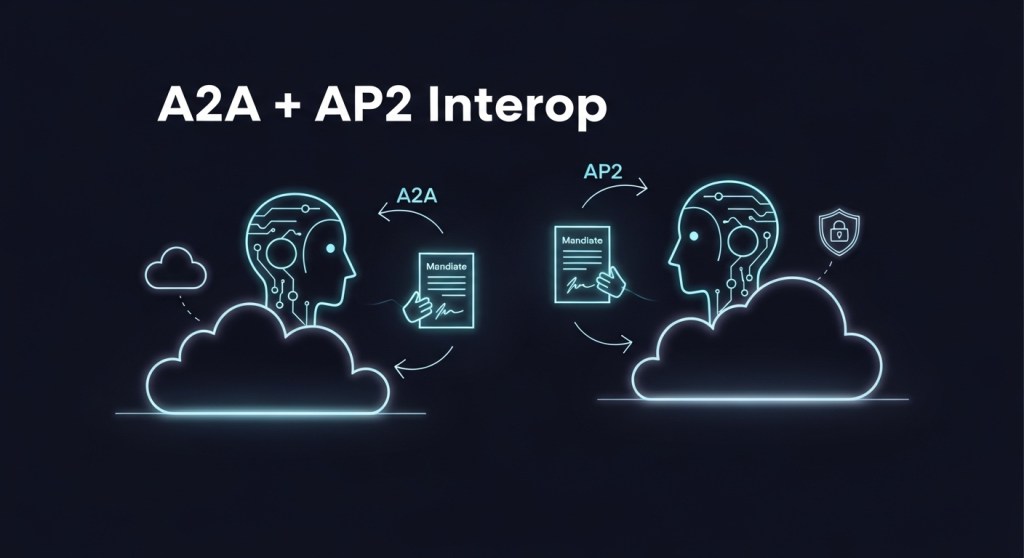
TL;DR — The agent economy is becoming interoperable and payment‑safe. Google’s A2A protocol standardizes agent‑to‑agent collaboration; the Agent Payments Protocol (AP2) adds signed mandates for secure, auditable purchases. Meanwhile, at AWS re:Invent (Dec 2–4, 2025), Amazon previewed three ‘frontier agents’ plus tighter guardrails and memory in AgentCore — a clear signal that long‑running, autonomous agents are going mainstream. Source, recap, AWS post. This guide gives founders and e‑commerce leaders a vendor‑agnostic architecture and a 14‑day pilot to test A2A + AP2 with measurable ROI.
What changed this week — and why it matters
- AWS frontier agents (Dec 2, 2025): Kiro (coding), Security Agent, and DevOps Agent are designed to run for hours or days with policy controls and evaluation packs. TechCrunch, AWS.
- Interoperability + payments stack: Google’s A2A enables agents from different vendors to collaborate; AP2 adds cryptographically signed mandates so agents can pay on your behalf with an audit trail. Google Cloud + PayPal detail how AP2 rides on A2A and MCP.
- Custom models for agents: AWS also pushed customizable Nova models and Nova Forge for domain‑specific agents. WIRED.
Bottom line: 2026 will favor teams that can compose agents across vendors (A2A), transact safely (AP2), and govern actions with policy, telemetry, and cost budgets.
The interoperability + payments blueprint (A2A + MCP + AP2)
Here’s a practical way to think about the emerging stack:
- A2A (Agent‑to‑Agent): standard messaging so your agents can discover capabilities (Agent Cards), exchange tasks, and collaborate across platforms/clouds. Spec overview, site, analysis.
- MCP (Model Context Protocol): standardized tool/context plumbing for agents (files, APIs, databases). A2A can model agents as MCP resources.
- AP2 (Agent Payments Protocol): payment‑method‑agnostic trust layer with signed mandates that prove user intent (e.g., Cart Mandate, Payment Mandate). Runs as an A2A extension and relies on MCP for tools. Google Cloud + PayPal, TechCrunch.
Reference architecture (vendor‑agnostic)
- User agent (your brand): orchestrates the experience, owns the UX and state.
- Remote agents: catalog/pricing, fulfillment/returns, logistics/ETAs — discovered via A2A Agent Cards.
- Credential provider (wallet/PSP): issues/verifies AP2 mandates; your agent never touches raw PAN data.
- Policy + telemetry: action allow/deny, budget caps, and OpenTelemetry events for every step.
If you’re on AWS, map policy and evaluation to AgentCore Policy and guardrails; see our 7‑day AWS pilot post. Read.
A 14‑day pilot to prove value (with KPIs)
Goal: ship an agentic checkout or returns/RMA flow where your agent collaborates with merchant/payment agents via A2A and finalizes payment via AP2 mandates — with strict governance and cost limits.
Week 1 — foundations
- Day 1: Pick 1 flow (checkout or returns). Define SLOs: success rate, median latency, cost/op, and guardrails (allowlist of domains/tools). Pair with our Browsing Security Baseline.
- Day 2: Stand up the User Agent and 1–2 Remote Agents (e.g., catalog + logistics). Publish A2A Agent Cards; wire OpenTelemetry spans.
- Day 3: Integrate MCP tools (product search, inventory, order API). Add policy checks before any write action.
- Day 4: Implement AP2 mandate flow: Cart Mandate signed by user device; Payment Mandate to network. Ensure wallet/PSP integration keeps PCI scope out of your agent. Reference.
- Day 5: Sandbox end‑to‑end tests with synthetic carts and seeded returns; log every decision and tool call.
- Day 6–7: Red‑team prompt injection and policy bypass. Capture false‑positive/negative blocks and refine allowlists. See our Desktop Agent Hardening and Agent Registry.
Week 2 — scale, measure, decide
- Day 8: Pilot with 10–20 internal users; enable real‑time policy alerts for risky actions.
- Day 9: Add a returns or discounts remote agent; validate multi‑agent task routing under A2A.
- Day 10: Apply Agent FinOps tactics: caching, SLM fallbacks, budget caps, and sampling.
- Day 11–12: Shadow 1–5% of real traffic in read‑only; compare conversion, AOV, refund rates.
- Day 13: Executive review: SLO attainment, $/order, dispute risk, security findings. Decide GA criteria.
- Day 14: Roll 5–10% to production behind a feature flag + automatic kill switch on SLO breach.
KPIs and dashboards to prove ROI
- Success: agent task success rate, payment approval rate, mandate issuance errors.
- Speed: median/95p task latency; time‑to‑mandate; checkout completion time.
- Cost: tokens/op, $/successful order, cache hit‑rate, SLM usage %.
- Risk: blocked high‑risk actions, prompt‑injection detections, dispute rate, chargeback ratio.
Real‑world signal: Lyft cited an 87% reduction in support resolution time and 70% higher driver usage after deploying an AI agent via Bedrock — the kind of before/after you should look for in your pilot. TechCrunch.
Security, compliance, and guardrails
- Policy gates before action: deny‑by‑default for write ops; natural‑language policies compiled to executable checks (map to AWS AgentCore Policy if you’re on Bedrock). Recap.
- Mandates for proof of intent: AP2’s Cart/Payment Mandates create a non‑repudiable audit trail across networks and issuers. Details.
- Agent self‑containment: keep PCI out of scope; the wallet/PSP handles sensitive data per AP2’s separation of concerns.
- Telemetry everywhere: emit spans for plans, tool calls, policy decisions, and mandate lifecycle events.
- Desktop vs. cloud agents: if you use desktop agents (for legacy back‑office apps), harden macOS TCC/PPPC and Windows WDAC/Controlled Folder Access; centralize secrets. Guide.
Where this fits in your stack
Use our comparison of AWS Frontier Agents, Microsoft’s ecosystem, OpenAI AgentKit, and Google Mariner to choose your execution layer. Then layer A2A for interop and AP2 for payments. Read the stack guide and our AP2‑ready checkout playbook.
FAQ
Is AP2 production‑ready? As of Dec 6, 2025, AP2 is emerging with strong partner backing and reference flows (Google Cloud + PayPal) but broad, GA merchant adoption is still early; pilot in sandbox and phase rollout. TechCrunch, Google Cloud.
Do I need custom models? Not to start. Many pilots use hosted models with SLM fallbacks. If you need deep domain behavior later, services like Nova Forge can help build specialized models. WIRED.
Next steps
- Pick one flow (checkout or returns) and define SLOs.
- Stand up A2A + MCP scaffolding with policy gates.
- Implement AP2 mandates via a wallet/PSP; keep PCI out of your agent.
- Pilot for 14 days with strict budgets and telemetry. If KPIs clear, scale.
Need help? HireNinja can implement your A2A + AP2 pilot, wire policy/telemetry, and deliver dashboards your execs trust — in two weeks. Book a 30‑min consult or subscribe for weekly agent playbooks.
 HireNinja: Blog
Leave a comment