Open Standards for AI Agents Are Here: What AAIF Means for Your 2026 Roadmap (+ 7‑Day Action Plan)
Published: December 10, 2025
Meta: OpenAI, Anthropic, and Block launched the Agentic AI Foundation (AAIF) under the Linux Foundation, donating MCP, AGENTS.md, and goose. Here’s why it matters—and exactly what founders can do this week.
Quick plan for this article
- Scan trusted coverage to confirm what’s new and why it matters.
- Translate the news into founder‑ready implications (interoperability, security, procurement).
- Provide a practical 7‑day action plan you can actually ship.
- Link out to deeper runbooks for identity, registries, evals, and production safety.
- Close with a lightweight procurement checklist and resources.
What happened (and why it’s big)
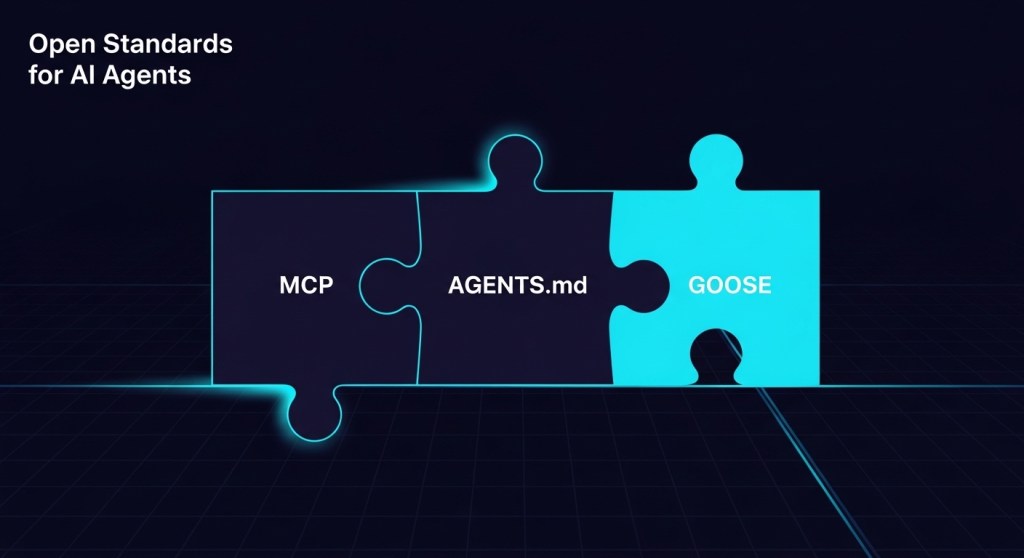
On December 9, 2025, OpenAI, Anthropic, and Block announced the Agentic AI Foundation (AAIF) under the Linux Foundation. They’re donating three cornerstone projects to a neutral home:
- Model Context Protocol (MCP) by Anthropic — the fast‑growing way agents connect to tools, apps, and data.
- AGENTS.md by OpenAI — a lightweight, markdown convention for project‑level instructions that make coding agents predictable across repos and toolchains.
- goose by Block — a local‑first agent framework built for structured, reliable workflows.
Independent reporting and announcements from WIRED, the Linux Foundation, Anthropic, and OpenAI confirm the move and list early backers including AWS, Microsoft, Google, Bloomberg, and Cloudflare.
Why founders and e‑commerce teams should care
- Interoperability gets real: A neutral body reduces the risk of vendor lock‑in and makes agent → tool integration portable across clouds and frameworks.
- Faster path to production: Standards like MCP + AGENTS.md shorten integration time and improve reliability—critical as you scale agents beyond prototypes.
- Security and governance align: With Microsoft’s Agent 365 and AWS’s new AgentCore Policy/Evaluations, the ecosystem is converging on registries, policy, identity, and telemetry—exactly what enterprises need.
- Risk management improves: Recent “IDEsaster” findings show how coding agents can chain IDE behaviors into RCE and data leaks; standards + policy layers make mitigations repeatable.
- For merchants: Standardized agents mean faster rollouts for WISMO, returns, and proactive CX agents across Shopify, WooCommerce, and Amazon without rewiring your stack each time.
Do this in the next 7 days
Use this founder‑friendly plan to align your roadmap with AAIF—without stalling current work.
Day 1–2: Inventory and choose your control plane
- Catalog agents and tools: List every agent, tool call, and data boundary. Note which already speak MCP.
- Pick a control plane: Evaluate Agent 365 vs. AWS AgentCore for your environment (identity, policy, observability, and cost model).
- Create an AGENTS.md template: Standardize repo‑level instructions for coding agents (testing, build steps, style, guardrails).
Day 3: Enable MCP across your app surface
- Stand up an MCP gateway or compatible connectors for the top 3–5 tools your agents use (CRM, billing, order status, inventory, docs).
- Map auth flows to your IdP and establish agent identity (service and delegated identities, token vaulting, rotation).
Day 4: Add policy and evaluations
- Define “allow/deny/confirm” boundaries per tool and user context. If you’re on AWS, pilot AgentCore Policy and Evaluations; if on Microsoft, map to Agent 365 policy + DLP.
- Adopt a minimal evals suite now; expand later. Start with our 7‑day agent evals playbook.
Day 5: Instrument telemetry and incident safety
- Turn on OpenTelemetry traces for every tool call and decision node; pipe to your existing observability.
- Follow our incident‑safe runbook to set tripwires, break‑glass, and rollback plans.
Day 6: Red‑team assumptions (especially coding agents)
- Recreate the “IDEsaster” class of attacks in a sandbox; disable risky default IDE behaviors and add human‑in‑the‑loop for sensitive actions.
- Scope a fix‑forward plan for any exploit chains you surface.
Day 7: Executive readout and 30‑day follow‑ups
- Share a 1‑pager on AAIF impact, costs, and KPIs (deflection, resolution time, revenue lift, MTTR).
- Green‑light a 30‑day sprint to ship an agent‑ready surface and align with upcoming A2A/AP2 requirements.
AGENTS.md: a tiny example you can copy
Drop this in the root of a repo to make coding agents more predictable across environments.
# AGENTS.md
Role: Senior Build Engineer for this repo.
Primary tasks: run tests; build; create PRs; fix failing checks.
Key rules:
- Never commit secrets. Run secret scan before PR.
- For package updates, run smoke tests.
- If tests fail, open an issue with failing steps and logs.
Tooling:
- Test: `npm test`
- Build: `npm run build`
- Lint: `npm run lint`
Approvals:
- Never push to main. Always open a PR with description and risk notes.
Outputs:
- PR title: chore/test: <summary>
- PR body: steps, logs, risk, rollback.
Procurement checklist (20 minutes)
- Standards: Does the vendor support MCP and AGENTS.md today? Roadmap ETA?
- Identity: Entra/Okta/Cognito integration for agent identities and delegated access?
- Policy: Can we intercept and audit every tool call (allow/deny/confirm)?
- Telemetry: OTEL traces across planning, tool use, and outputs? Export to your APM?
- Evaluations: Built‑in evals and CI gates for tasks we care about?
- Sandboxing: Secure browser, code execution, and data scoping by tenant?
- Portability: If we switch models/clouds, what breaks? What’s standardized?
For e‑commerce leaders
Standardized agents mean you can pilot fast and scale safely. Start with high‑ROI automations (WISMO, returns eligibility, shipping exceptions) and make them portable across storefronts and support channels. Use our 72‑hour starter to ship the first ten automations: Holiday Support, Solved.
Further reading
- AAIF backgrounders: WIRED, Linux Foundation, OpenAI, Anthropic
- Enterprise guardrails: AWS AgentCore Policy/Evals, Microsoft Agent 365
- Security context: “IDEsaster” overview via Tom’s Hardware. Pair with our incident‑safe runbook.
The takeaway
AAIF signals a standards‑driven 2026: agents that talk the same language, with policy, identity, and telemetry built in. Treat this as your chance to de‑risk, move faster, and keep your options open across vendors. Start this week, keep momentum for 30 days, and you’ll be in front of the curve when your competitors are still untangling integrations.
Work with HireNinja
Want a turnkey pilot aligned to MCP, AGENTS.md, and your control plane of choice? Talk to HireNinja. We’ll help you ship a governed agent pilot in two weeks—complete with policy, evals, and telemetry—and turn early wins into lasting growth.
 HireNinja: Blog
Leave a comment