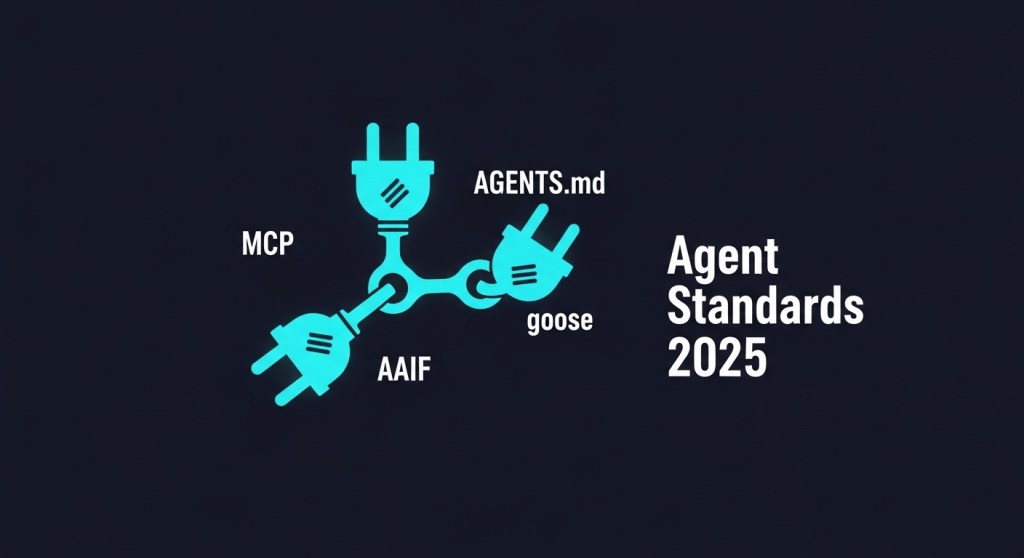
Agent Standards Are Here: What AAIF (MCP, AGENTS.md, goose) Means for Founders — and a 7‑Day Plan
Updated: December 22, 2025
On December 9, 2025, the Linux Foundation announced the Agentic AI Foundation (AAIF), co‑founded with OpenAI, Anthropic and Block, and supported by AWS, Google, Microsoft, Bloomberg and Cloudflare. The launch brings three cornerstone projects under one neutral home: MCP (Model Context Protocol), AGENTS.md, and goose. For startups and e‑commerce teams betting on AI agents in 2026, this is the moment to standardize and ship.
Source announcements: Linux Foundation, OpenAI, Anthropic, and TechCrunch coverage.
Why this matters now
Agent projects have exploded across support, marketing, ops, and storefronts—but most teams still wrestle with brittle connectors, non‑portable prompts, and vendor lock‑in. AAIF’s goal is to make agents interoperable, portable, and governable across platforms so you can ship faster and reduce switching costs.
- Interoperability: MCP gives agents a common way to talk to tools, apps, and data services.
- Portability: AGENTS.md provides repository‑level guidance so coding agents behave consistently across IDEs and CI.
- Choice & Control: goose is an open, local‑first agent framework you can run on your own infra.
Quick primer: MCP, AGENTS.md, goose
Model Context Protocol (MCP)
MCP is an open standard for connecting models/agents to external tools and data with clear schemas and permissions. It’s already adopted across leading assistant platforms. Expect faster integrations, better observability, and easier vendor swaps.
AGENTS.md
A simple, repo‑level spec that tells coding agents how to operate in your project—conventions, environments, build commands, tests, and guardrails. It makes autonomous coding agents more predictable and makes your guidance portable between ChatGPT, Cursor, Copilot, Gemini, etc.
# AGENTS.md (example)
Project: ninja-shop
Stack: Next.js + Shopify + PostgreSQL
Build: npm ci && npm run build
Test: npm run test
Rules:
- Never commit .env.*
- Use feature branches via `git switch -c feat/<name>`
- Security: Do not install packages without Snyk pass
PR:
- Add tests for cart, checkout, VAT calc
- Run `npm run lint:fix` before PR
goose
An open‑source, local‑first agent framework contributed by Block. It combines LLMs, tools, and standardized MCP‑based integrations to execute reliable workflows with your preferred infra and policies.
Who should act
Startup founders who need velocity without lock‑in; e‑commerce operators who want consistent agent behavior across channels; and product leaders who must meet 2026 governance rules while keeping a fast ship cadence.
Your 7‑day implementation plan
-
Inventory your agent surface (Day 1)
List the tools your agents call today (catalog, pricing, CRM, support inbox, search, payments). Map them to MCP servers or plan to wrap them. Prioritize the 3 calls that drive revenue or ticket deflection.
-
Add AGENTS.md to two critical repos (Day 2)
Start with your storefront and backend services. Encode build commands, secrets policy, deployment targets, and PR rules. This alone reduces agent thrash and improves reproducibility.
-
Standardize commerce actions (Day 3)
Define consistent actions for search, compare, add‑to‑cart, checkout, refund. If you sell on Shopify/Etsy, make your catalog and inventory agent‑readable. Use our guides: Assistant Checkout: 7‑Day Plan and the 60‑minute build tutorial.
-
Ship evaluation & guardrails (Day 4)
Adopt a lightweight reliability harness: define success metrics, golden tasks, and auto‑rollback. See our agent quality playbook: Agents Just Got Real.
-
Harden security (Day 5)
Lock down extension access, API scopes, and data egress. Rotate keys, enforce per‑action approvals for payments, and audit third‑party browser extensions. Reference: Prompt Security Plan.
-
Prepare distribution (Day 6)
Publish structured listings to assistant surfaces and news assistants. See: ChatGPT App Store guide and Meta AI distribution plan. Don’t forget the browser: Browser AI is the new homepage.
-
Close the compliance loop (Day 7)
Document your agent data flows and third‑party AI usage to stay audit‑ready. Review: U.S. AI preemption order plan, Apple’s third‑party AI rule, and Pay‑to‑crawl.
KPIs to watch
- Agent reliability: success rate on golden tasks; mean time to intervention.
- Time‑to‑integration: hours to connect a new tool via MCP.
- Commerce impact: add‑to‑cart rate from assistant sessions; checkout conversion; AOV.
- Support deflection: % of tickets resolved by agents within SLA.
- Compliance coverage: % of agent actions with data‑handling docs and approvals.
Risks and mitigations
- Early‑spec churn: Pin MCP/SDK versions and gate upgrades behind canaries.
- Security regressions: Enforce least privilege; isolate secrets; red‑team agent tools before production.
- Vendor drift: Keep AGENTS.md as the single source of guidance; require parity tests across assistant platforms.
- Measurement gaps: Log every action with trace IDs; sample sessions for human review weekly.
Bottom line
AAIF is the clearest signal yet that agentic AI is moving from hacks to infrastructure. If you standardize on MCP for connections, encode behavior in AGENTS.md, and keep your core workflows in a portable framework like goose, you’ll ship faster today—and avoid painful rewrites in 2026.
Work with HireNinja to deliver AAIF‑ready agents for your store or SaaS. Need a head start? Ship checkout‑capable assistants and storefront actions in days using our playbooks above.
 HireNinja: Blog
Leave a comment