Editor’s checklist
- Scan late‑December assistant news across TechCrunch, The Verge, and Android/auto ecosystems.
- Define how the Gemini delay affects founders’ Q1–Q2 2026 roadmaps.
- Map near‑term distribution: Android, Alexa+, in‑car assistants.
- Codify a 10‑step plan for growth, compliance, and measurement.
- Link to deeper playbooks and tutorials from this blog.
What changed (and why it matters)
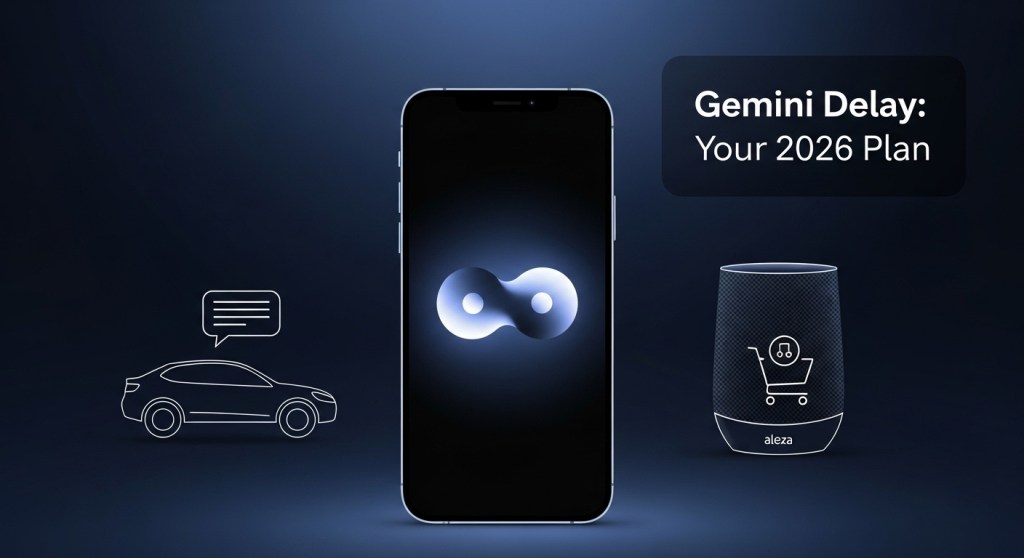
Google is extending its timeline to fully replace Google Assistant with Gemini on Android into 2026. That buys everyone a little time—but also signals something bigger: assistants are becoming a first‑class distribution surface across mobile, home, and in‑car.
In the same week, Amazon expanded Alexa+ integrations (Square, Yelp, Expedia, Angi) while Waymo began testing a Gemini–powered in‑car ride assistant. For founders and e‑commerce operators, the takeaway is simple: even with Google’s delay, customers will increasingly ask assistants—on phones, speakers, and dashboards—to discover, compare, and buy. The winners in 2026 will have product data, policies, and workflows ready for assistant hand‑offs.
Your 10‑move plan for Q1–Q2 2026
1) Treat assistants as a new SEO channel
Assistants parse entities, attributes, availability, and policies. Publish clean, comprehensive product and service data (pricing, inventory, shipping, returns, support SLAs) with up‑to‑date structured data. Start with Product, Offer, AggregateRating, FAQ, and LocalBusiness schema. Then audit how assistants summarize your pages using conversational queries.
Deep dive: Assistant SEO in 2026 (7‑step founder playbook).
2) Ship an assistant‑ready product catalog
Standardize titles, attributes, and availability across channels. Add high‑signal attributes assistants love: materials, compatibility, sizing, bundle options, warranty, and clear return terms. Keep variants and price breaks synchronized via your PIM/Feed.
3) Build an assistant checkout path (even if it starts outside your site)
Customers will increasingly complete purchases via assistant flows. If your audience overlaps with ChatGPT shoppers or Alexa devices, prototype a low‑friction path now. You can also spin up a proof‑of‑concept shopping experience and measure intent before expanding.
Tutorial: Build a ChatGPT Shopping App (60‑minute guide).
4) Map Alexa+ opportunities to your business model
Alexa+ is adding commerce‑adjacent integrations (e.g., Expedia, Square, Yelp, Angi). If you’re local services, hospitality, or retail with offline moments, design intents like: “book a consult,” “add to order,” “reschedule pickup,” or “find nearest service slot.” Ensure hours, location, and pricing are accurate across listings; train your team to handle assistant referrals.
5) Prepare for in‑car discovery
With Waymo testing Gemini in‑car and traditional OEMs shipping assistant features, think “drive‑time intents”: curbside pickup coordination, quick reorders, service appointments, and last‑mile support. Add short, speakable answers to common questions and ensure phone‑safe flows (tap‑to‑confirm, SMS links, or voice codes).
6) Harden reliability before you scale recommendations
Assistant traffic surges expose brittle systems. Add guardrails: safe defaults, price ceilings, stock checks, idempotent ordering, and policy constraints. Evaluate with user‑journey scripts and “shadow” runs. Roll out progressively by segment and geography.
Playbook: Reliability Playbook for AI Agents.
7) Watch policy shifts on WhatsApp and Meta surfaces
Meta has moved to restrict general‑purpose chatbots on WhatsApp in early 2026, while allowing business‑specific support cases to continue. If you serve customers on WhatsApp, keep your bot focused on concrete support flows (order status, returns, appointments) with explicit opt‑ins, and avoid positioning it as a general assistant.
8) Align data governance with new U.S. AI rules
If you’re passing user data into assistant flows, keep data‑minimization and documentation tight. Record what’s shared, why it’s needed, and how you honor deletion. Build a one‑pager for legal and your vendors covering model providers, data retention, and incident response.
Primer: U.S. AI Rules: Your 30‑Day Compliance Plan.
9) Instrument assistant referrals like a first‑class channel
Add UTM conventions for assistant sources (e.g., utm_source=assistant&utm_medium=alexa|gemini|chatgpt&utm_campaign=assistant_referrals). Track: queries answered, hand‑off rate to web/app, cart creation, AOV, and CX outcomes. Build a weekly dashboard to spot which intents convert and where drop‑offs occur.
10) Staff the flywheel with AI agents—not headcount
Use agents for feed hygiene, listing syncs, reviews/Q&A triage, and conversational QA testing. Start with one or two high‑ROI automations and expand. This is the fastest path to keep up with assistant distribution without ballooning payroll.
Need a shortcut? Try HireNinja’s AI agents for catalog ops, assistant QA, and customer support automation.
Founder FAQ
Does the Gemini delay change my roadmap?
It creates breathing room, not a pass. Assistants are already routing demand (Alexa+ in the living room, Gemini experiments in the car). Use Q1 to ship data quality, guardrails, and measurement. Aim to run your first assistant acquisition test early Q2.
What if my customers aren’t on Android?
Great—start with Alexa+ use cases or ChatGPT shopping pilots. The goal is assistant fluency, not platform dependency. Skills you build now (structured data, intent design, safe hand‑offs) translate across ecosystems.
How do I avoid unreliable answers?
Constrain assistants to high‑quality sources (your product data, policy pages, and FAQs). Keep answers short, cite policies, and prefer links with clear next steps (e.g., “view size chart” → PDP anchor). Add automated checks for price mismatch, out‑of‑stock, and restricted SKUs.
Will WhatsApp still work for support?
Yes, if you focus on customer‑specific support. Keep it scoped to your business, enforce consent, and don’t market a general chatbot. Build guardrails and escalation to human agents where needed.
A 30‑day sprint you can start today
- Week 1: Fix the feed—normalize titles, attributes, variants, and return policy text; add Product/Offer/FAQ schema. Publish or update a canonical shipping/returns page.
- Week 2: Draft 10 “speakable” answers for top questions. Add a lightweight assistant checkout or Cart‑via‑Link experiment. Turn on UTM tracking for assistant traffic.
- Week 3: Reliability pass—add guardrails, test with adversarial prompts, and run shadow orders in staging. Start a WhatsApp support script with clear escalation.
- Week 4: Launch one Alexa+ intent and one Android/Gemini discovery test. Review conversion, CX, and ops logs. Prioritize the top 3 fixes and repeat.
Need a head start? Our team uses AI agents to clean feeds, generate speakable answers, and run assistant QA on autopilot. Talk to HireNinja.
Related reads to go deeper
Bottom line
The Gemini delay doesn’t slow the assistant future—it just gives you a window to get your house in order. Use the next 30 days to publish cleaner data, wire safe hand‑offs, and test one or two high‑intent assistant flows. When assistants finally become the default on Android and beyond, you won’t be scrambling—you’ll be converting.
Ready to move faster? Put AI agents to work on your catalog, support, and assistant QA. Get started with HireNinja.
 HireNinja: Blog
Leave a comment