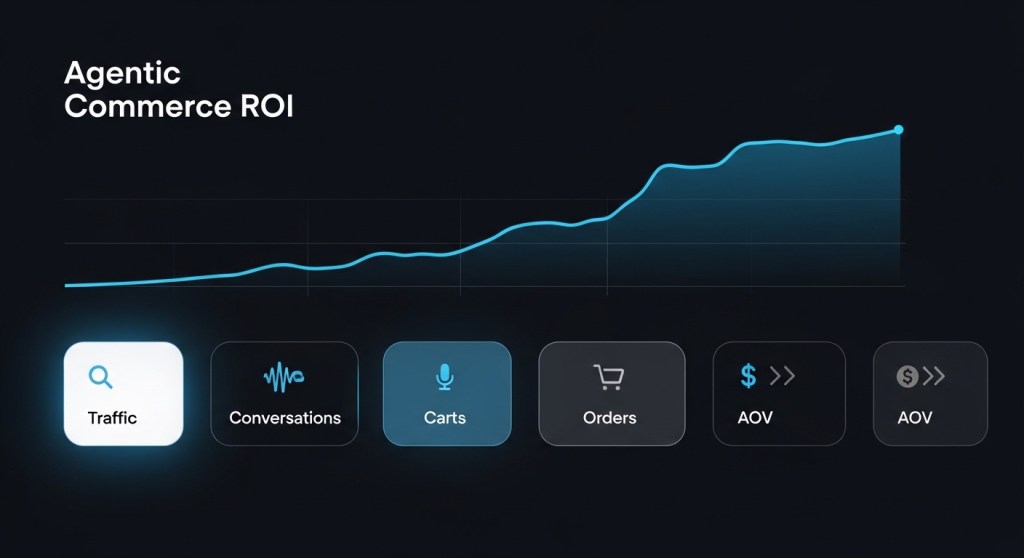
The 2026 Agentic Commerce Metrics Playbook: Prove ROI for Google Business Agent, Alexa.com, and Lenovo Qira
Agentic commerce is no longer a slide at CES—it’s a live channel. With Google’s Business Agent and UCP, Alexa.com’s assistant ecosystem, and Lenovo Qira, shoppers can ask, compare, and buy without ever visiting your homepage. That’s powerful—and dangerous—unless your analytics keep up.
At a glance: what you’ll get
- A clear definition of assistant-stage conversions and how they differ from web conversions.
- The 10 metrics that actually matter for agentic commerce in 2026.
- A 48-hour implementation plan for UCP + assistant attribution (Shopify/WooCommerce compatible).
- Guardrails to avoid dark patterns and pricing drift while you optimize.
Why agentic attribution is different
Traditional funnels assume sessions, pages, and pixels. Agentic funnels begin with intents and actions that may happen outside your site: a user asks an assistant for the best product, the agent calls your endpoint, then hands the shopper a deep link or checks out on your domain. Some steps are chat-only; some are API-only. If you only measure pages, you’ll miss the sale—or worse, misattribute it.
Define conversions by intent resolution, not just pageviews
- Resolved intent: The assistant paired a user’s goal (e.g., “buy running shoes under $120”) with your eligible offer (price, availability, shipping) and surfaced it as the primary recommendation.
- Actionable handoff: The assistant produced a deep link, cart, or on-domain checkout handoff.
- Completed order: The transaction executed (on-domain or via deep link) with a verifiable assistant attribution signal.
That means your measurement stack must capture events and parameters from assistants (e.g., channel, query class, recommended SKU, confidence) and join them with on-site behavior and orders.
The 10 metrics that matter in 2026
Acquisition and visibility
- Assistant impressions (eligible + shown): How often your offers were eligible and actually shown by the assistant for target queries. Split by channel (Google Business Agent, Alexa.com, Qira).
- Top intent classes: The query clusters that trigger your products (e.g., “budget under X,” “compare A vs B,” “gift”). Use these to guide offer bundles and schema.
- Recommendation share: Percent of eligible queries where you were the recommended item (or in the top 3). This is the agentic equivalent of organic rank.
Engagement
- Conversation-to-click (C2C): Rate at which assistant recommendations drive a click, deep link, or cart handoff.
- Handoff quality score: The completeness of the data passed (SKU, price, shipping, coupon, UTM or channel IDs). High quality handoffs yield fewer drop-offs.
- Resolution time: Time from first query to handoff. Faster resolution generally increases conversion for urgent, low-consideration purchases.
Commerce
- Assistant-attributed conversion rate (AACR): Orders with a valid assistant source parameter ÷ assistant-driven sessions.
- AOV by assistant: Average order value per channel; use it to prioritize which assistants get richer bundles or financing prompts.
- Price integrity variance: Percent of orders where shown price matched on-site checkout within your policy bands. This protects margin and trust.
LTV and service
- Repeat purchase rate from assistant-sourced customers: Track repurchase windows vs. web-acquired cohorts to validate LTV impact.
Implement measurement in 48 hours
If you’re starting from zero, use this sprint to ship reliable tracking without boiling the ocean. You can harden and automate later.
Day 1: Get assistant-ready signals in place
- Expose clean product data: Ensure up-to-date price, stock, shipping, and variant info via feeds or endpoints. If you’re on Shopify, start with the practical build in Google Business Agent: The 48‑Hour Shopify Playbook.
- Ship assistant-friendly schema: Validate product, offer, and review markup and include return policy, shipping, and price validity windows. See the fast checklist in UCP Is Live: The 72‑Hour Ecommerce Fix.
- Define and reserve your attribution parameters: Standardize a query string like
?src=agent&chan=gba|alexa|qira&intent={class}&rec=1so every deep link or handoff carries the same keys. - Stand up a lightweight events endpoint: Capture pre-click assistant events (eligible, shown, recommended) and log them with timestamps, SKU, and channel IDs. Even a serverless function + sheet works to start.
Day 2: Close the loop to orders
- Map handoff → session: On landing, read your assistant params, set first-party cookies, and include the values in checkout hidden fields. Pass them to your order object.
- Validate price integrity: Log assistant price shown and compare at order creation. Alert if variance > your policy threshold. For risk controls, use the guidance in Stop ‘Surveillance Pricing’ Before It Starts.
- QA with synthetic intents: Create 10–15 representative assistant queries (brand, budget, compare, long-tail). Confirm each produces a handoff with full parameters, and that orders carry those parameters to your data warehouse.
Channel-specific tips
Google Business Agent
- Focus on intent classes: Many queries begin informational (“best X for Y”). Make your product copy and schema resolve intent quickly—size, compatibility, shipping time.
- Handoff design: Offer 1-click deep links to preconfigured carts for your most frequent bundles. See setup foundations in Google’s Business Agent Is Live.
Alexa.com
- Voice-first friction: Shorten descriptions and clarify tradeoffs (“long battery life, under 2 lbs”).
- Cart intent: Prioritize cartable SKUs with clear availability and delivery windows. Prep work: Retailer’s UCP Starter Kit.
Lenovo Qira
- Contextual recs: Qira’s strength is device context (work vs. leisure). Prepare offer variations (e.g., office vs. travel bundles) and test which wins on AOV.
- On-device latency: Precompute popular bundles and cache shipping estimates to keep resolution time low.
Playbook: from metrics to money
- Pick 3 hero intents (one brand term, one budget-focused, one comparison). Build perfect responses and handoffs for these before broadening.
- Set weekly targets for Recommendation Share, C2C, AACR, and AOV by assistant. Publish the scoreboard.
- Run two-week experiments on copy, bundles, shipping promises, and price anchors. Change one thing per intent at a time.
- Protect trust with price integrity alerts and transparent attribution. See the compliance checklist in The 2026 AI Shopping Compliance Playbook.
- Invest in AASO (Assistant App Store Optimization). Structure your content for assistant discovery and ranking; practical tips in AASO in 2026.
FAQ: common roadblocks
“What if we can’t get pre-click assistant data?”
Start with reliable post-click signals (channel, intent class in URL). You can backfill impression estimates from Recommendation Share and C2C once you have enough volume.
“Will assistant deep links cannibalize SEO?”
Not if you preserve your canonical pages and keep assistant landing pages indexable only when they match canonical content. Use consistent schema and avoid doorway pages. See the AI-mode checklist in this 72‑hour fix.
“How do we credit assistants vs. affiliates vs. paid?”
Create a shared attribution taxonomy: src (agent/aff/paid), chan (gba/alexa/qira), camp (experiment ID). Use last-touch for transactional reporting, but maintain a path model for planning.
Your 7-day plan (condensed)
- Day 1–2: Ship schema, endpoints, and assistant parameters. Validate with synthetic intents. Start here: 48‑Hour Shopify Playbook.
- Day 3–4: Launch 3 hero intents with perfect handoffs and on-domain tracking. Add price integrity alerts.
- Day 5–6: Optimize copy, shipping promises, and bundles per assistant. Track C2C and AACR changes.
- Day 7: Publish your scoreboard and next two experiments. Review compliance and parity with this UCP parity playbook.
Bottom line
Assistants are a performance channel. Treat them like one. If you track the 10 metrics above and iterate on three hero intents, you’ll see where the money leaks—and what to fix first. Build discipline now and you’ll compound visibility, conversion, and LTV as agentic platforms keep expanding.
Need a faster path? Teams use HireNinja to operationalize agentic commerce—clean endpoints, consistent handoffs, and attribution that finance trusts. Talk to HireNinja or try HireNinja to ship this playbook in days, not weeks.
 HireNinja: Blog
Leave a comment