Alexa.com + Google’s UCP Just Rewired Online Shopping: A 5‑Day Founder Plan (Jan 22–26, 2026)
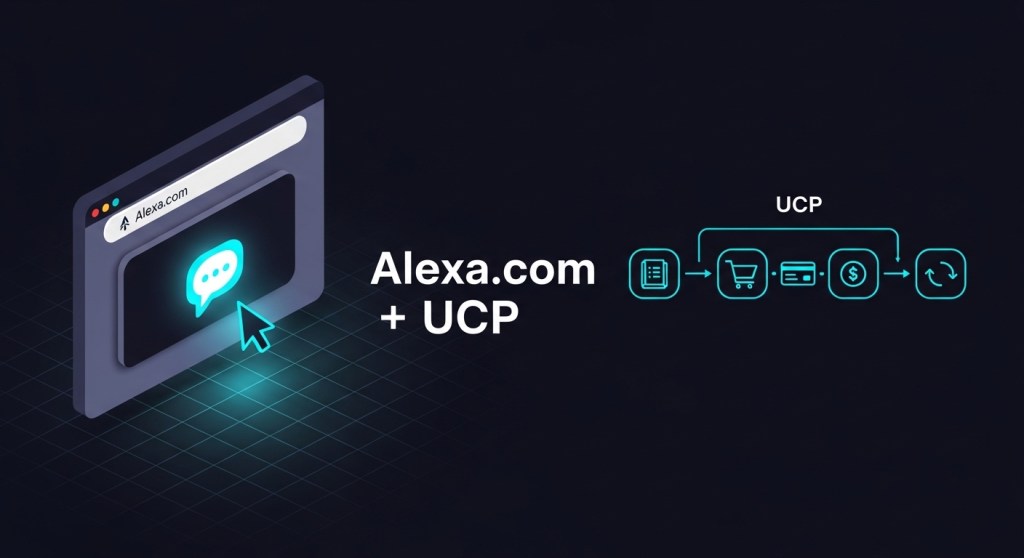
Two big shifts landed this month: Amazon brought Alexa+ to the web at Alexa.com and Google announced the open Universal Commerce Protocol (UCP) for AI‑agent shopping. If you run an e‑commerce brand or SaaS in retail, these aren’t just headlines—they’re a new distribution stack you can activate this week.
Below is a crisp briefing on what changed and a 5‑day plan to ship real outcomes by Monday without breaking SEO, pricing trust, or attribution.
What changed (and why it matters)
- Alexa.com is live on the web: Alexa+ now works in a browser, not just on Echo devices—expanding assistant entry points for discovery, Q&A, and purchasing.
- Google’s UCP standardizes agentic shopping: An open specification for product discovery, checkout, and post‑purchase across partners like Shopify, Etsy, Wayfair, Target, and Walmart—meaning agents can complete purchases without bespoke integrations per retailer.
- CES/NRF 2026 validated momentum: From Lenovo’s cross‑device agent Qira to retail‑first AI showcases, assistants are moving from demo to distribution.
Translation: assistants are becoming a measurable sales channel. To benefit, your catalog must be clean, your actions routable, your pricing transparent, and your attribution rock‑solid.
Already shipping on HireNinja
If you want longer playbooks after you finish this 5‑day sprint, use these deep dives:
- Google Business Agent: The 48‑Hour Shopify Playbook
- UCP Is Live: A 72‑Hour Plan
- The 2026 Agentic Commerce Metrics Playbook
- AASO in 2026: Ranking on Alexa.com & Qira
- AI Shopping Compliance Playbook
Your 5‑day founder plan (Jan 22–26)
Day 1 (Today): Make your catalog agent‑readable
Assistants can’t sell what they can’t parse. Fix your data first:
- Feeds & schema: Ensure complete
Productschema withname,image,description,sku,brand, andoffers(price, currency, availability). AddaggregateRatingwhen verified. - Canonical URLs: Avoid duplicate product URLs; assistant ranking (AASO) penalizes noisy variants.
- Availability & variants: Surface real‑time stock and size/color options in your feed and on PDPs.
- Trust signals: Prominently display shipping, returns, and support SLAs; agents increasingly summarize these to users.
Resource: The Retailer’s UCP Starter Kit.
Day 2: Turn on Google Business Agent touchpoints
Even before full UCP endpoints, you can claim and configure Google’s Business Agent to answer pre‑purchase questions and route to your checkout:
- Claim & verify your brand’s Business Agent inside Merchant tools and connect product feeds.
- Author responses for top 25 FAQs (sizing, materials, shipping, warranty). Keep answers concise and link to PDPs.
- Map intents → actions: inquiries like “buy,” “compare,” “is it in stock?” should trigger deep links or your checkout endpoint.
How‑to: Claim Your AI Sales Associate.
Day 3: Ship minimal UCP endpoints (MVP)
You don’t need every extension to start. A minimal agent‑ready flow:
- Product capability: Resolve product IDs, price, and availability via a clean GetProduct style endpoint.
- Cart capability: Create/update cart with quantity and variant selection.
- Payments handshake: Support at least one popular handler (e.g., Shop Pay, Google Pay, PayPal) and advertise accepted handlers.
- Order confirmation: Return a stable order ID plus customer‑safe summary so agents can generate receipts.
Guardrails to include on day one:
- Pricing parity: Publish a clear parity policy so assistants won’t recommend gray‑area discounts that erode trust.
- Consent logging: Record user/agent consent for purchase and data use; include a kill switch to pause agent checkout.
- SKU allowlist: Exclude hazmat, MAP‑restricted, or age‑gated items until you’ve validated compliance flows.
Template policies: Transparent UCP Playbook.
Day 4: Test in Alexa.com and Google AI Mode, wire attribution
Run the following tests and wire “agent” attribution end‑to‑end:
- Prompts to try in Alexa.com:
- “Find a [your product] under $100 in stock. What’s the fastest shipping option?”
- “Compare [your product] vs [competitor] for battery life and warranty. Show me the best value.”
- “Buy the [exact SKU] from [your brand] in size M, pay with Shop Pay.”
- Prompts for Google AI Mode:
- “Is [your brand]’s [product] compatible with [device]? In my cart if yes.”
- “Who has [product] in stock near me with free 2‑day shipping? Place order if delivery < 3 days.”
- Attribution: Tag orders with
source=agent&channel=alexa_comorchannel=google_ai_mode, propagate through payment metadata, and reconcile in analytics and your data warehouse.
Measurement framework: Metrics Playbook.
Day 5: Close the loop—post‑purchase, policy, and comms
Agentic commerce isn’t complete at the “thank you” page. Round out the experience:
- Post‑purchase capabilities: Expose endpoints for order status, returns initiation, and exchanges so assistants can self‑serve customers.
- Receipts & privacy: Standardize receipts that assistants can parse; update your privacy policy to explicitly mention agent interactions, consent, and retention windows.
- Customer support scripts: Given Alexa+’s more conversational (and sometimes personality‑forward) tone, prepare support macros that acknowledge assistant‑initiated actions and provide human escalation paths.
- Marketing: Announce “Now shop via Alexa.com and Google’s AI Mode” with opt‑in instructions and supported payment methods.
Common pitfalls (and quick fixes)
- Stale inventory in assistants: Automate feed refreshes and return real‑time availability in UCP calls; don’t rely on cached PDP HTML.
- Coupon chaos: Agents may surface outdated codes scraped from the web. Publish a live promotions manifest; reject expired promos server‑side with a friendly reason.
- Broken attribution: If you can’t reconcile agent orders to spend, finance will shut it down. Start with source tags + unique order notes and graduate to server‑side events.
- Policy gaps: Document agent consent, refund timelines, and review moderation. Regulators are watching assistant journeys closely.
Where this is heading
Short term, assistants will route qualified intent directly to your cart. Medium term, standards like UCP—and competitors like Lenovo’s Qira—will normalize cross‑device, cross‑context shopping where “the assistant” is the entry point, not your homepage. Brands that win will publish trustworthy data, instrument attribution, and design user consent into every step.
Need a head start?
- Talk to us about an Agent Readiness Audit: feeds, schema, UCP endpoints, and testing scripts.
- Get a copy‑paste UCP MVP for Shopify/WooCommerce plus payment handler setup.
- Stand up a weekly AASO report for Alexa.com and emerging surfaces.
Try HireNinja to deploy agent‑ready checkout and attribution in days—not months. Or start with the playbooks linked above and ping us when you’re ready to ship faster.
Related reading (background)
Published January 22, 2026.
 HireNinja: Blog
Leave a comment