Updated: January 24, 2026
Agentic Shopping Just Escalated: UCP Buy Buttons, Alexa.com on the Web, and Google Business Agent — What to Do by Monday
Google’s Universal Commerce Protocol (UCP) is moving into live buy buttons across AI surfaces, Amazon’s Alexa+ is now accessible at Alexa.com, and Google’s Business Agent is appearing inside Merchant Center. If you run an online store or a tech product with a catalog, the next 48 hours matter.
Quick checklist (read first)
- Claim and customize Google Business Agent in Merchant Center; ship a 24‑hour QA pass.
- Make your product pages agent‑ready: fix specs, sizing, returns, shipping, and inventory freshness.
- Start a UCP readiness workstream (IDs, pricing, taxes, fulfillment, offer parity, and consent).
- Stand up AASO (Assistant App Store Optimization) for Alexa.com and device surfaces.
- Wire attribution to capture agent‑assisted revenue without breaking SEO.
- Run a privacy & pricing sanity check to avoid misrepresentation or “surveillance pricing” traps.
What changed this week (and why it matters)
- UCP buy buttons: Google is pushing checkout into AI Search and Gemini via the Universal Commerce Protocol. Expect instant checkout paths and deeper data requirements.
- Business Agent in Merchant Center: Google’s branded agent now shows up for eligible U.S. retailers; see Google’s announcement here. It answers product questions in Search using your site + feed.
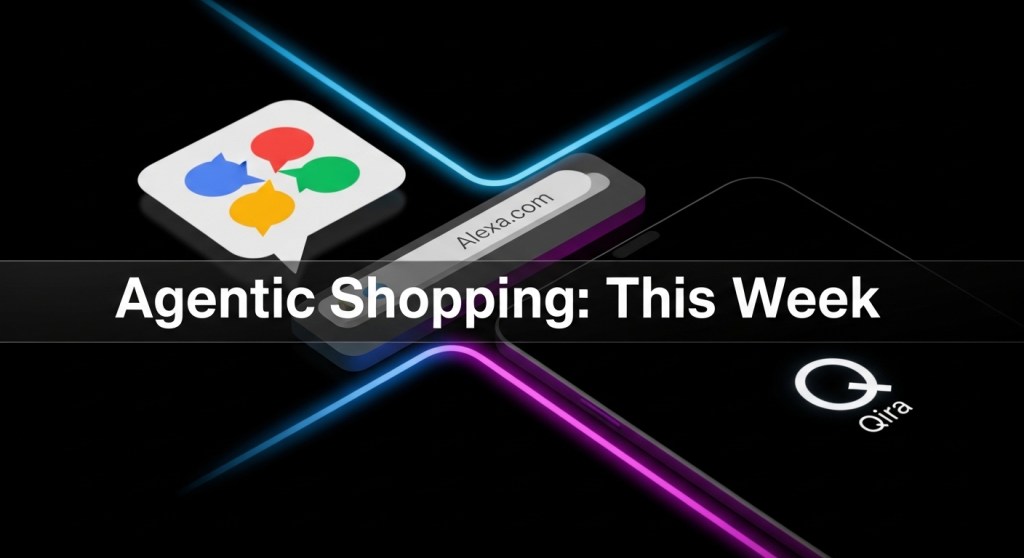
- Alexa+ hits the web at Alexa.com: Amazon is rolling out an agentic, browser‑based assistant via Alexa.com. This expands assistant discovery and shopping beyond Echo devices; Amazon says 97% of shipped devices will support Alexa+.
- Lenovo Qira: A cross‑device personal agent announced at CES; see Lenovo’s press release here. Expect more third‑party surfaces where your product data needs to be agent‑friendly.
Your 48‑hour plan
1) Turn on and harden Google Business Agent
Eligible U.S. retailers can now activate Business Agent in Merchant Center. Customize welcome text, conversation starters, colors, and support handoff — but the quality of answers still lives and dies with your site and feed. Run a tight QA sprint:
- Cover specs, sizing, compatibility, materials, warranty, shipping/returns, and in‑stock variants.
- Consolidate scattered FAQs into canonical copies on product and policy pages.
- Ensure structured data (Product, Offer, AggregateRating, ShippingDetails) matches your feed.
Use our step‑by‑step guides to move fast: 24‑Hour QA Checklist and the 48‑Hour Shopify Playbook.
2) Start a UCP readiness workstream
UCP is the connective tissue for agent‑led commerce. Even if you’re not checking out inside AI Search this week, treat it like PCI for your product/offer data:
- Identity & Offers: Stable product IDs, variant logic, GTIN/MPN coverage, and price/availability parity across your site, feeds, and marketplaces.
- Payments & Tax: Map supported tender types (Google Pay, PayPal as it rolls out), tax zones, and total landed price surfaces.
- Fulfillment: Accurate shipping speeds, cutoff times, packaging constraints, and returns windows per region.
- Consent & Auditing: Ensure any discounts/offers triggered in AI mode are consented, logged, and reconcilable.
Use our practical primers: UCP 72‑Hour Plan and Transparent UCP Playbook.
3) AASO for Alexa.com (and device surfaces)
With Alexa+ on the web, assistant discovery behaves more like an app store + search hybrid. Prioritize:
- Entity‑rich product pages with plain‑language Q&A that map to common voice/web queries.
- Freshness and authority signals: updated availability, recent reviews, policy clarity.
- Stable deep links and clean handoffs to carts (Amazon, Shopify, your site) where appropriate.
See our AASO playbook to rank without harming SEO.
4) Measurement that survives agentic handoffs
Attribution gets messy when assistants answer questions and complete purchases. Implement server‑side tagging, event‑level IDs, and clean “agent‑assisted” channel definitions so you can defend budget and ROI:
- Distinct UTMs for agentic surfaces; align with your MMM/MTAs.
- Event stitching with order IDs and offer IDs across site, feed, and agent logs.
- Agentic funnel maps: impression → engagement → assisted add‑to‑cart → checkout.
Steal from our 2026 Metrics Playbook.
5) Compliance and trust (avoid avoidable suspensions)
Merchant Center misrepresentation flags spike when product, policy, and pricing drift. Before you scale agents:
- Make policy pages unambiguous; mirror returns and shipping windows in structured data.
- Remove unverifiable superlatives and claims; align feed vs. page titles and variant logic.
- QA checkout like a bot: payment methods, tax, delivery estimates, and error states.
Use our Compliance Playbook for a 2‑hour sweep.
Field‑tested QA prompts
Drop these into each surface to quickly expose gaps:
- Specs: “Will the 65W USB‑C charger overheat a 45W laptop? What’s the continuous output and cable length?”
- Sizing: “I’m between M and L. Chest 39”, waist 33”. Which size and what’s the return window?”
- Compat: “Does this water filter fit the 2022 Model X? List exact SKUs.”
- Fulfillment: “If I order by 3 p.m. today to 11211, when will it arrive and what are shipping options?”
- Policies: “Is there a restocking fee on returns? Who pays return shipping?”
Founder play: ship something by Monday
- Activate Business Agent and complete a 24‑hour QA pass with the prompts above.
- Assign a UCP tiger team (eng, ops, legal) to document IDs, pricing, taxes, fulfillment, and consent.
- Refresh the top 20% of SKUs (that drive 80% of revenue) for agent‑readable answers and structured data.
- Enable agentic attribution events in your analytics; align UTMs and order stitching.
- Publish a status page for policies and discounts referenced by agents to reduce misinterpretation.
Need help? Put Ninjas on it
If you want this done while you sleep, our AI Ninjas can audit feeds, harden product pages, and script your QA runs:
Or DM us to scope a sprint that enables UCP endpoints, Business Agent customization, and AASO without breaking SEO.
 HireNinja: Blog
Leave a comment