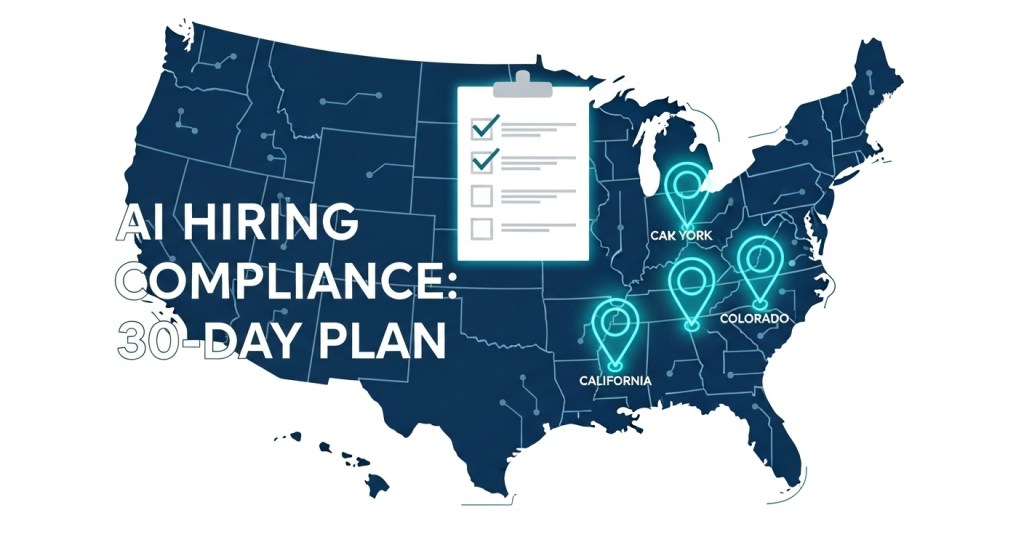
AI Hiring Compliance in 2025–2026: The Recruiter’s 30‑Day Plan
Updated: November 14, 2025 (U.S.)
TL;DR: If you use AI in hiring, you now need a concrete plan. NYC’s Automated Employment Decision Tools (AEDT) law requires annual bias audits and notices; California finalized employment AI regulations effective October 1, 2025; Colorado’s AI Act compliance date moved to June 30, 2026. Meanwhile, big tech is experimenting with AI‑allowed interviews. This guide gives you a 30‑day checklist to get compliant and future‑ready.
Why this matters now
- NYC LL 144 (AEDT): Bias audits within one year of use, public posting of audit summaries, and candidate notices are required. NYC DCWP, Deloitte summary.
- California (effective Oct 1, 2025): New regulations tie bias testing and recordkeeping to discrimination risk; expect discovery value in litigation. Seyfarth.
- Colorado: The AI Act’s compliance date is delayed to June 30, 2026; start your risk program now. Faegre Drinker, Littler.
- Hiring is changing: Meta tested AI‑enabled coding interviews, signaling a shift toward evaluating AI collaboration skills. WIRED.
Who this guide is for
Talent leaders, HR/TA ops managers, and startup founders who use (or plan to use) AI for sourcing, screening, assessments, or interviews—and need a practical, jurisdiction‑aware plan.
Your 30‑day plan
Week 1 — Inventory and risk map
- Inventory tools: List every AI‑touched step: resume parsing, ranking, chatbots, assessments, video interviews, reference checks, and ATS plug‑ins. Note version, vendor, purpose, locations covered.
- Decide scope: Flag any tool that “substantially assists or replaces” human discretion for hiring or promotion decisions (NYC AEDT trigger).
- Data you’ll need: Historical decisions, protected‑class fields (collected lawfully), job family, requisition volume, and outcome labels (advance/reject/hire).
Week 2 — Bias audit + candidate notice (NYC) and baseline testing (elsewhere)
- NYC AEDT: Engage an independent auditor, publish the audit summary on your careers page, and provide required notices at least 10 business days before use. See: DCWP FAQ and final rules explainer.
- Outside NYC: Run internal adverse‑impact testing (by sex and race/ethnicity) and document methodology and thresholds; save reports and model cards to your evidence file.
- Accessibility check: Ensure AI chatbots and interview platforms work with screen readers and offer alternative formats on request.
Week 3 — Policies, rubrics, and vendor contracts
- AI Interview Policy: If you allow AI assistance during interviews, define permitted vs. prohibited uses, disclosure requirements, and a knowledge‑check protocol after each AI‑assisted response. See trend: Meta’s AI‑enabled interviews.
- Rubrics: Add dimensions for “AI collaboration” (prompt clarity, tool choice, verifiability, security/privacy hygiene) alongside job‑specific competencies.
- Vendor terms: Add representations on bias testing, model updates, training data provenance, change logs, and audit support. Require opt‑outs for automated decisioning where applicable.
Week 4 — Go‑live, monitor, and publish
- Publish: If in NYC, publish your bias audit summary and the AEDT distribution date on your site in a conspicuous location.
- Monitor: Add a monthly adverse‑impact check and a quarterly calibration review. Log candidate accommodation requests and outcomes.
- Train: Upskill interviewers on the new rubric and your AI policy. Run mock sessions to de‑risk day one.
What to do by jurisdiction
New York City (active)
LL 144 requires a bias audit within one year of use, public posting of a summary, and candidate notices. Independent auditors may exclude groups under 2% of the dataset, but you must disclose counts for unknown categories. Penalties start at $500 and can rise per violation. Source: DCWP, Deloitte.
California (effective Oct 1, 2025)
California finalized employment AI regulations that make bias testing and data retention central to risk management and litigation readiness. Ensure extended recordkeeping for automated decision data and clear disclosures when automated tools replace human decision‑making. Source: Seyfarth.
Colorado (compliance by June 30, 2026)
Colorado’s AI Act imposes a duty of reasonable care for deployers of high‑risk AI systems and requires risk programs, impact assessments, and notices. Implementation was delayed to June 30, 2026—use the time to build your governance program. Sources: Faegre Drinker, Littler.
AI‑allowed interviews are coming—design them well
Large employers are piloting AI‑enabled interviews that more closely reflect real work. Instead of banning AI, many teams will assess how candidates work with AI. Source: WIRED.
Design tips:
- Require real‑time narration of prompts and tools used; log prompts (with consent) for auditability.
- Use knowledge checks after AI‑assisted answers to confirm understanding.
- Score prompt clarity, tool selection rationale, verification (tests, benchmarks), and security/privacy hygiene.
Recommended 2026‑ready tooling stack
- ATS + AI: Ensure your ATS supports model cards, audit logs, and exportable decision data. See our guide on AI + ATS integrations.
- AI interview note‑takers: Consider recruiter‑specific tools (e.g., Metaview) that summarize interviews and integrate with ATS. TechCrunch.
- Autonomous screeners: Voice/video screeners can triage high‑volume roles; evaluate bias controls and transparency. TechCrunch.
- Sourcing with guardrails: LinkedIn’s AI tools for recruiters and SMBs can help, but configure data retention and disclosures. TechCrunch.
- Future signal: Expect new platforms (e.g., OpenAI’s Jobs Platform) to push skills‑based, AI‑verified matching. TechCrunch.
Templates you can copy
Candidate notice (NYC AEDT)
“We use an automated employment decision tool to assist with initial screening for [role]. The tool evaluates [factors]. A human recruiter reviews all decisions. You may request an alternative selection process or accommodation by contacting [email]. Our most recent bias audit summary is available at: [link].”
AI‑allowed interview policy (excerpt)
- Permitted: Using AI to draft, refactor, or test code/content during live interviews; using retrieval tools to reference public documentation.
- Prohibited: External help from another person; using private or proprietary data you don’t own; pasting candidate‑identifying or confidential info into third‑party tools unless explicitly allowed.
- Disclosure: Candidates must state when AI was used and how outputs were verified.
- Assessment: We run brief knowledge checks after AI‑assisted answers.
Metrics that matter
- Adverse‑impact ratio (selection rates by group), monitored monthly.
- Model drift (performance change over time), reviewed quarterly.
- Time‑to‑first‑response and offer acceptance for candidate experience.
- Accommodation SLA (time to fulfill an alternative process).
Keep learning
For practical techniques to reduce bias, read: Overcoming Bias in AI‑Powered Hiring. If you’re building a 2026 stack, see: Measuring ROI of AI Hiring Tools and AI Chatbots for Candidate Engagement.


Leave a Reply