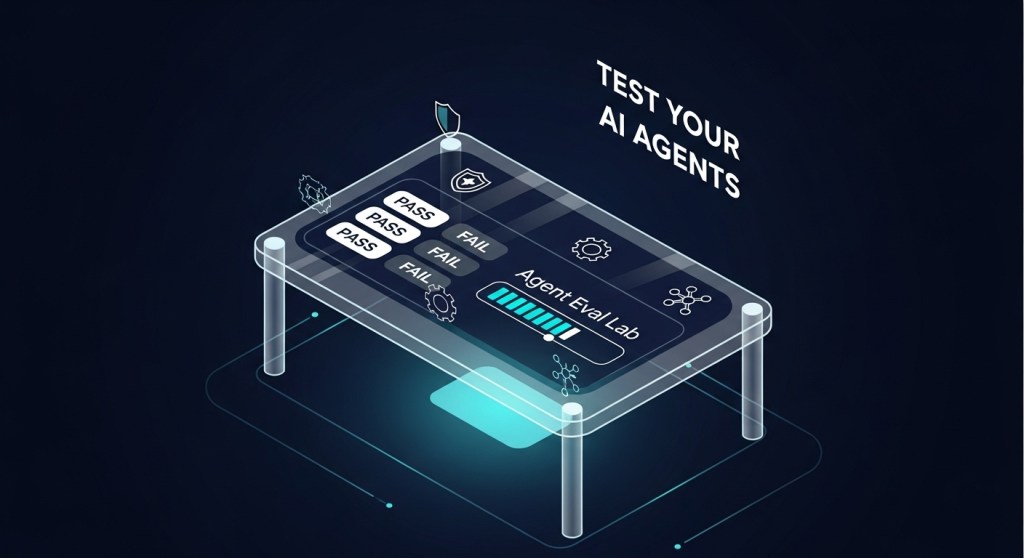
TL;DR: In 2025, agent reliability is the difference between a flashy demo and real ROI. Here’s a practical 7‑day plan to spin up an agent evaluation lab—complete with metrics, simulations, security tests, interoperability checks (MCP/A2A), and go/no‑go gates.
Why now? In the past few weeks we’ve seen: Microsoft publish a synthetic simulation to stress‑test agents and surface failure modes; OpenAI add Evals for Agents to AgentKit; and Salesforce push Agentforce 360 and research‑driven evals into the enterprise. Together, these signal that testing agents like software—with repeatable suites, traces, and SLOs—is becoming table stakes. citeturn6search5turn6search0turn5search0turn5news13
Who this guide is for
- Startup founders and product leaders racing to ship reliable agents in production.
- E‑commerce operators rolling out sales and support agents.
- Engineering and ops teams tasked with governance, security, and ROI.
What you’ll build in 7 days
A lightweight, reproducible evaluation lab that measures agent outcomes (goal completion, first‑pass success), safety (prompt‑injection and tool‑use abuse), interoperability (MCP/A2A flows), and cost (per‑resolution COGS)—then gates releases with scorecards.
Day 1 — Define goals, risks, and SLOs
- Map critical user journeys (e.g., refund, exchange, subscription upgrade). For each, capture success criteria and “definitely don’t do” constraints.
- Pick outcome metrics: Goal Completion Rate (GCR), First‑Pass Resolution (FPR), Mean Actions to Success (MAS), Escalation Rate (ER), Cost per Resolution (CPR), Safety Incident Rate (SIR).
- Set SLOs (e.g., GCR ≥ 90%, FPR ≥ 70%, SIR = 0). Outcome‑oriented agent metrics are gaining traction beyond infra metrics like latency. citeturn8academia12
Related reads: Agent Observability (AgentOps) in 2025 and Stop Agent Impersonation.
Day 2 — Stand up your evaluation harness
- Pick a baseline: OpenAI Evals for Agents (AgentKit) for trace grading; Salesforce’s research around MCPEval; or AWS Labs’ open agent‑evaluation framework if you’re on Bedrock/Q. citeturn6search0turn7academia17turn7search0
- Wire in LLM‑as‑judge plus deterministic checks. IBM’s overview is a good primer on combining rubric scoring with hard assertions. citeturn7search3
- Automate: run evals on every prompt/config change in CI; fail the build if GCR/FPR drop beyond thresholds.
Day 3 — Add realistic simulations and tracing
- Simulate messy reality: Build Magentic‑style scenes (competing offers, decoy data, adversarial websites). Microsoft’s study shows how agents fail in adversarial markets and why we need safe‑by‑default behaviors. citeturn6search5
- Computer‑use tasks: Include browser/desktop flows to mimic real tools. New agents from Anthropic (Chrome) and Amazon (Nova Act) emphasize screen‑level actions and benchmarks like OSWorld/GroundUI. citeturn6search4turn1search6
- Trace everything: Emit OpenTelemetry‑style spans for actions, tool calls, and cost; feed them into your AgentOps dashboard. See our AgentOps playbook.
Day 4 — Security, safety, and abuse testing
- Prompt‑injection suite: Test direct and indirect attacks, tool hijacking, and data exfiltration across MCP servers. Start with community checklists and research like MCP‑Guard. citeturn7search2turn7academia13
- Known‑bad scenarios: Reproduce incidents and logic flaws seen in the wild (e.g., misconfigured MCP integrations). citeturn7search4
- Identity & permissions: Enforce per‑tool scopes, signer policies, and human‑in‑the‑loop approvals for sensitive actions. Cross‑reference our security checklist.
Day 5 — Interoperability checks (MCP and A2A)
Agents increasingly call other agents via shared protocols. Verify:
- MCP: Can your agent call standard MCP servers (e.g., files, email, GitHub) without brittle adapters? Validate auth, rate limits, and logging on each server. citeturn7news15turn7news16
- A2A: If you’re orchestrating cross‑platform flows (e.g., Copilot Studio to Gemini), test goal handoffs and action permissions. Microsoft has publicly aligned with Google’s A2A, underscoring where enterprise agent workflows are headed. Tie this back to your architecture. citeturn0search5
Related guide: Stop Building Agent Islands.
Day 6 — Cost, latency, and scale
- Budget per resolution: Track tokens, tool calls, and retries; set CPR targets per use case. Bake budget caps into your agent config.
- Throughput SLOs: Run load tests on your most common flows; log queue time vs. action time; throttle gracefully.
- Memory discipline: Apply TTLs and summarization to prevent context bloat and leakage; verify no PII persists beyond policy. See our agent memory playbook.
Day 7 — Scorecards and go/no‑go
Ship a one‑page scorecard per release with GCR, FPR, MAS, ER, CPR, and SIR; list failing tests and mitigations; run a shadow launch before full GA. If you’re on AgentKit or Agentforce, include built‑in eval artifacts in your release checklist for auditability. citeturn6search0turn5search0
Metrics cheat‑sheet
- GCR (Goal Completion Rate) — % of tasks completed within constraints.
- FPR (First‑Pass Resolution) — % completed with zero human escalation.
- MAS (Mean Actions to Success) — average tool/browser actions to finish.
- ER (Escalation Rate) — % that require human takeover.
- CPR (Cost per Resolution) — tokens + infra + API calls per success.
- SIR (Safety Incident Rate) — security or policy violations per 1,000 runs.
Use outcome‑oriented metrics alongside domain‑specific ones; research is coalescing around business‑impact and autonomy measures vs. pure latency/throughput. citeturn8academia12
Tooling options (pick 1–2 to start)
- OpenAI AgentKit + Evals for Agents — trace grading, connector registry, and admin controls. citeturn6search0
- Agentforce 360 + MCPEval (research) — enterprise agent orchestration with MCP‑based evaluation; strong Slack integration. citeturn5search0turn5news13
- AWS Labs agent‑evaluation — open‑source harness with CI/CD hooks; Bedrock/Q friendly. citeturn7search0
- Benchmarks to sample — OSWorld, REALM‑Bench; add your own business‑specific tasks. citeturn8academia13
Security gotchas to simulate
- Indirect prompt injection via web pages, PDFs, or MCP servers; test obfuscated payloads and tool‑hijack attempts. citeturn7search2
- Integration logic flaws (over‑broad permissions, multi‑tenant leakage) in MCP/A2A connectors. citeturn7search4
- Computer‑use risks (clickjacking, hidden UI elements) when your agent controls a browser/desktop. Track screen context and require consent for sensitive actions. citeturn6search4
Cross‑reference our security checklist and impersonation guards to enforce signer policies, step‑up verification, and audit trails. Read more.
Interoperability matters (because your stack isn’t a walled garden)
The shift toward shared protocols is real: Microsoft aligned with Google’s Agent2Agent (A2A), while MCP keeps gaining OS‑level support and community servers. Bake protocol tests into CI so agents can safely hand off goals across platforms. citeturn0search5turn7news15
From lab to production: rollout pattern
- Private pilot with shadow mode + evaluator traces.
- Progressive exposure (1% → 5% → 25%), abort on SIR > 0 or GCR dip.
- Weekly eval review across product, security, and ops (own a shared scorecard).
If you’re shipping customer support agents, pair this with our 2025 Buyer’s Guide & ROI model.
FAQ
Do we need a browser‑control agent to start? No. Begin with API‑only tasks; add computer‑use flows once your eval harness is green. Recent launches (e.g., Anthropic’s Chrome agent) show where UX is going, but you don’t need it on day one. citeturn6search4
Which protocol should we bet on? Test both: MCP (rich ecosystem, growing OS support) and A2A (cross‑vendor agent handoffs). Use whichever unlocks your workflows—and keep tests in place to prevent regressions. citeturn7news15turn0search5
How do we keep evals current? Version your datasets, rotate adversarial payloads monthly, and snapshot agent configs with each release. Pull cues from Microsoft’s evolving simulations as new failure modes appear. citeturn6search5
Next steps
- Clone an eval harness (AgentKit Evals or AWS Labs) and run your first suite today.
- Add three Magentic‑style adversarial tests and two MCP security cases.
- Publish a one‑page scorecard and set your go/no‑go gate.
Ready to ship reliable agents? HireNinja can help you stand up this lab, wire observability, and move from pilot to production with confidence. Learn more or subscribe for more playbooks.


Leave a Reply