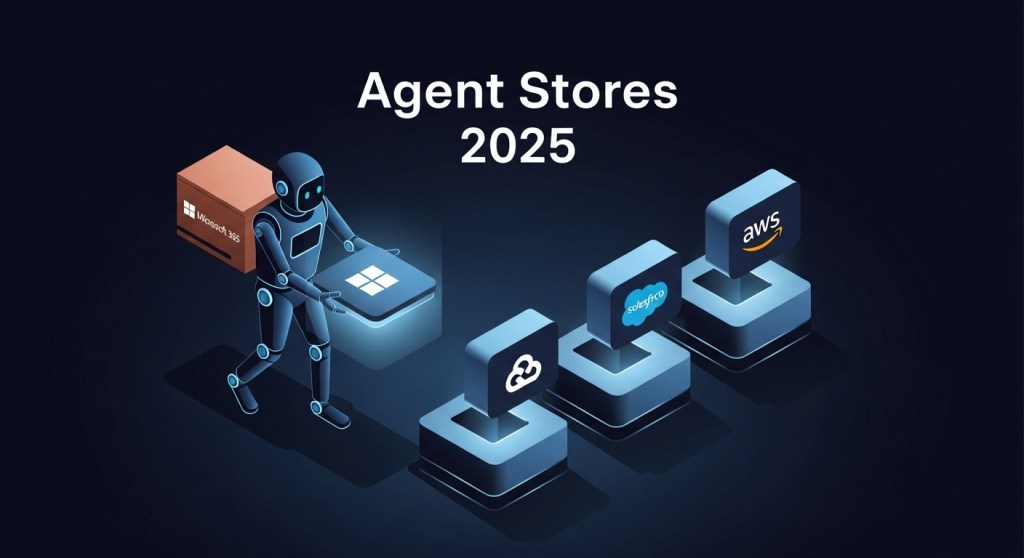
If 2024 was about proofs of concept, 2025 is about distribution. Agent Stores and marketplaces are rolling out across the enterprise stack, and getting listed is quickly becoming the fastest way to turn your AI agent into real usage and revenue. This guide shows founders exactly where to publish (today), how to price, and what governance hurdles to expect.
Why this matters now
In the past week, Google DeepMind previewed SIMA 2, a Gemini‑powered generalist agent that can reason and act inside virtual worlds—another signal that agent capabilities and expectations are rising. Founders need distribution channels that can handle real work, not just demos.
At the same time, platform rules are tightening. Amazon’s recent legal warning to Perplexity over its agentic shopping assistant illustrates how quickly terms of service enforcement can affect agent go‑to‑market plans. Publishing through official channels helps you stay onside with policy and procurement.
Where to publish your agent in 2025
1) Microsoft 365 Copilot Agent Store (live)
Microsoft’s Agent Store lives inside Copilot Chat, letting organizations discover, install, and manage agents with enterprise governance. Microsoft highlights more than 70 agents and supports both low‑code and pro‑code paths via Copilot Studio. Makers can publish custom agents to Copilot Chat and monetize through the store, while IT governs access in the Microsoft 365 admin center.
- Best for: B2B workflow agents that live where knowledge workers already are (Teams, Outlook, M365 apps).
- Governance: Org‑scoped distribution, validation for security/compliance, granular controls via admin center.
- Monetization: Store‑based discovery with enterprise purchasing and (in select programs) pay‑as‑you‑go options enabled by IT.
2) Google Cloud Marketplace for AI Agents (live)
Google Cloud now accepts AI agents in Cloud Marketplace. Vendors create an Agent Card (JSON) that describes capabilities per the A2A spec, choose pricing (free, subscription, usage, or combined), and publish via Producer Portal. Customers can add the agent to Google Agentspace and handle billing through Google.
- Best for: Agents that run on GCP and need cross‑agent collaboration via A2A.
- Governance: Standard Marketplace review plus additional AI agent requirements; listing updates reviewed by Google.
- Monetization: Flexible subscription or usage‑based pricing models billed by Google.
3) Salesforce Agentforce 360 + Slack AgentExchange (rolling out)
Salesforce branded its agent platform “Agentforce 360,” and is extending distribution into Slack with a native AgentExchange marketplace. Customers can discover and install partner agents—including models and integrations from Anthropic, OpenAI, Google Cloud, and others—directly inside their Salesforce and Slack environments.
- Best for: Sales, service, and RevOps agents embedded in CRM and Slack workflows.
- Governance: Enterprise‑grade controls consistent with Salesforce/Slack deployment patterns.
- Monetization: App‑style marketplace distribution to existing Salesforce/Slack customers.
4) AWS Agent Marketplace (announced; track timing)
TechCrunch reported that AWS is launching an Agent Marketplace, positioning it as a central hub for startups to sell agents directly to AWS customers—joining Google Cloud and Microsoft’s competing stores. If your stack already runs on AWS or Bedrock, add this channel to your roadmap and prepare your listing assets now.
Quick comparison: distribution at a glance
| Channel | Status | Where agents run | Pricing model | Governance |
|---|---|---|---|---|
| Microsoft Agent Store | Live | M365/Copilot Chat | Store + enterprise purchasing; org scoping | Admin center controls, validation |
| Google Cloud Marketplace | Live | GCP + Agentspace | Free, subscription, usage, combined | Marketplace review + AI agent rules |
| Salesforce Agentforce 360 / Slack AgentExchange | Rolling out | Salesforce + Slack | Marketplace/AppExchange‑style | Enterprise deployment patterns |
| AWS Agent Marketplace | Announced | AWS (likely Bedrock) | TBD; expect Marketplace norms | AWS Marketplace policies |
10‑day listing plan (you can reuse across stores)
- Define the job‑to‑be‑done and boundaries. Write a one‑line outcome (“Increase NPS by resolving order status tickets”) and a one‑page guardrails spec (PII policy, allowed actions, escalation path). For help, see our 2025 Buyer’s Guide + RFP.
- Instrument reliability and cost. Stand up an evaluation harness and track task success, latency, hallucination rate, and per‑task cost. Our Evaluation Lab Playbook has templates.
- Prep your listing content. Draft the Microsoft Agent Store description, Google Agent Card (A2A JSON), screenshots, pricing, and support SLAs.
- Wire governance. Enable admin‑center controls (Microsoft), set Marketplace compliance (Google), and prep Slack/Salesforce permissions.
- Run a policy check. Confirm your agent identifies itself and respects site/app ToS before you publish; avoid gray‑area “agentic browsing” that can trigger takedowns.
- Ship a private preview. Start with a small tenant or a handful of GCP projects. Validate install, auth, billing, and telemetry.
- Launch with a proof metric. Target one measurable outcome (e.g., 30% fewer WISMO tickets) and feature it in your listing.
- Plan interop, not silos. Support A2A/MCP handoff so your agent can coordinate with others across platforms. Pair this with our Interoperability Playbook.
- Ready your support playbook. Define escalation, human‑in‑the‑loop, and incident response. Tie to SLAs and chat/voice queues.
- Announce where users work. Publish inside Teams/Outlook (Microsoft), Slack (Salesforce), or GCP consoles. Don’t make users change context to try your agent.
Pricing that closes quickly
Set pricing by task unit (e.g., “per resolved ticket,” “per enriched lead,” “per SKU update”) instead of tokens. Microsoft’s Agent Store supports org‑scoped install and enterprise purchasing; Google Cloud Marketplace lets you choose subscription or usage‑based billing with metered metrics. This aligns cost to value and makes procurement smoother.
Compliance and listing readiness
- Identity and disclosure: Make it obvious users are interacting with an AI agent; many platforms require that agents identify themselves.
- Data handling: Document retention, redaction, and vendor subprocessors. Set geographic controls if needed.
- Action safety: Implement allow/deny lists, human approval for high‑risk actions, and rate limits.
- ToS alignment: Avoid scraping/automation that violates app policies; prefer official connectors and APIs. Recent enforcement shows platforms are watching.
For a deeper governance pass (ISO 42001/NIST AI RMF/EU AI Act), use our 2025 Compliance Checklist.
Launch checklist (copy/paste)
- One‑line value prop + 3 screenshots
- Microsoft listing (Agent Store) and/or Google Agent Card JSON complete
- Telemetry: success, latency, cost per task
- Guardrails: PII policy, escalation rules, audit logs
- Pricing: usage metric mapped to business outcome
- Support: docs, response SLAs, status page
What’s next
Expect ongoing shifts: Microsoft is expanding Agent Store programs; Google’s A2A standardization could make cross‑agent handoffs routine; Salesforce’s Slack‑native marketplace will pull agents deeper into daily work. If AWS follows through with its marketplace, distribution will feel like the early days of app stores—except this time, your product is an actor, not a static app. Build for governance and interop from day one.
Need help shipping? HireNinja can help you package, govern, and list your agent in 10 days—complete with evaluation harness, pricing model, and marketplace‑ready assets. Learn more or subscribe for new playbooks.


Leave a Reply