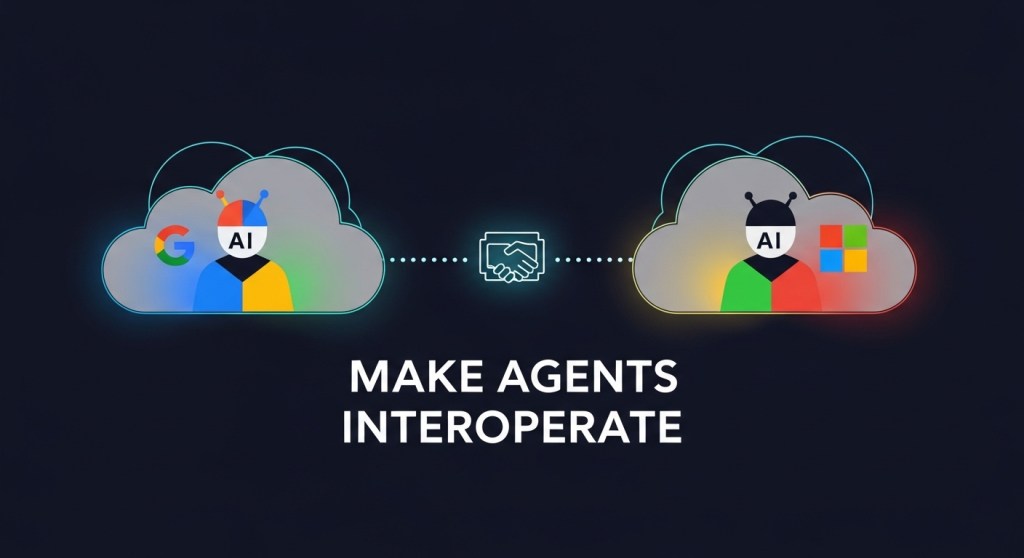
A2A + MCP in 2025: The Interoperability Blueprint to Make Your AI Agents Talk Across Clouds
TL;DR: Ship agents that collaborate across vendors. Use Google’s Agent2Agent (A2A) for agent‑to‑agent communication, Anthropic’s MCP for tool/data access, and OpenAI’s AgentKit for evals and guardrails. Then measure outcomes, not vibes.
Why interoperability just became urgent
In April 2025, Google introduced the Agent2Agent (A2A) protocol to let AI agents communicate and coordinate across platforms—an inflection point for multi‑agent systems. citeturn2search1
By May, Microsoft said it would support A2A in Azure AI Foundry and Copilot Studio, signaling cross‑cloud momentum rather than another closed ecosystem. citeturn2search0
A2A is open‑sourced and evolving in the wild, with a repo and community docs you can implement today. citeturn2search4turn2search2
A2A vs. MCP: How they fit together
- A2A: A messaging/coordination layer for agents to discover each other, negotiate capabilities, and exchange tasks/results. Think “agents talking to agents” across clouds. citeturn2search1turn2search5
- MCP (Anthropic): A standard interface for agents to use tools and data via connector servers (DBs, APIs, files, etc.). Think “USB‑C for agent tools.” citeturn4search0
Used together: your support agent (A2A) asks an external returns agent to authorize an exchange, while your internal inventory agent fetches stock via MCP. citeturn2search1turn4search0
Reference architecture (e‑commerce example)
Scenario: Customer requests a size exchange.
- Support Agent (hosted on your site) parses the user request.
- It discovers a Returns Agent via A2A Agent Card; sends a task with order ID and policy constraints.
- Inventory Agent queries stock via MCP servers (Postgres + ERP) and returns options.
- Returns Agent negotiates a prepaid label and confirms exchange window, then posts a status update (A2A task lifecycle).
- Support Agent summarizes next steps to the user and logs metrics.
Why this works: A2A standardizes discovery, messaging, and long‑running task status; MCP standardizes tool/data calls. citeturn2search2turn4search0
7‑day rollout plan
Day 1–2: Pick the high‑leverage workflow + define capabilities
- Choose one cross‑team task (returns/exchanges, warranty claims, VIP outreach).
- Draft each agent’s capability contract (inputs, skills, auth scopes, KPIs).
- Create an Agent Card (agent.json) to advertise skills and endpoints. citeturn2search2
Day 3: Wire internal tools with MCP
- Expose read‑only DB queries and specific actions (e.g., create RMA) via MCP servers with OAuth. citeturn4search0
- Restrict to least‑privilege tools and log calls for audits.
Day 4: Security, identity, and permissions
- Use the A2A Agent Card to declare auth and permitted actions; adopt enterprise identity (e.g., W3C DID) as supported by the spec/community. citeturn2search2
- Add transaction limits and dual‑control for refunds (see our post on stopping agent impersonation).
Day 5: Evals, traces, and guardrails
- Stand up Evals for Agents (OpenAI AgentKit) to grade traces, regressions, and prompt changes. citeturn3search1
- Instrument steps and costs; see our OpenTelemetry blueprint.
Day 6: Pilot with a partner agent
- Start with one trusted external agent (e.g., shipping/3PL). Stage, then canary 5–10% of traffic.
- Measure success, handle time, human‑handoff rate, and cost per resolved task.
Day 7: Go‑live gates
- Run an agent red‑team and break‑glass drills before full rollout. citeturn1news12
- Finalize policies and evidence for audits (see compliance checklist link below).
Quickstart: Minimal Agent Card and A2A task
{
  "agent": {
    "name": "returns-agent",
    "version": "1.0",
    "skills": ["create_rma", "get_return_label"],
    "auth": {"type": "oauth2", "scopes": ["returns.create", "returns.read"]},
    "endpoints": {
      "task": "https://returns.example.com/a2a/task",
      "status": "https://returns.example.com/a2a/status/{task_id}"
    }
  }
}
// Client sends a task to the Returns Agent
POST /a2a/task
{
"goal": "Authorize exchange and generate label",
"input": {"order_id": "SO-12345", "sku": "SWEATER-XL"},
"callback_url": "https://support.example.com/a2a/callback",
"auth": {"bearer": "<token>"}
}See community docs and repo for full spec details and samples. citeturn2search2turn2search4
Reliability and safety: set expectations
- Computer‑use reliability: OpenAI’s Computer‑Using Agent (which powers Operator/agent mode) is still improving and requires oversight on sensitive actions—plan your human‑in‑the‑loop accordingly. citeturn3search0turn3search2
- Avoid “agents are tools” anti‑pattern: Use A2A for agent‑to‑agent negotiation; use MCP for tool/data integrations. citeturn2search5turn4search0
- Real‑world caveat: Fully AI‑staffed experiments show promise and pitfalls; keep clear go‑live gates, policies, and telemetry. citeturn1news12
KPIs and costs to track from day one
- Success rate per task type: % of A2A tasks that finish without human handoff.
- Median time‑to‑result: Submission → status=done.
- Handoff rate: % escalated to human; instrument reasons.
- Unit economics: $ per resolved task (model + infra + refunds leakage). See our cost‑control playbook.
- Guardrail breaches: blocked actions, auth failures, PII policy hits.
Tooling picks that play nicely with interop
- Build: Google ADK with native A2A; Anthropic’s MCP servers; OpenAI AgentKit for workflow builder and evals. citeturn2search6turn4search0turn3search1
- Observe: OpenTelemetry traces for spans per agent step; see our observability blueprint.
- Ship: When listing in agent stores, ensure your Agent Card is accurate and security docs are ready; see our agent‑store guide.
Common pitfalls (and how to avoid them)
- Over‑permissioned agents: Scope each agent narrowly; add daily transaction caps and approval flows. See our permissions guide.
- No evals or canaries: Run trace grading and regression tests before changing prompts/tools. citeturn3search1
- Compliance as an afterthought: Map runtime controls to ISO 42001/NIST AI RMF/EU AI Act evidence. See our compliance checklist.
- Skipping human‑in‑the‑loop for high‑risk actions: Require confirmations on refunds, credentials, or PII changes. citeturn3search0
Next steps
- Make your site agent‑friendly (NLWeb/Schema.org/MCP) with our weekend guide.
- Stand up a returns/exchanges or checkout recovery flow with our 7‑day playbook.
- Plan a holiday pilot—see AI shopping agents for Holiday 2025.


Leave a Reply