Editorial checklist
- Scan competitors’ latest agentic commerce coverage and standards (ACP, AP2, A2A).
- Clarify the audience and use cases: startup founders, e‑commerce operators, tech leads.
- Identify the gap: analytics and attribution for agent-led purchases and support.
- Deliver a 14‑day implementation plan with KPIs, dashboards, and guardrails.
- Cite standards and news; link internally to our recent agent rollout guides.
Why agent attribution matters now
On September 29, 2025, OpenAI launched Instant Checkout in ChatGPT, powered by the open Agentic Commerce Protocol (ACP) co‑developed with Stripe. U.S. users can buy from Etsy listings today and from over a million Shopify merchants soon—directly in chat. For merchants, ACP is the new programmatic handshake between agents and stores. For growth teams, it changes attribution: clicks give way to structured order messages and server events. citeturn5view0turn3search0
In parallel, Google announced the Agent Payments Protocol (AP2), a payment‑agnostic standard that introduces cryptographically signed “mandates” (Intent and Cart) to prove user authorization in both human‑present and human‑not‑present purchases—critical telemetry for fraud prevention and downstream analytics. citeturn4search1turn4search2
Interoperability across agent stacks is also accelerating. Google’s A2A protocol lets agents collaborate across platforms and vendors, with discovery via Agent Cards—useful for tracing multi‑agent workflows and their contribution to outcomes. Microsoft has said it will support A2A in Azure AI Foundry and Copilot Studio. citeturn11search0turn0search7
What this playbook solves
You’re likely asking:
- How do we measure revenue and support impact when the “session” happens inside an AI agent—not our site?
- Which fields or events from ACP/AP2/A2A should we persist to attribute conversions and resolution outcomes?
- How do we deter spoofed “agent sales” while preserving conversion rate?
Below is a fast, pragmatic plan you can ship in two weeks.
KPIs to add to your 2025 dashboard
- Agent‑Sourced Revenue (ASR): Gross order value where agent channel is present in the server‑side payload (ACP checkout or AP2 mandate chain).
- Agent‑Assist Rate: % of total orders or support cases initiated or resolved by an agent (voice, chat, email).
- Cart Mandate Conversion (AP2): Cart mandates issued vs. successfully paid—proxy for frictions inside agent UX. citeturn4search1
- First‑Contact Resolution by Agent (FCR‑A) and Escalation Rate (agent → human).
- Cost per Successful Step (CPSS): Agent platform cost divided by successful action steps (e.g., order.create, return.authorize).
- Mean Time to Refund/Return (Agent): Tracks post‑purchase service reliability of agent‑origin orders.
Where the data comes from
1) ACP order events (ChatGPT Instant Checkout)
ACP defines a merchant‑controlled checkout interface and server‑to‑server callbacks for order acceptance and payment orchestration. Store the agent platform identifier (e.g., “chatgpt”) and request or order IDs that arrive in the ACP payloads; tie them to customer and SKU. This becomes your ground truth for agent‑sourced revenue. citeturn7view0
2) AP2 mandate metadata
AP2 introduces signed mandates (Intent, Cart, and Payment) to verifiably capture user authorization and agent involvement. Persist mandate references and the presence type (human‑present vs human‑not‑present) in your data warehouse for fraud analytics, dispute workflows, and cohort analysis. citeturn4search1
3) A2A task traces
For multi‑agent workflows (e.g., a shopping agent coordinating with a fulfillment agent), A2A task IDs and Agent Cards provide a clean join key to attribute which agent contributed which step. Include these IDs in your internal events so you can reconstruct the path later. citeturn11search0
4) Platform evals and traces
OpenAI’s AgentKit ships evals and step‑by‑step traces; use them to benchmark conversion and error rates by flow version and prompt. Pipe trace summaries to your observability stack (e.g., logs + metrics). citeturn0search0
A 14‑day rollout plan
- Day 1–2 — Inventory agent surfaces
List voice (Twilio/WhatsApp), chat (ChatGPT Instant Checkout), helpdesk, and browser agents. Map each to the platform (OpenAI, Anthropic, custom), protocol (ACP/AP2/A2A/MCP), and channel owner. - Day 3 — Define attribution schema
In your warehouse, add columns for agent_platform, agent_request_id, ap2_presence_type, ap2_mandate_id, a2a_task_id, and source_protocol (ACP/AP2/A2A). Use a slowly changing dimension for agent versions. - Day 4–5 — Wire ACP webhooks
Capture ACP order acceptance and payment events; normalize into orders_agent table. Start reporting ASR and Cart Mandate Conversion if available. citeturn7view0 - Day 6 — Add AP2 mandate logging
When available, persist Intent and Cart mandate IDs and presence flag with each order. This adds provable consent context to your analytics and reduces false positives in fraud review. citeturn4search1 - Day 7 — Thread A2A IDs through workflows
If you orchestrate multi‑agent flows (e.g., catalog enrichment → price check → checkout), pass A2A task IDs in your internal events and tie them to orders or tickets. citeturn11search0 - Day 8 — Instrument support agents
For Zendesk/Help Scout agents, capture ticket create/resolve events with an agent_actor field. Then compute FCR‑A and Escalation Rate. Cross‑link to order history. - Day 9 — Build the dashboard
Create an “Agent Commerce” dashboard: ASR, Agent‑Assist Rate, Cart Mandate Conversion, CPSS, FCR‑A, and returns. - Day 10 — Add cost telemetry
Join platform billing exports (e.g., OpenAI usage) to traces by agent_request_id and compute CPSS. - Day 11 — Guard against spoofing
Validate signatures where provided (AP2 mandates), maintain an allowlist of agent platforms per protocol, and require per‑agent rate limits and mTLS/API keys for agent‑facing endpoints. See our guide on stopping agent impersonation. Read it. - Day 12 — QA with synthetic orders
Run ACP sandbox orders and AP2 test mandates; verify events flow correctly to your warehouse and dashboards. citeturn7view0turn4search1 - Day 13 — Set targets
Agree on Q1 targets: e.g., 8–15% of DTC revenue via agents, FCR‑A ≥ 65%, CPSS ↓ 30% vs. baseline. - Day 14 — Ship and review
Go live with a small SKU set and a subset of support intents. Weekly ops review on agent KPIs.
Design notes: accuracy, safety, and ops
- Accuracy over hype: ACP’s goal is to preserve merchant control and observability; AP2’s mandates are about provable user intent. Design your data model around these primitives, not scraped UTM tags. citeturn5view0turn4search1
- Fraud and disputes: Mandate IDs plus presence type let you triage chargebacks more confidently and segment risky flows (e.g., human‑not‑present delegated purchases). citeturn4search1
- Multi‑agent complexity: A2A traces and Agent Cards clarify who did what in a chain—useful when debugging outcomes or allocating budget. citeturn11search0
- Evals for agents: Bake in step‑level evals (success, latency, cost) so growth and engineering share a single truth. OpenAI’s AgentKit shows the direction. citeturn0search0
How this fits your 2025 roadmap
If you’re running e‑commerce, start with our new 30‑day agent‑readiness checklist and AP2 vs. ACP comparison to ready your store for the holidays, then add attribution using this playbook. Agent‑ready store checklist. For support, pair this with our 7‑day Zendesk agent rollout and red‑teaming guide. Zendesk agent in 7 days • Agent red‑teaming.
Market signal: investor interest in customer‑facing agent platforms is spiking—e.g., Wonderful’s $100M Series A. If you can prove agent ROI and safety with clean attribution, you’ll be ahead of budget conversations in Q1. citeturn0search1
Closing example: a simple attribution pipeline
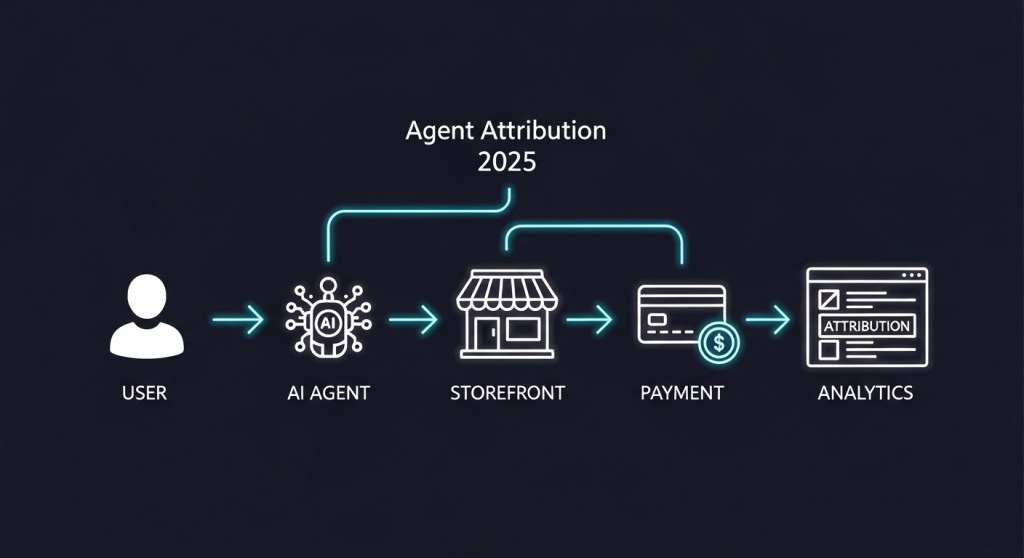
- ACP webhook receives order; payload contains agent platform identifier and request/order IDs.
- Warehouse job enriches with AP2 mandate references (if present) and A2A task IDs from internal logs.
- BI dashboard shows ASR, Cart Mandate Conversion, CPSS, FCR‑A by agent version.
- Alerts fire if Cart Mandate Conversion dips or CPSS spikes after a prompt/version change.
Take action
Want help instrumenting ACP/AP2, stitching A2A traces, and proving ROI in two weeks? Talk to HireNinja. We’ll stand up the schema, webhooks, and dashboards, and ship guardrails that don’t tank conversion.
Further reading: Interop via A2A, ACP details, AP2 mandates, and real‑world lessons on agent fallibility. citeturn11search0turn7view0turn4search1turn0news12


Leave a Reply