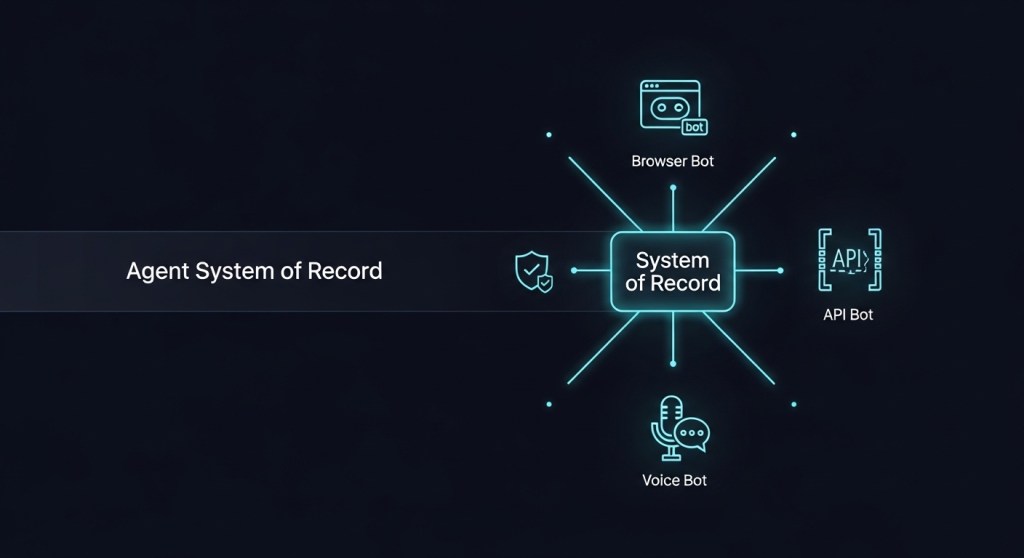
Do You Need an Agent System of Record? A 2025 Buyer’s Guide to Managing AI Agents with A2A, MCP, and AgentKit
Teams are shipping browser agents, API agents, and voice agents faster than they can govern them. The result: duplicated skills, unclear ownership, rising costs, and compliance risk. A new class of platform—the Agent System of Record (ASoR)—is emerging to centralize identity, policy, telemetry, and ROI for your agent fleet. citeturn4search1
What is an Agent System of Record?
An ASoR is a control plane for AI agents—much like an HRIS is for employees or a CRM is for customers. It catalogs every agent (who it is), scopes what it can do (skills, permissions, data), tracks what it actually did (events, costs, outcomes), and enforces policies (guardrails, approval flows). Enterprise vendors are beginning to formalize this layer to manage both first‑party and third‑party agents in one place. citeturn4search0
Why 2025 is the tipping point
- Interoperability moves mainstream: Microsoft joined Google’s agent‑to‑agent (A2A) standard push so agents can collaborate across apps and clouds—accelerating multi‑agent workflows. citeturn0search3
- Browser‑native agents mature: Google’s Project Mariner brings safe, parallelized browsing actions, increasing the number of tasks teams can offload to agents. citeturn0search1
- Developer tooling improves: OpenAI’s AgentKit streamlines building, evaluating, and deploying production agents with connectors and evals—reducing in‑house plumbing. citeturn0search2
- Proof that agents drive outcomes: Customer support agents are attracting sizable funding and reporting high resolve rates, pushing leaders to standardize governance and measurement. citeturn0search7
ASoR core capabilities (buyer’s checklist)
Use this checklist when evaluating platforms—or when composing a build‑your‑own stack.
- Identity & Access: Unique agent identity, signed requests, environment scoping, and least‑privilege credentials. Tie identities to protocol‑level claims and your SSO. See our 14‑day playbook to stop agent spoofing.
- Policy & Guardrails: Task boundaries, spending limits, human‑in‑the‑loop gates, and allowlists for external actions (AP2/ACP, payments, PII).
- Observability & Traceability: End‑to‑end traces per action with tool calls, DOM/API diffs, and outcomes; export via OpenTelemetry; real‑time alerts for drift or anomalies. Pair with our AgentOps SLOs & incident playbooks.
- Cost & ROI: Native cost meters for model usage, tools, and infra; attribution to orders, tickets, and MQLs. See our Agent Attribution Playbook.
- Interoperability: Support for agent‑to‑agent protocols (A2A) and a tool registry (MCP servers) so agents can discover and call skills across systems. citeturn0search3turn3search7
- Evaluation & Quality: Built‑in eval loops, regression suites, red‑team datasets, and safe rollouts. AgentKit‑style evals are a plus even if you’re not on OpenAI. citeturn0search2
- Audit & Compliance: PI/PCI posture, retention, regional routing, and documented incident handling. Voice/UX channels require special handling.
Build vs. Buy in 2025
Buying an enterprise ASoR
If you’re already on a major platform, an enterprise ASoR may be the fastest route to governance, with centralized visibility into agent tasks, access, and costs. Vendors are positioning ASoR offerings to treat agents as first‑class digital workers alongside employees and contractors. citeturn4search1
Building a pragmatic ASoR stack
Engineering‑led teams can assemble a lean stack with:
- Registry & Interop: MCP servers for internal tools (e.g., GitHub, Gmail, Custom APIs) so agents can discover capabilities consistently. citeturn3search3turn3search5
- Execution: Mix API‑first agents (AP2/A2A) with browser agents for long‑tail sites. Our guide on Browser vs. API agents covers trade‑offs. Google’s Mariner shows what modern browsing agents can safely automate. citeturn0search1
- Agent Dev Layer: Use OpenAI AgentKit or your preferred framework for agent workflows, connectors, and evals. citeturn0search2
- Telemetry: Standardize traces via OpenTelemetry; stream to your observability stack; alert on policy or SLO breaches.
- Commerce Hooks (if applicable): Wire AP2/ACP for secure cart, pay, and fulfillment. Start with our Shopify/Woo and 7‑step agent‑ready weekend checklists.
Who needs an ASoR now?
- E‑commerce with >5 agents in production: return/exchange, catalog QA, PDP enrichment, merchandising, and checkout/upsell agents often overlap and conflict.
- SaaS with support and sales agents: as resolution rates climb and new channels launch (e.g., Mariner‑capable browser agents), you need shared identity, policy, and ROI views. citeturn0search1turn0search7
- Regulated or global teams: you’ll need audit trails, regional routing, and consistent approvals.
A 14‑day pilot plan
- Days 1–2: Inventory & risks. List every agent, inputs, secrets, actions, and current metrics. Flag high‑risk actions (refunds, payouts, PII). Pair this with our AgentOps SLOs.
- Days 3–4: Identity and policy. Issue distinct credentials, scopes, and spending caps per agent. Add approval gates for money moves. See agent spoofing playbook.
- Days 5–6: Instrumentation. Add OpenTelemetry spans for each tool call and external action; centralize logs.
- Days 7–9: Interop baseline. Register a minimal tool set via MCP (search, email, product DB). If collaborating agents, add A2A messaging and capability tags. citeturn3search7turn3search4
- Days 10–11: Evals & guardrails. Run regression scenarios, set SLOs (success, latency, cost), and define rollback. AgentKit‑style evals are a plus. citeturn0search2
- Days 12–14: Report & decide. Produce a single report: agents, actions, costs, incidents, ROI by workflow. Choose build vs. buy and plan your next 30 days.
Example: A mid‑market Shopify brand
A cosmetics retailer runs five agents: returns, VIP support, PDP enrichment, inventory sync, and checkout cross‑sell. After adopting an ASoR, they consolidate secrets, enforce refund approvals over $150, and tag capabilities through MCP so the cross‑sell agent can check inventory before offering bundles. Resolution time drops 28%, refund fraud falls, and they can attribute $97k/month in agent‑assisted upsell revenue using last‑action mandates from AP2/ACP. See our Agent SEO and Attribution Playbook for measurement patterns.
Risks and how to mitigate them
- Over‑permissioned agents: adopt least privilege and rotate keys; require explicit mandates for financial actions.
- Shadow agents: scan for unregistered agent traffic; block unknown signatures at the edge.
- UI drift and brittle browser automations: prefer APIs for critical paths; reserve browser agents for long‑tail sites or research. Google’s Mariner points to safer parallelization, but you still need rollbacks. citeturn0search1
- Vendor lock‑in: favor open protocols (A2A, MCP) and exportable traces so you can switch foundations. citeturn0search3turn3search5
Bottom line
If you operate more than a handful of production agents—or plan to in Q1 2026—an Agent System of Record is the difference between scale and sprawl. Whether you buy a turnkey platform that treats agents as first‑class digital workers, or assemble a lightweight stack around A2A and MCP with AgentKit‑style evals, the organizations that centralize identity, policy, telemetry, and ROI will win. citeturn4search1turn0search2turn0search3
Further reading
- Enterprise ASoR momentum and features. citeturn4search1turn4search0
- Agent‑to‑Agent standardization (A2A). citeturn0search3
- MCP server ecosystem round‑up. citeturn3search3turn3search7
- Browser agents landscape (Mariner). citeturn0search1
- OpenAI AgentKit launch and evals. citeturn0search2


Leave a Reply