Editorial checklist (what you’ll get)
- Competitor scan: latest on agent management/orchestration.
- Audience: founders, e‑commerce, and tech leads shipping agents.
- Gap we fill: concrete rollout for an agent registry and RBAC.
- SEO: “AI agent registry,” “agent sprawl,” “AI agent governance.”
- Deliverable: 7‑day implementation plan + KPIs + templates.
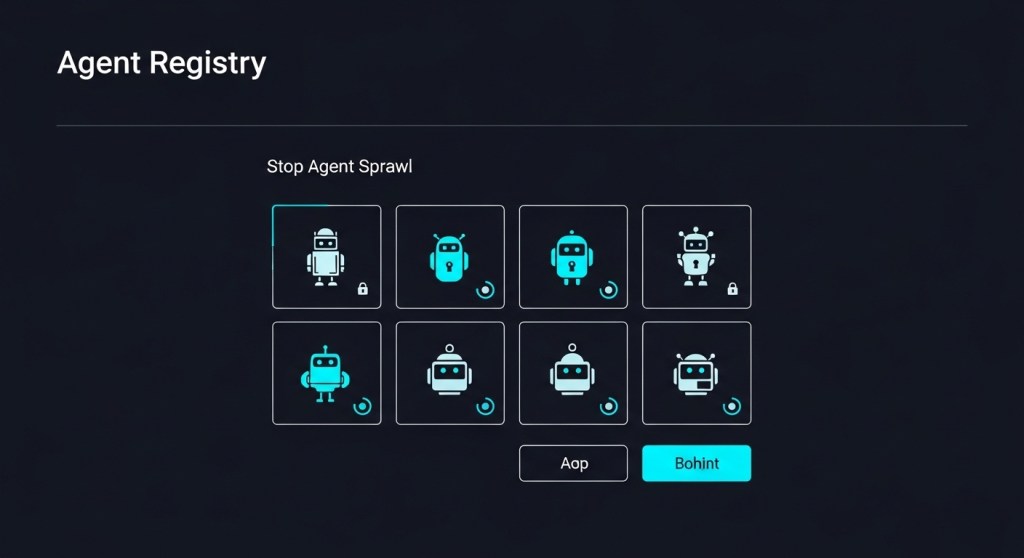
Stop Agent Sprawl: Ship an AI Agent Registry and RBAC in 7 Days (MCP/A2A‑Ready)
Enterprise AI is rapidly shifting from single chatbots to fleets of task‑specific agents. Microsoft’s new Agent 365 underscores the trend: companies need a way to inventory, govern, and secure hundreds or thousands of agents—just like people and apps. citeturn1news12
If you’re a startup founder or e‑commerce operator, you don’t need a mega‑suite to get started. In one week, you can stand up a lightweight Agent Registry plus role‑based access controls (RBAC), wired for today’s interoperability standards—MCP for tool connectivity and A2A for agent‑to‑agent handoffs—so you can scale without chaos. citeturn2news15turn0search7
Who this is for
- Technology startup founders shipping agentic workflows in product or ops.
- E‑commerce leads enabling agentic support, merchandising, or checkout.
- Platform/infra teams asked to “make agents safe” without slowing velocity.
What counts as “agent sprawl”
- No single inventory of agents, owners, or environments.
- Undefined scopes: agents can access tools/data they shouldn’t.
- Shadow agents launched from prototypes with no reviews or logs.
- Hard‑to‑reproduce failures; no traces, no rollback, no approvals.
Today’s landscape in 60 seconds
- Build/ship kits: OpenAI AgentKit (builder, evals, connector registry). citeturn0search0
- Enterprise suites: Salesforce Agentforce 360. citeturn0search2
- Interop: A2A is gaining traction across clouds. citeturn0search7
- Connectivity: MCP support is rolling into Windows and developer stacks. citeturn2news15
The core: an Agent Registry + RBAC
Your registry is a single source of truth for every agent in each environment (dev, staging, prod). Minimum viable schema:
{
  "agent_id": "seo-brief-writer-v3",
  "purpose": "Generate briefs & publish drafts to WordPress",
  "owner": "growth@acme.com",
  "environments": ["dev","staging","prod"],
  "model": "gpt-4.x-reasoning",
  "tool_scopes": ["wordpress.posts:create","serp:read"],
  "data_domains": ["marketing","public-web"],
  "a2a_capabilities": ["handoff:reviewer","handoff:publisher"],
  "mcp_servers": ["serp","drive","github"],
  "identity": {"auth": "OIDC client","audience": "wp-admin"},
  "risk_rating": "medium",
  "human_in_the_loop": true,
  "status": "approved",
  "version": "3.2.1",
  "changelog_url": "https://…/CHANGELOG.md"
}
Back it with RBAC and policy‑as‑code so that scopes, data access, and high‑risk actions require approvals. Open Policy Agent (OPA) is a proven engine for expressing these rules in Rego. citeturn3search2turn3search1
7‑Day rollout plan (startup‑friendly)
- Day 1 — Inventory and owners. Crawl repos and clouds for agents, prompts, and background jobs. Create a basic registry (even a spreadsheet) with owner, purpose, environment, model, tools, data, and risk. Map each agent to a human owner and Slack channel for incidents.
- Day 2 — Choose your path.
- Managed: Pilot Microsoft Agent 365 (if eligible) for catalog and access oversight. citeturn1news12
- Build‑first: Use OpenAI AgentKit’s connector registry + evals for a product‑embedded approach. citeturn0search0
- CRM‑centric: If you live in Salesforce, evaluate Agentforce 360. citeturn0search2
- DIY: Postgres + Backstage‑style service catalog, exposed via a thin API.
- Day 3 — Identity and scopes. Issue distinct OIDC clients/service principals per agent. Enforce least‑privilege scopes (e.g.,
orders:refundvsorders:read). Require human approval for PII or money‑movement scopes. Tie each agent to an identity card in your registry (owner, client_id, allowed audiences). See our Agent Identity guide. - Day 4 — Policy as code. Author guardrails in OPA/Rego: allowed tools, data domains, environment‑by‑environment toggles, rate limits, and approval gates for destructive actions. Store policies in Git; require PR reviews for policy changes. citeturn3search2
- Day 5 — Observability and audit. Emit OpenTelemetry traces and structured audit logs: who/what/when, prompts, tool calls, decisions, outputs, and approvals. Pipe to your SIEM and APM. This enables SLOs and post‑mortems. citeturn3search4
Deep dive: Agent Observability blueprint. - Day 6 — Interop and change control. Define A2A handoffs in the registry (which agents can call which, and for what intents). Register MCP servers centrally and restrict which agents can use them. Ship canary releases and approval workflows for agent version bumps. citeturn0search7turn2news15
Related: A2A Interoperability guide. - Day 7 — Launch, KPIs, and runbooks. Put two agents behind the registry gate in staging, then production. Track: task success rate, human‑approval rate, incident rate, MTTR, and ROI. Publish runbooks for rollback and incident response. See our ROI Playbook and Governance Checklist.
Governance you can defend
Map your controls to the NIST AI Risk Management Framework so leadership and auditors recognize the structure (govern, map, measure, manage). Keep a profile that shows where the registry, RBAC, policies, and logs satisfy each function. citeturn2search0turn2search3
Tooling quick picks
- Agent catalog/management: Agent 365 (early access). citeturn1news12
- Build/deploy agents: OpenAI AgentKit (builder, evals, connector registry). citeturn0search0
- Suite option: Salesforce Agentforce 360. citeturn0search2
- Policy engine: OPA/Rego. citeturn3search2
- Tracing/logs: OpenTelemetry. citeturn3search4
- Interop: A2A protocol, MCP servers. citeturn0search7turn2news15
Example: e‑commerce “agentic checkout” guardrail
Goal: allow a checkout‑assistant agent to apply coupons and generate orders, but require human approval for refunds over $50 or shipping‑address changes after payment.
package agents.checkout

# Only allow approved environment and scopes
allow_tool_call if {
  input.agent_id == "checkout-assistant"
  input.env == "prod"
  input.scope in {"cart:apply_coupon","orders:create"}
}

# Require human approval for sensitive actions
require_approval if {
  input.action in {"orders:refund","orders:update_address"}
  input.amount > 50
}
Pair this with observability spans for each tool call and include the registry’s version + changelog in every trace to speed up incident response. See our Agentic Checkout playbook.
KPIs to prove it’s working
- Task success rate (by agent, by environment)
- Approval rate and time‑to‑approve for sensitive actions
- Incident rate and MTTR (trace‑linked)
- Unauthorized call blocks (policy prevented)
- Agent ROI: hours saved, cost per successful task
Common pitfalls
- One service principal for “all agents” (blast radius too large)
- Policies in docs, not code (no reviews, no drift detection)
- No versioning or canaries (silent regressions in production)
- Unregistered MCP servers (shadow tool access)
What’s next
Once the registry and RBAC are in place, layer in automated evals and red teaming, and expand A2A handoffs to cover end‑to‑end flows (e.g., support → billing → logistics). For deeper vendor comparisons across platforms, see our 2025 Enterprise Guide to AI Agent Platforms.
Call to action: Want a production‑ready Agent Registry in two weeks? Talk to HireNinja—our team can implement the blueprint, wire up MCP/A2A, and hand you dashboards and runbooks. Start with our 7‑day SEO Agent and expand from there.


Leave a Reply