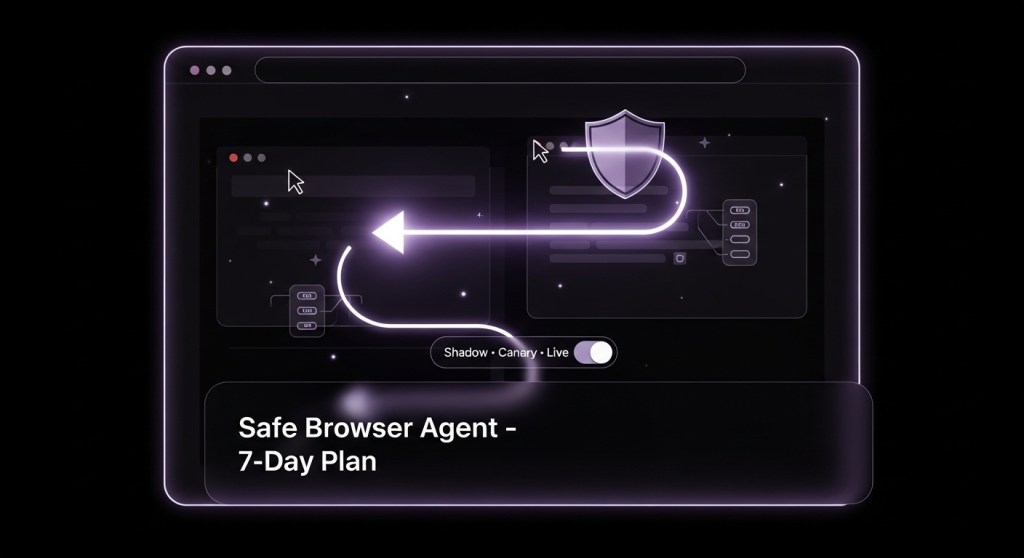
Who this is for: startup founders, e‑commerce ops leaders, product/AI teams shipping agentic automation fast but safely.
Today’s plan (quick checklist)
- Pick a browser‑capable agent stack (Antigravity, Mariner, Nova Act) and define a narrow use case.
- Run in shadow mode with strict network/domain and action allow‑lists.
- Add an “agent firewall”: prompt‑injection filters, OPA policies, and human approvals for risky steps.
- Instrument OpenTelemetry tracing + evals; set measurable SLOs and cost caps.
- Promote with canaries and a kill‑switch; monitor live KPIs and rollback paths.
Why browser agents, and why now?
Vendors are shipping agent‑first tools that can read and act inside your browser or a headless session: Google’s Antigravity built on Gemini 3, Google’s web agent Project Mariner, and Amazon’s Nova Act. These promise faster task automation (research, form fills, reconciliations) and unlock high‑ROI workflows that APIs alone can’t cover. See Antigravity’s agent‑oriented IDE approach, Google’s Mariner rollout, and Nova Act’s browser control research preview for context. Antigravity, Project Mariner, Nova Act.
But browser agents also widen the attack surface: indirect prompt injections embedded in pages, delayed tool invocation, and unsafe actions on sensitive sites. Researchers have shown how calendar or document text can coerce an agent into executing unintended actions. Evidence and examples.
The 7‑Day Shipping Plan
Day 1 — Choose your stack and carve a small win
- Pick one: Antigravity (Gemini 3 IDE + multi‑agent orchestration), Google Project Mariner (web browsing agent), or Amazon Nova Act (browser‑control agent, SDK). Links above.
- Use case: start with a read‑only e‑commerce task: competitor price check, shipping‑policy diffs, or product content QA.
- Interop: map where A2A (agents talking to agents) or MCP servers will broker tool access later. Microsoft and Google are aligning on A2A‑style standards—plan for it now. Background.
Day 2 — Run in shadow mode with strict sandboxes
- Launch your agent in shadow (no customer‑visible actions). Whitelist domains, block third‑party trackers, disable downloads, and use non‑privileged accounts.
- Force read‑only until evals pass. Explicitly block forms, payments, cart edits, and account settings.
- Log all DOM reads, link clicks, and navigation events for later replay.
- Helpful: our guide to shadow, canary, and kill switches.
Day 3 — Add an agent firewall (policies + approvals)
- Prompt‑injection defenses: strip hidden text, block off‑domain instructions, and require a policy check before executing any action sourced from page content. See known risks here.
- OPA policy gates: Author policies like: “Only POST to domains on allow‑list,” “Never submit forms with fields matching payment or PII regex,” “Require human approval for actions labeled High‑Risk.”
- Human‑in‑the‑loop: add approvals inside Slack/Chat where the agent presents a structured diff: URL, action, DOM selector, captured fields, and redacted preview.
- Deep dive: Ship an Agent Firewall.
Day 4 — Instrument tracing and set SLOs
- Add OpenTelemetry spans for every browse, parse, and action step; tag with URL, selector, latency, retries, and approval outcome.
- Define SLOs: Task Success Rate ≥ 95% on shadow scripts; False‑Action Rate ≤ 0.5%; P95 latency by page type; Cost per successful task.
- Reference: Agent Reliability Lab.
Day 5 — Build evals that mimic the messy web
- Create a fixture set of 50–100 pages representing CAPTCHAs, pop‑ups, consent banners, infinite scroll, A/B variants, and paywalls.
- Automate checks: expected DOM nodes present, correct price parsed, correct currency, and no sensitive forms submitted.
- Fail the build if new prompts or tools regress the eval score by more than 1–2 points. OpenAI’s AgentKit includes eval building blocks you can adapt. AgentKit.
Day 6 — Canary, budget caps, and rollback
- Promote to a canary cohort (e.g., 5% of internal tasks or low‑risk domains). Enforce real‑time budget caps per agent via token/step/URL limits.
- Ensure one‑click rollback and an emergency kill switch wired to your ops channel.
- Related playbook: Agent CI/CD in 7 Days.
Day 7 — Go live with controlled writes
- Enable write actions for a single, preapproved workflow (e.g., update out‑of‑stock badges) with human approval on first N=50 executions.
- Publish dashboards: task success, approval rate, blocked actions by policy, cost per task. Review weekly and tighten policies.
- Watch spend: follow our cost‑control playbook.
Architecture: a minimal, safe browser‑agent stack
- Agent runtime: Antigravity, Mariner, or Nova Act SDK.
- Policy layer: OPA (deny‑by‑default) + URL/selector allow‑lists + secrets vault.
- Interop: MCP servers for tool access; A2A gateway for chaining with CRM/IT agents (aligns with industry movement toward shared agent protocols).
- Observability: OpenTelemetry + central trace store; redact PII at the edge.
- CI/CD: prompt/versioning, eval gates, canary deploys, kill switch.
Security patterns that actually work
- Off‑domain instruction blocking: Reject any page‑sourced instruction to visit or submit to an unapproved domain.
- Selector whitelists: Only act on DOM nodes matching vetted selectors (e.g.,
.add-to-carton known templates). - Sensitive‑field redaction: Never pass values for fields matching payment/SSN/credential regex; require human approval if detected.
- Delayed‑action review: Queue writes; a human reviews diffs before commit. This thwarts delayed tool‑invocation tricks described by researchers.
- Session scoping: Rotate ephemeral identities; tie cookies and tokens to one task; auto‑purge on error or timeout.
Three fast, ROI‑positive use cases
- Price and promo monitors: crawl competitor PDPs daily, extract prices and promo banners, alert via Slack. Start read‑only; later, update your catalog labels via an MCP connector.
- Returns policy QA: detect changes in refund windows and shipping thresholds; open tickets with proposed policy tweaks.
- Product content QA: flag missing alt text, broken links, and size‑chart discrepancies; submit PRs to your CMS.
If you run Salesforce, note the enterprise push toward agentic platforms like Agentforce 360 that coordinate agents across sales, service, and Slack—useful when your browser agent must hand off to CRM workflows. Context.
What about SEO and content agents?
Pair a browser agent (for live‑web research, SERP parsing, fact checks) with an always‑on content agent for drafting and publishing. See our SEO agent 7‑day playbook to wire both safely.
Buyer’s notes
- Antigravity + Gemini 3: strong multi‑agent orchestration; developer‑friendly IDE; pair with strict policies.
- Project Mariner: closer to Google’s ecosystem and Vertex; good for teams already on Gemini and AI Pro tiers.
- Nova Act: flexible SDK and headless workflows; still maturing—keep canaries tight.
Wrap‑up and next steps
Browser agents can unlock high‑ROI automation fast—if you ship them with guardrails. Use shadow runs, an agent firewall, evals, tracing, canaries, and cost caps. Align with MCP/A2A so your browser agent can hand off safely to CRM, IT, and finance automations as you scale.
Want help? Subscribe for weekly playbooks, or talk to us about a 14‑day pilot to stand up a safe browser agent for your team.


Leave a Reply