Editorial plan checklist
- Scan the latest vendor moves (Microsoft Agent 365; Google Gemini 3 + Antigravity; Salesforce Agentforce 360; OpenAI AgentKit).
- Define what an AI agent control plane is and why it matters now.
- Ship a pragmatic 7‑day build plan using MCP + OpenTelemetry.
- Map vendor integrations and risk controls.
- Share KPIs, dashboards, and cost/safety guardrails.
AI Agent Control Plane for 2026: Unify Agent 365, Antigravity/Gemini 3, Agentforce 360, and AgentKit with MCP + OpenTelemetry
The week of November 18, 2025 made one thing clear: enterprise AI is moving from chat to agents. Microsoft introduced Agent 365 to manage fleets of bots; Google launched Gemini 3 and unveiled Antigravity—an agent‑first dev environment; Salesforce expanded Agentforce 360; OpenAI’s AgentKit targets production agent workflows; and Amazon’s Nova Act continues the browser‑agent push. If you operate a SaaS or e‑commerce business, you now need a vendor‑neutral way to onboard, govern, observe, and optimize agents across these stacks.
This article gives you a practical blueprint for an AI agent control plane you can start in a week, built on two open pillars: MCP (Model Context Protocol) for interop and OpenTelemetry for observability. We also link to ready‑to‑ship components from our recent guides so you can move fast, safely.
What is an agent control plane?
An agent control plane is the layer that sits above vendor platforms and standardizes how you:
- Register and identify agents, capabilities, tools, secrets, and owners.
- Enforce policy (permissions, human approvals, risk tiers, budget caps, kill switches).
- Observe and evaluate behavior (traces, metrics, logs, evals) with explainability hooks.
- Interoperate across vendors via connectors and protocol standards.
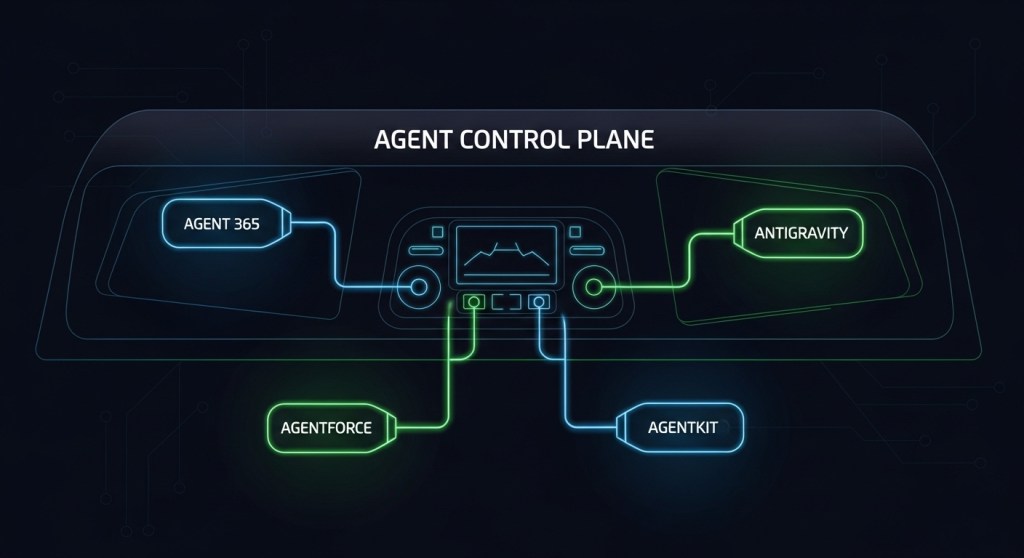
Think of it as Kubernetes‑style control for agents: consistent governance and telemetry regardless of whether the runtime is Agent 365, Antigravity/Gemini, Agentforce, or AgentKit.
Why now
- Microsoft Agent 365 adds a native registry, access controls, and security oversight for enterprise bots (announced Nov 18, 2025). Reuters · WIRED
- Google Gemini 3 and Antigravity bring deeper reasoning and an agent‑first IDE (Nov 18, 2025). Google · Gemini app
- Salesforce Agentforce 360 ships an enterprise agent suite and builder (Oct 13, 2025). TechCrunch
- OpenAI AgentKit focuses on productionizing agent workflows (Oct 6, 2025). TechCrunch
- Amazon Nova Act extends browser automation capabilities (Mar 31, 2025). TechCrunch
The reference architecture (5 layers)
- Identity & Registry — Central registry of agents, owners, scopes, allowed tools, and secrets. Start with our template: Agent Registry.
- Policy & Approvals — OPA policies, role‑based permissions, risk tiers, human‑in‑the‑loop for sensitive actions. See: Agent Firewall.
- Interop & Connectors — Use MCP servers/clients to connect CRMs, ERPs, and internal tools once, then reuse across platforms. Explore the MCP GitHub org.
- Observability & Evals — Standardize traces/metrics with OpenTelemetry’s generative‑AI semantic conventions and add eBPF where helpful. Docs: OTel Gen‑AI semconv and OTel eBPF. Pair with our Agent Reliability Lab.
- Runtime & Safety Controls — CI/CD for agents, canaries, shadow tests, and kill switches. Use: Agent CI/CD.
Your 7‑day build plan
- Day 1 — Stand up the Registry: Create agent IDs, owners, purposes, tool lists, and secrets. Export a public subset for Agent 365 and internal UIs. Guide.
- Day 2 — Enforce Policy: Add an agent firewall with allow‑listed tools, scoped credentials, user approval steps, and rate/budget caps. Guide.
- Day 3 — Wire Interop via MCP: Connect CRMs, ticketing, storefronts, and data sources once using MCP servers. This lets Agent 365, Antigravity projects, Agentforce bots, and AgentKit workflows reuse the same connectors.
- Day 4 — Add Observability: Emit OpenTelemetry spans with Gen‑AI attributes (model, input/output tokens, tool calls, latency, errors). Capture traces end‑to‑end, then add evals for critical tasks. Guide.
- Day 5 — Ship CI/CD & Safeguards: Shadow new agents, run canaries, require approvals for new tools/permissions, and wire kill‑switches. Guide.
- Day 6 — Pilot Browser Automations: Start with a contained task like warranty claims or invoice reconciliation using Nova Act/Mariner‑style agents. Use our safe browser‑agent playbook.
- Day 7 — Optimize Cost & SLOs: Route by task difficulty, shrink prompts, cache aggressively, and set SLOs/Budgets per agent. Cost playbook.
Vendor integration notes
- Microsoft Agent 365: Use it to inventory agents, apply policies, and quarantine risky ones. It’s positioned to manage third‑party bots too. Reuters, WIRED.
- Google Antigravity + Gemini 3: Antigravity elevates agents to a first‑class surface in an IDE; Gemini 3 adds stronger reasoning/agentic capabilities. Google, Project Mariner.
- Salesforce Agentforce 360: Enterprise agent suite with an agent builder and Slack integration. TechCrunch.
- OpenAI AgentKit: A toolkit to build, evaluate, and deploy agents with a connector registry. TechCrunch.
- Amazon Nova Act: A browser‑control agent and SDK—useful for tasks not covered by APIs. TechCrunch.
Key design choices (quick ADRs)
- Interop: Prefer MCP to reduce N×M integrations; maintain a private MCP server catalog for internal systems. GitHub org.
- Observability: Adopt OpenTelemetry Gen‑AI semconv; tag spans with model, temperature, tool calls, retries, cost, and risk tier. Consider eBPF‑based collection for cross‑runtime visibility.
- Risk: Map agent actions to human approvals (e.g., refund >$200 requires confirmation). Contain browser agents in sandboxed profiles and time‑boxed sessions.
E‑commerce quick wins (ship in 48 hours)
- Proactive BFCM recovery: Auto‑email customers with abandoned carts + inventory changes; escalate to a human if the agent detects frustration. Use the BFCM automations.
- RMA triage: Parse tickets, generate labels, update ERP, and notify customers; require approval on high‑value orders.
- Vendor follow‑ups: Agents compile late‑shipment lists and send standardized nudges, with human review on escalations.
KPIs and dashboards
- Reliability: Task success rate, rollback count, MTTR for failed actions, eval pass rate.
- Cost: Cost per successful task, token per tool call, cache hit rate, model mix.
- Risk: % actions requiring human approval, blocked policy events, injection/escape attempts.
Use our Reliability Lab and Cost Playbook to stand up dashboards fast.
Bottom line
The platform race is on, but you don’t have to pick a winner. Build a thin, strong control plane on MCP + OpenTelemetry and plug in Agent 365, Antigravity/Gemini, Agentforce, and AgentKit as they mature. You’ll get portability, safety, and clean KPIs—without vendor lock‑in.
Next steps
- Clone our registry/policy templates and connect first MCP servers.
- Instrument with OTel Gen‑AI spans and enable sandboxed browser runs.
- Pilot one production task with approvals and hard budget caps.
Need help? Subscribe for weekly playbooks—or book a 30‑minute session with HireNinja to review your agent control plane.


Leave a Reply