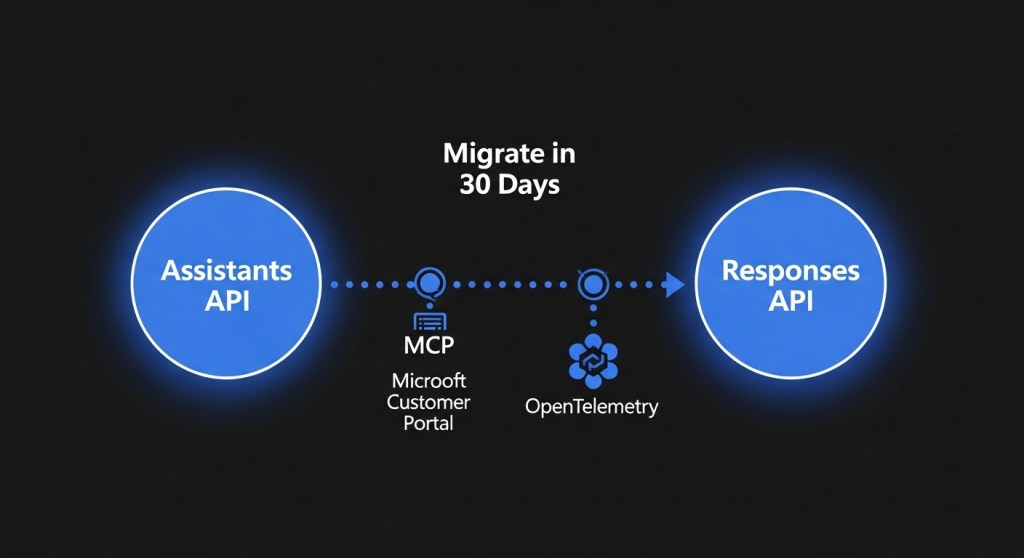
Migrate from OpenAI Assistants API to the Responses API in 30 Days (MCP + Agents SDK + OpenTelemetry)
OpenAI has deprecated the Assistants API and will sunset it on August 26, 2026. If your product or internal automations still rely on Assistants objects, this 30‑day plan helps you move to the Responses API, add MCP for tool interop, and wire up OpenTelemetry for cost, reliability, and compliance—without vendor lock‑in. Official migration guide; Assistants deprecation details.
What’s changing—and why you should move now
- Assistants → Prompts: Configuration (model, tools, instructions) becomes versioned prompts you manage in the dashboard.
- Threads → Conversations: Streams of items instead of just messages—cleaner for long‑running agent loops.
- Runs → Responses: A simpler, agentic loop with first‑party tools (web/file search, computer use) and remote MCP servers. See OpenAI’s overview of Responses API + Agents SDK and TechCrunch’s timeline coverage here.
At the same time, enterprise agent management is arriving fast—see Microsoft’s Agent 365—and agent‑first dev tools like Google’s Antigravity IDE are normalizing multi‑agent, tool‑using workflows. Migrating now lets you standardize on MCP and add observability before agent sprawl hits.
Who this is for
- Startup founders & product leads shipping agentic features or internal tooling.
- E‑commerce operators automating support, catalog ops, or merchandising across Shopify/Woo/Marketplace APIs.
- Engineering/platform teams consolidating on Responses + MCP with guardrails and telemetry.
The 30‑Day Migration Plan
Days 1–7: Inventory, risk map, and quick wins
- Inventory Assistants: List Assistant IDs, tools, models, retrieval patterns, and where Threads persist (DB, S3, etc.). Map each to a target Prompt and Conversation.
- Create Prompts: In the OpenAI dashboard, convert key Assistants into Prompts for versioning and A/B rollout. See OpenAI’s Assistants → Prompts mapping.
- Stand up a staging environment with Responses SDKs (TS/Python) and a non‑prod OpenTelemetry collector. Use OTel’s GenAI conventions to capture tokens, latency, errors, and tool calls. Reference: OTel for GenAI.
- Pick one business flow to migrate first (e.g., support triage or catalog enrichment) to build momentum and templates.
Days 8–14: Move from Threads → Conversations; Runs → Responses
- Swap endpoints: Replace chat/Assistants calls with
/v1/responsesandConversations. Keep inputs identical initially to isolate API deltas. See migration guide. - Tooling parity: Re‑declare functions/tools under Responses; test built‑in tools (file/web search, computer use) where applicable.
- Add MCP for interop: Expose internal systems (e.g., product DB, order API) as MCP servers and allow the Responses API to call them via the Agents SDK. Start with HTTP/SSE transport; graduate to hosted MCP tools later. Docs: Agents SDK + MCP.
- E‑commerce example: An MCP server offers tools like
get_product(id),update_inventory(sku, qty),refund_order(id). Your agent can now resolve a support ticket or fix a catalog issue end‑to‑end—verifiably and traceably.
Days 15–21: Observability, SLOs, and spend control
- Trace every call: Emit spans for model calls and tool invocations with attributes for model, tokens, cost, cache hits, user/org, and path outcome (success, fallback, human‑handoff). Use OTel processors to derive cost and per‑workflow SLOs. Reference: OTel GenAI.
- Define SLOs: e.g., Path success ≥ 95% for “refund request” flow; Median latency ≤ 3s; Cost ≤ $0.08 per resolved ticket. Feed failures to a dead‑letter queue for red‑teaming.
- FinOps dashboard: Break down spend by model, tool, team, and workflow. For practices, see our guide Agent FinOps for 2026.
Days 22–30: Certify, govern, and roll out
- Evals + red‑team: Run task‑level evals and adversarial tests before production. Follow our Red‑Teaming Playbook and Reliability Engineering Playbook.
- Permissions + registry: Register each agent, define scopes, and enforce least‑privilege keys and secrets rotation. See our Agent Registry and Security Baseline.
- Gradual rollout: Ship to a pilot cohort; monitor path success, handoff rates, latency, and cost/issue. Keep a one‑click revert to the Assistant‑backed path during the pilot.
FAQ: Practical gotchas we see in migrations
1) Do we have to move all Threads? No. OpenAI recommends migrating new chats to Conversations and backfilling only when needed. See the official guidance.
2) Is Assistants API truly going away? Yes—OpenAI marks it deprecated and sets the sunset for Aug 26, 2026 in docs. Press reports vary by phrasing (e.g., “H1 2026” or “second half of 2026”), but use the official date to plan. Sources: OpenAI Docs, TechCrunch, Reuters.
3) Why add MCP now? MCP is fast becoming the way agents talk to tools across vendors. Adding it during migration avoids re‑plumbing later. See the Agents SDK MCP guide. Microsoft and others are aligning on interop standards as agent fleets grow. Coverage: Wired on Agent 365.
4) How do we prove ROI? Treat each agentic flow like a product feature: define path success, cost per outcome, and time saved. We walk through this in Agent FinOps and our Agentic SEO experiments.
Templates you can copy
- Support desk (WhatsApp/Email/Shopify): Start from our 30‑day build guide here; swap Assistants for Responses; expose commerce ops via MCP tools; monitor resolved_without_handoff as your north‑star.
- Agent platform rollouts: If you’re evaluating vendor suites, use our RFP & Scorecard to keep MCP + Telemetry requirements front and center.
What good looks like after Day 30
- All new chats on Conversations + Responses; prompts versioned and owned by product.
- MCP‑based tool calls for key workflows—portable across vendors.
- OpenTelemetry dashboards for path success, latency, cost, and handoff rate.
- Red‑teaming + reliability gates in CI; registry + least‑privilege access in place.
Call to action: Need hands‑on help? Book a 45‑minute Responses API migration workshop with our team. We’ll review your Assistants inventory, draft your MCP plan, and set up OTel dashboards you can reuse across every agent. Subscribe for new playbooks.


Leave a Reply