Agentic Checkout: An AP2‑Ready Playbook for E‑Commerce Teams
Published: December 3, 2025
Quick checklist (what you’ll get)
- What “agentic checkout” is and why it matters now
- How Google’s AP2 (Agent Payments Protocol) works in plain English
- An AP2‑ready reference architecture for e‑commerce
- A 14‑day pilot plan for Shopify/WooCommerce teams
- Metrics, guardrails, and cost controls with links to deeper playbooks
Why this matters now
Agent platforms are shipping fast. AWS previewed new frontier agents and expanded AgentCore controls at re:Invent on December 2, 2025, signaling a push toward enterprise‑grade autonomy and policy‑based boundaries for agents. Source, Source. Microsoft is positioning Agent 365 as an admin hub for your growing bot workforce. Source. And Google introduced the Agent Payments Protocol (AP2) so agents can pay on a user’s behalf with cryptographic authorization. Source, Source.
Analysts expect agentic shopping to be a major new channel: Morgan Stanley projects AI shopping agents could add ~$115B to U.S. e‑commerce by 2030. Source.
Agentic commerce and AP2 in plain English
Agentic commerce means AI agents (your customer’s assistant—or your brand’s agent) can discover products, negotiate options, and complete purchases. To do this safely across many platforms, Google proposed AP2, an open protocol that standardizes how agents authorize and execute payments.
Key AP2 concepts
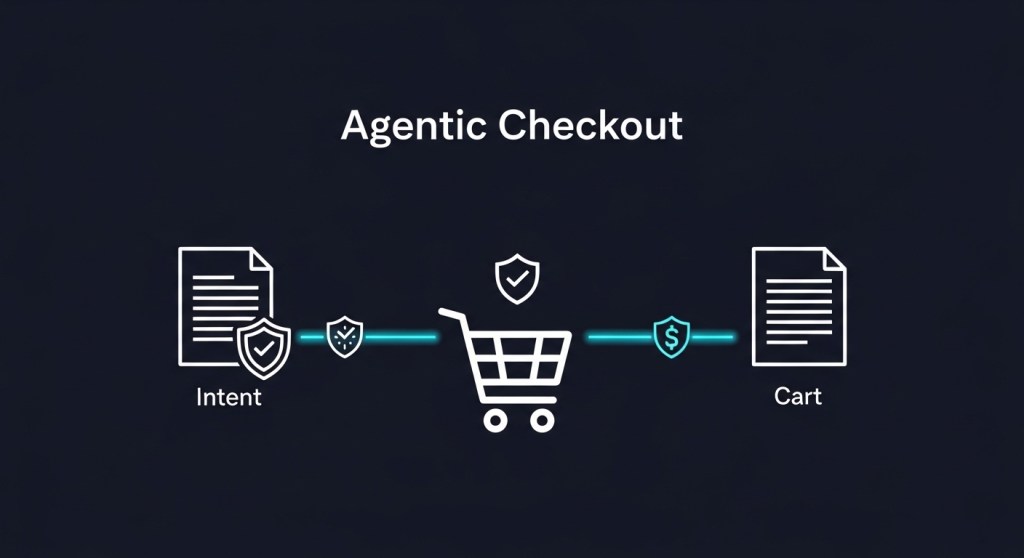
- Mandates: cryptographically signed instructions that prove the user authorized the agent (think: a tamper‑proof permission note). AP2 uses at least two: an Intent Mandate (e.g., “Find me a carry‑on under $200”) and a Cart Mandate (final approval for specific items and price).
- Verifiable Credentials: the digital IDs used to sign mandates and link payment methods.
- Interoperability: AP2 is designed to work alongside MCP (Model Context Protocol) for tool access and A2A (Agent‑to‑Agent) for agent collaboration, so a buyer’s agent can safely talk to a merchant’s agent. A2A overview, MCP in Windows.
AP2‑ready reference architecture for e‑commerce
If you run Shopify, WooCommerce, or a custom storefront, here’s a minimal, vendor‑agnostic architecture to prepare for agentic checkout while preserving safety and observability:
- Agent Gateway (ingress): Accept requests from buyer agents via a standard endpoint. Validate schema, auth, and rate limits. For AWS shops, align gateway policy with AgentCore Policy to enforce written guardrails on actions. Source.
- Catalog & Pricing APIs: Serve structured product data that agents can reliably parse (consistent IDs, stock, variants, taxes, shipping windows).
- Cart Service: Build idempotent cart endpoints that can create, update, and sign a Cart Mandate request with the exact item list, price, taxes, and ship date.
- AP2 Mandate Service: Verify Intent and Cart mandates, link to a payment token, and maintain a non‑repudiable audit trail (hash + timestamp + VC issuer).
- Fraud/Abuse Layer: Velocity limits, anomaly detection, BIN rules, disposable email clamp, and sandbox SKUs to prevent agent “cart bombing.”
- Telemetry: Emit traces and events for every step (intent → cart → payment) with OpenTelemetry so you can investigate failures and measure lift. See our agent reliability playbook.
- Agent Registry & Access: Track which internal agents can act (and how), plus inbound partner agents. Map permissions to “least privilege.” See our guide to stopping agent sprawl.
- FinOps: Tag agent traffic, meter cost, and set budgets/chargebacks so autonomy doesn’t blow up COGS. See Agent FinOps for 2026.
- Security & Browsing Guardrails: Apply a 12‑control baseline to mitigate prompt injection/data exfiltration when agents browse your store. See our browsing security baseline and 30‑day security baseline.
The 14‑day AP2 pilot (Shopify/WooCommerce)
Goal: Safely simulate agentic checkout and measure real lift without risking production.
Days 1–3: Define scope and controls
- Pick 10–20 SKUs with clean metadata and clear inventory rules.
- Open a Sandbox Storefront domain with sample payment methods.
- Write guardrails: max quantity per order, price caps, shipping windows, geofencing, refund policy, and allow‑list of agent user‑agents/IPs.
Days 4–6: Stand up agent endpoints
- Expose a read‑only Catalog API (IDs, variants, stock, price, tax class, ship SLA).
- Implement Cart API with idempotency keys and a signature of line items + totals.
- Create a minimal AP2 Mandate Service: accept Intent Mandate → return nonce; accept Cart Mandate → verify hash + bind to a tokenized payment method.
Days 7–9: Integrate policy + observability
- Add policy enforcement at the gateway (block items/addresses that violate rules). If you’re on AWS, mirror AgentCore Policy patterns so human‑readable rules stop disallowed actions. Reference.
- Emit OpenTelemetry spans for intent, cart, mandate verification, payment auth, and order creation.
- Spin up a simple Agent Registry listing inbound agents and permissions. See our registry blueprint.
Days 10–12: Run agent scenarios
- Buyer agent places a constrained order (e.g., “Find two carry‑ons under $200; deliver by Friday”). Verify Intent → Cart → Payment path.
- Merchant agent offers a bundle/upsell within the rules. Ensure the Cart Mandate reflects final price and terms.
- Inject edge cases: stock out mid‑flow, price change, shipping delay. Confirm mandate invalidation and cart recompute.
- Test browsing defenses against prompt‑injection bait pages. Use our 12‑control baseline.
Days 13–14: Decide go/no‑go + next steps
- Review metrics (below). If lift/risk trade‑off is favorable, plan a limited production experiment behind a feature flag and allow‑listed agents.
- Document the chargeback playbook: how to reconcile disputes using mandate audit trails.
- Align with finance on budgets and chargebacks per agent. See Agent FinOps.
Metrics that prove ROI
- Agentic conversion rate: orders with valid Cart Mandates / agent carts.
- Average order value uplift: agentic vs. baseline cohort.
- Time‑to‑purchase: first intent → order creation.
- Mandate failure rate: cryptographic mismatch, expired, revoked.
- Fraud/chargeback rate: by agent and by mandate issuer.
- Operational cost per agent order: model + infra cost; meter with OpenTelemetry tags.
Need a full metrics plan? See our upcoming e‑commerce ROI playbook draft: 30‑Day Agent ROI for E‑Commerce.
Risk and compliance: what to put in your runbook
- Identity & permissions: maintain per‑agent identities and least‑privilege permissions. Start with our 30‑day baseline.
- Auditability: store mandate hashes, VC issuers, and immutable order logs for dispute resolution.
- Prompt‑injection defenses: sanitize browsing, block untrusted tool calls, and enforce out‑of‑band confirmations for high‑risk actions. See our 12‑control baseline.
- Vendor neutrality: design to AP2/MCP/A2A so you can work with AWS, OpenAI, or Microsoft stacks as they evolve. Microsoft’s Agent 365 and industry A2A adoption underline the need for a registry and governance layer from day one. Source, Source.
What about platforms and frameworks?
Whether you build on AWS Frontier Agents, OpenAI’s Responses/Agents SDK, or Google’s agent tools, AP2‑style mandates and a clean telemetry path will be table stakes. If you’re migrating off legacy agent stacks, see our guide to moving to the Responses API with MCP.
Bottom line
Agentic checkout is moving from demo to design pattern. Teams that ship an AP2‑ready pilot now will win new demand, reduce friction for repeat purchases, and arrive at 2026 with guardrails already in place.
Need help? HireNinja can run a 2‑week AP2 readiness sprint—architecture, sandbox endpoints, telemetry, and a safe experiment plan.


Leave a Reply