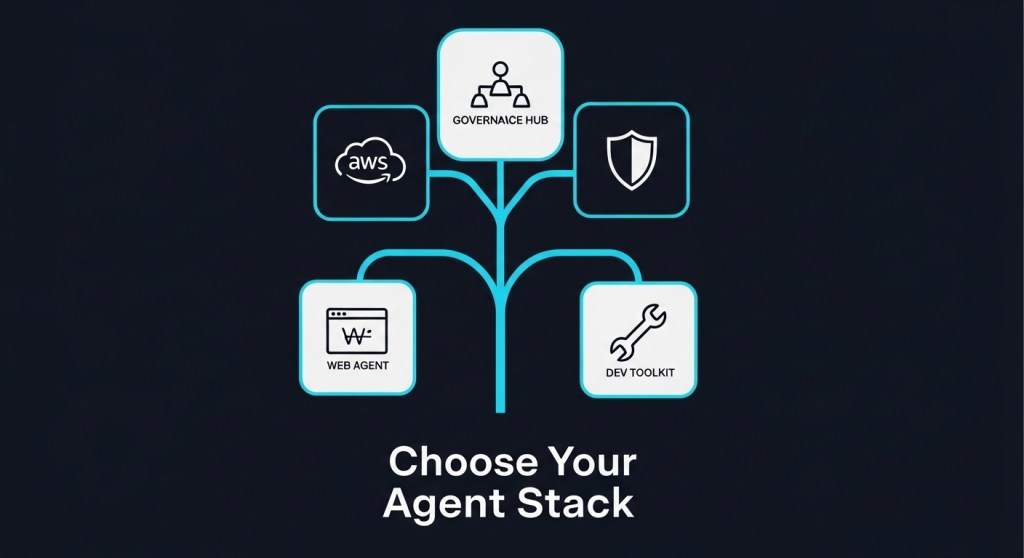
Quick summary: Enterprise agent platforms just leapt forward. AWS previewed new frontier agents and Policy guardrails in AgentCore, Microsoft introduced Agent 365 to govern fleets of agents, and OpenAI and Google continue to push agent toolkits and browser agents. This guide compares the stacks you’ll see in 2026—and gives you a vendor‑agnostic, 14‑day pilot you can run now.
What changed this week (and why it matters)
- AWS frontier agents: AWS previewed three agents—including Kiro, a coding agent designed to operate for days—and expanded AgentCore with Policy, memory, and evals to bound agent behavior. TechCrunch, TechCrunch.
- Desktop OS agents: Simular launched a Mac agent (Windows coming) that literally moves the mouse to automate PC workflows—useful for legacy tools and back‑office tasks. TechCrunch.
- Microsoft Agent 365: A governance hub for your “bot workforce” with registry, usage, and security controls—treating agents like digital employees. Wired.
- Interoperability: Microsoft adopted Google’s A2A protocol for cross‑agent communication—momentum toward multi‑vendor agents working together. TechCrunch.
- Developer toolkits: OpenAI’s AgentKit streamlines building, evaluating, and shipping agents on the Responses API. TechCrunch.
- Browser agents: Google’s Project Mariner and Anthropic’s Chrome agent extend agents into the browser for purchase flows and web tasks. TechCrunch, TechCrunch.
The decision guide: Which agent type fits your use case?
Different stacks shine in different jobs. Use this map to avoid over‑engineering and ship value fast.
1) API‑first enterprise agents (AWS Frontier Agents / AgentCore)
Best for: product engineering, DevOps, data‑heavy back‑office workflows where you can wire tools via APIs and need policy guardrails, memory, and evaluations.
Why now: AgentCore Policy lets you write natural‑language boundaries that are enforced at run‑time—great for compliance and least‑privilege operations. Source.
Watchouts: upfront integration work; requires observability to prevent prompt‑injection/data egress.
2) Governance hubs (Microsoft Agent 365, Workday Agent System of Record)
Best for: orgs expecting many agents across functions and vendors; need a registry, controls, and usage visibility.
Why now: Agent 365 treats agents like digital employees—registry, access, and protections—aligning with emerging cross‑agent standards like A2A. Wired, TechCrunch. Workday’s system offers a similar control center at the business‑app layer. TechCrunch.
Watchouts: not a build tool; you still choose where agents run (cloud, desktop, browser).
3) Developer toolkits (OpenAI AgentKit + Responses API)
Best for: startups shipping a product surface powered by agents (support, onboarding, data ops) with fast iteration and evals.
Why now: AgentKit bundles agent builder, evals, and connectors to move from prototype to production faster. Source.
Watchouts: plan migration paths and vendor‑agnostic interfaces; instrument traces early.
4) Browser agents (Google Mariner; Anthropic’s Chrome agent)
Best for: automating web tasks across partner sites (shopping, forms, research) when APIs aren’t available.
Why now: modern browser agents can navigate stores, carts, and checkout—with human oversight. Google Mariner, Anthropic.
Watchouts: highest prompt‑injection and data‑exfil risk—enforce browsing guardrails and monitoring.
5) Desktop OS agents (Simular and peers)
Best for: back‑office teams using desktop apps/legacy tools (accounting, shipping, catalog uploads) where you need RPA‑like actions without APIs.
Why now: agents can control mouse/keyboard to automate repetitive tasks at the workstation. Source.
Watchouts: policy and audit at the endpoint; session isolation; screen/credential hygiene.
Tie this to e‑commerce outcomes
- Returns/RMAs, payout reconciliation, catalog updates: Desktop or API‑first agents. See our Desktop AI Agents pilot.
- Agent‑assisted checkout and cart help: Browser agents + store‑side controls. Start with our AP2‑ready checkout playbook.
- Engineering productivity and DevOps: API‑first agents on AWS; evaluate with policy + observability. See our AWS pilot.
Governance first: required controls before scale
Agents create new risk surfaces. Bake these into your first sprint:
- Agent registry and access model: stop agent sprawl; assign owners, scopes, secrets, and SLAs. Blueprint.
- Browsing security baseline (12 controls): block prompt‑injection and exfiltration; enforce allow‑lists, stripping, and sandboxes. Guide.
- Reliability SLOs and traces: target 99% path success with MCP + OpenTelemetry. Playbook.
- Evaluation and red‑teaming: certify agents before production. Checklist.
- FinOps: meter, budget, and charge back with FOCUS + telemetry. Framework.
A 14‑day pilot that works in any stack
Pick one high‑value workflow (e.g., payout reconciliation or returns triage) and run this plan:
- Days 1–2: Define a single success metric (e.g., minutes saved per ticket, percent auto‑resolved). Capture a 7‑day baseline.
- Days 3–5: Stand up your agent environment: AWS AgentCore (Policy + Gateway), or OpenAI AgentKit project, or a browser/desktop agent. Instrument traces with OpenTelemetry; add guardrails from our browsing baseline.
- Days 6–8: Dry‑run on historical data. Create a three‑tier permission model: Read‑Only, Simulate, Execute‑with‑Approval.
- Days 9–10: Live shadow mode on 10–20% of traffic. Log denials/overrides for analysis.
- Days 11–12: Red‑team the workflow (jailbreaks, injection, tool abuse). Patch prompts/policies; re‑run tests.
- Days 13–14: Ship a limited execute‑with‑approval rollout. Report ROI with time‑savings, conversion, error rates, and unit economics; set SLOs for the next 30 days.
Quick picks by team profile
- Shopify/WooCommerce store (under 50 people): Desktop agent for back‑office ops + browser agent for on‑site assistance. Prepare checkout for agent hand‑offs with AP2 controls.
- SaaS startup: OpenAI AgentKit for product‑embedded agents; add an agent registry early to avoid sprawl. How‑to.
- Enterprise: Govern with Agent 365 or Workday as the system of record; run API‑first agents on AWS; enable A2A‑style interop for cross‑vendor workflows. Agent 365, Workday.
FAQ
Are browser agents safe enough for checkout? They can be—with allow‑listed domains, content scrubbing, action review, and strong session isolation. Use our 12‑control baseline.
What if we’re already on Microsoft 365? Use Agent 365 as the control plane and still run AWS or OpenAI‑based agents. A2A‑style interop reduces vendor lock‑in. Reference.
Do we need a registry if we only have two agents? Yes—ownership, secrets, and SLAs pay off immediately and prevent chaos later. Start small: one page, one owner, one scope. Guide.
Next up: If you want help choosing or piloting your stack, start with our 14‑day desktop agent pilot or our 7‑day AWS plan. Subscribe for new playbooks, or contact HireNinja to scope a pilot.


Leave a Reply