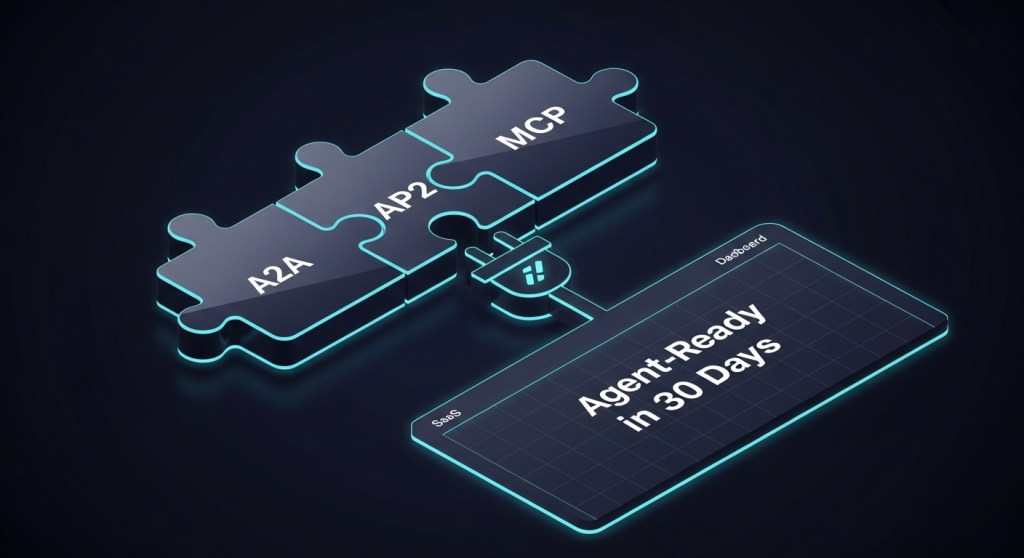
- Scan competitors and news to confirm what’s trending in agents (A2A, AP2, MCP, Agent 365, AWS frontier agents).
- Define “agent‑ready” for a SaaS: A2A discovery, AP2 payment safety, MCP tool access, plus governance.
- Pick a 30‑day scope and KPIs; ship a minimal A2A agent card and endpoints.
- Add AP2 mandates to make checkout agent‑safe; pilot on a sandbox route.
- Expose 1–2 MCP tools for secure, least‑privilege actions.
- Layer governance using Agent 365/AWS AgentCore; instrument with logs and review gates.
Ship an Agent‑Ready SaaS in 30 Days: A2A Agent Cards, AP2 Mandates, and MCP Tools
Why now: Enterprises and platforms are accelerating agent adoption. AWS just expanded AgentCore controls for building and monitoring agents; Microsoft launched Agent 365 as an admin hub; and Google’s Project Mariner is operationalizing browser agents. If your SaaS isn’t discoverable and safe for agents, you’ll be invisible in agentic workflows—or worse, a risk. citeturn0search4turn0news13turn5search3
What “agent‑ready” means (in plain English)
Agent‑ready SaaS exposes three thin interfaces:
- A2A Agent Card + minimal endpoints so any compliant agent can discover your capabilities and invoke tasks (think: a JSON “business card” and a few standard routes). citeturn2search0turn2search2
- AP2 payment mandates so agents can shop or pay safely on a user’s behalf using signed, non‑repudiable “mandates” (Cart, Intent, Payment). citeturn3search1turn3search0
- MCP tools to perform least‑privilege actions (e.g., “create invoice,” “cancel order”) from any MCP‑aware agent platform. citeturn7search0
These are complementaries: A2A gives interoperable coordination, AP2 gives payment safety and accountability, and MCP gives secure tool access. citeturn2academia13
30‑Day Plan (founder‑friendly)
Week 1 — Scope, KPIs, and your Agent Card
Pick a narrow journey (e.g., “create trial account,” “upgrade plan,” “refund an order”). Define KPIs: agent conversion, time‑to‑complete, error rate. Then publish an agent.json Agent Card at /.well-known/agent.json with 1–3 tasks. Example fields: name, auth, capabilities, and endpoint URLs. citeturn6search9
- Discovery: Your card lets A2A registries or other agents find and understand your SaaS capability surface. citeturn6search8
- Tip: Start read‑only operations first (quote/estimate), then add state‑changes with approvals.
Why this matters: A2A is becoming the lingua franca for cross‑vendor agent workflows, with support across big platforms. citeturn2search0turn2search3
Week 2 — Minimal A2A endpoints + guardrails
Implement three routes:
POST /a2a/tasksto accept a goal + inputs, return a task ID.GET /a2a/tasks/{id}for status/results.GET /.well-known/agent.jsonfor Agent Card discovery.
Controls: OAuth2 service principals, mTLS for partner agents, allow‑lists per tenant, rate limits, and explicit scopes in your Agent Card. If you’re on AWS, align with AgentCore’s new policy/guardrail features for “policy as boundaries.” citeturn0search4
Week 3 — Add AP2 mandates to make checkout agent‑safe
For e‑commerce or paid plans, implement AP2 on a sandbox checkout route:
- Cart Mandate for human‑present approvals (final basket + signature).
- Intent Mandate for human‑not‑present flows (user‑signed constraints like budget/SKU class + prompt playback of the user’s request).
- Payment Mandate to signal “AI agent present” and modality to networks/issuers for risk and dispute resolution. citeturn3search0turn3search1
Why now: The AP2 spec is converging around verifiable, signed mandates so merchants, networks, and issuers can trust agentic purchases. It’s designed to complement A2A. citeturn3search2
E‑commerce teams: pair this with our Agentic Checkout playbook.
Week 4 — Expose 1–2 MCP tools for least‑privilege actions
Stand up a small MCP server (e.g., TypeScript/Python) to expose scoped actions like create_refund or generate_invoice. MCP lets agent platforms call your tools consistently without brittle, one‑off integrations. citeturn7search0
Integration tip: Many agent stacks (including Mariner‑derived experiences) combine web use with tool calls; MCP keeps those actions explicit and auditable. citeturn5search3
Lightweight governance you can ship this month
- Registry + controls: If your org uses Microsoft, catalog your agents/tools in Agent 365 and enforce least‑privilege access by default. citeturn0news13
- AWS shops: Use AgentCore Policy to bound actions and instrument evaluations; run sensitive steps behind review gates. citeturn0search4
- Desktop flows: If you automate UIs (returns, reconciliation), borrow hardening patterns from our desktop agents guide and Google Mariner’s visible‑action approach. citeturn5search3
Success metrics and dashboards
Track: agent‑initiated conversions, approval latency (AP2), refund/chargeback deltas (post‑AP2), time‑to‑resolution for support tasks, and cost/task. For a ready‑to‑use metrics sprint, see our 30‑day ROI playbook.
Why this post is different (SERP gap)
Most coverage is either protocol‑level documentation (A2A/AP2/MCP) or news about agent platforms (AWS frontier agents, Agent 365, Mariner). Few connect all three interfaces into a single 30‑day, founder‑friendly implementation plan with governance steps you can adopt today. citeturn2search0turn3search0turn7search0turn0search4turn0news13turn5search4
Sample artifacts you can copy
Agent Card (minimal)
{
  "name": "Acme Billing Agent",
  "version": "0.1.0",
  "description": "Quotes, upgrades, refunds",
  "auth": {"type": "oauth2", "scopes": ["quote:read", "refund:create"]},
  "api": {"tasks": "/a2a/tasks", "status": "/a2a/tasks/{id}"},
  "capabilities": [{"name": "create_refund", "inputs": ["order_id", "amount"]}]
}
Reference: A2A Agent Card and JSON spec. citeturn6search9turn6search0
Where this fits in your stack
- Strategy: If you’re deciding among Frontier Agents, Agent 365, AgentKit, or Mariner‑style agents, use our 2026 Agent Stack guide. citeturn0search4
- E‑commerce: For back‑office automation (reconciliation, RMAs, catalog), see the 14‑day desktop agent pilot and AP2 checkout playbook.
- Security: Baseline your browsing/desktop agents using our 2026 security baseline and desktop hardening guide.
Risks to manage
- Prompt injection and tool abuse: prefer allow‑listed MCP tools with typed inputs; add policy gates for high‑risk actions. citeturn7search4
- Ambiguous liability on purchases: AP2’s signed mandates provide a clearer audit trail for disputes. citeturn3search0
- Operational sprawl: centralize registry, monitoring, and permissions in Agent 365 or AgentCore. citeturn0news13turn0search4
Call to action
Want help shipping this in 30 days? Start with our A2A + AP2 blueprint and book a 14‑day pilot with HireNinja to make your SaaS discoverable, payment‑safe, and tool‑ready for the agentic era.


Leave a Reply