Agent Registries Are Here: How to Build an AI Agent Control Plane for 2026
Long‑running, autonomous AI agents are moving from demos to production. The next urgent step isn’t another bot—it’s a registry and control plane to inventory agents, enforce policy, watch costs, and prove ROI.
Why this matters right now
In the last two weeks, the conversation shifted from building agents to governing them. Microsoft unveiled Agent 365, positioning it as a control plane that treats agents like digital employees with identity, access, and monitoring. citeturn1news12turn2search0turn2news16
At AWS re:Invent, Amazon added Policy, Evaluations, and enhanced Memory to its AgentCore platform—clear signals that enterprise deployments will hinge on guardrails, telemetry, and lifecycle controls for long‑running agents. citeturn2search1
Press coverage also highlighted frontier agents capable of working for hours or days, which makes centralized governance non‑negotiable for 2026 rollouts. citeturn1search2turn0news14turn0news12
What is an agent registry and control plane?
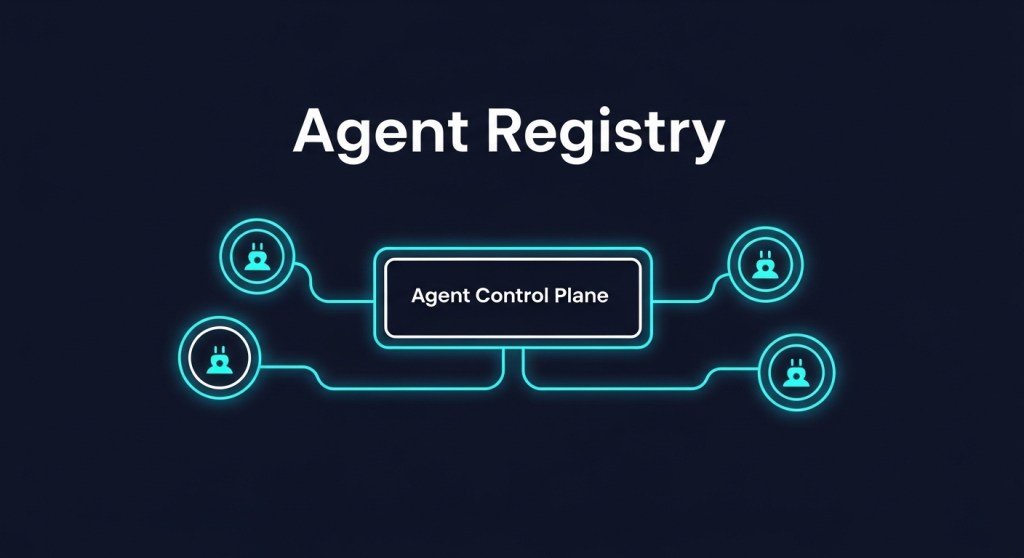
An agent registry is a system of record for all agents in your company—first‑party, vendor, and even shadow agents. A control plane layers policy, identity, evaluation, and telemetry so you can enable useful autonomy without losing oversight.
Concretely, your control plane should provide:
- Inventory & discovery: Find every agent, owner, purpose, capabilities, and connected tools.
- Identity & permissions: Issue nonhuman identities, rotate secrets, and constrain scope (RBAC/ABAC).
- Policy enforcement: Gate risky actions (payments, PII access, code deploys) with human‑in‑the‑loop thresholds.
- Evaluations & QA: Pre‑deployment scenario tests and runtime scoring for correctness, tool use, and safety.
- Memory lifecycle: Govern what agents remember, how long, and where memories live (and are scrubbed).
- Telemetry & audit: Centralize traces, artifacts, and decisions for root‑cause analysis and compliance.
- Cost controls: Budgets, rate limits, and model/tool routing to avoid runaway spend.
This mirrors patterns emerging in commercial launches and research frameworks for governing agentic systems. citeturn2search0turn2search1turn2academia12turn2academia15
Build vs. buy: Agent 365, AWS AgentCore, or roll your own?
Option A — Microsoft Agent 365: A management layer that inventories agents (including those with Entra Agent IDs), applies guardrails, and surfaces operational telemetry within Microsoft 365/Teams workflows. If you already standardize on Microsoft identity and productivity stacks, this gives you a fast start. citeturn2search0turn1news12
Option B — AWS AgentCore: If your agents run on AWS, AgentCore’s Policy (action gating via natural‑language rules), Evaluations (13 built‑in evaluators + custom scoring), and Memory (episodic retention) reduce time to production while preserving oversight. citeturn2search1
Option C — Open source / hybrid: Some teams prototype with emerging registries and artifact hubs to track agents, MCP servers, and skills, then wire policy and telemetry via their existing IAM/SIEM stack. This path trades convenience for portability and cost control. citeturn2search2
The control plane blueprint (reference architecture)
- Identity & access: Treat every agent as a first‑class nonhuman identity. Issue credentials, enforce least privilege, and segregate duties for tool access (e.g., finance vs. content). citeturn2news17
- Policy engine: Use allow/deny lists and threshold rules (e.g., auto‑refunds ≤ $100; approvals > $100) with signed policy changes and change‑management logs. citeturn1search0
- Evaluation pipeline: Maintain pre‑deployment scenario banks and runtime probes; fail‑closed on critical violations; publish dashboards. citeturn2search1
- Memory governance: Define retention, redaction, and residency. Allow teams to purge or export an agent’s memory as part of offboarding. citeturn2search1
- Observability: Emit structured traces/metrics/logs for plan→act→observe loops; tag high‑risk actions and attach artifacts/screenshots for audits.
- Incident response: Create playbooks for prompt injection, objective drift, and tool abuse; enable kill‑switches and quarantine. citeturn2news18
- FinOps guardrails: Enforce per‑agent budgets, model routing, and caching; alert on spend anomalies and retry storms.
A 14‑day rollout plan (minimal viable governance)
Week 1: Inventory, identity, and baseline policy
- Day 1–2: Inventory agents across teams and vendors. Record owners, purposes, tools, data scopes, and environments (prod/stage/dev).
- Day 3–4: Issue nonhuman identities; rotate secrets; set least‑privilege scopes for each agent’s tool chain.
- Day 5: Stand up a policy engine with 5 high‑impact controls: payments threshold, PII access, code deploy, data export, and external posting.
- Day 6–7: Pick 10 representative scenarios and wire an evaluation pipeline; publish a dashboard for leadership.
Week 2: Memory, telemetry, and runbooks
- Day 8: Define memory retention and redaction; enforce region‑based storage where required.
- Day 9: Enable distributed tracing for agent loops and attach artifacts to risky actions.
- Day 10–11: Create incident runbooks for injection, drift, and escalation; test kill‑switches.
- Day 12: Add cost budgets and alerts; test model/tool routing under load.
- Day 13: Soft‑launch with one back‑office workflow (refunds, reconciliation, catalog updates).
- Day 14: Review metrics and ship v1 governance report to leadership; expand scope.
Need inspiration? See our 7‑day AWS pilot, desktop agent hardening, and agent browsing security baseline for ready‑to‑use checklists. AWS Frontier Agents: A 7‑Day Pilot, Desktop AI Agents: Hardening Blueprint, Agent Browsing Security Baseline.
KPIs and acceptance criteria
- Policy coverage: % of agents governed by the top 5 controls; target ≥ 90%.
- Evaluation pass‑rate: Scenario pass‑rate at P95; target ≥ 95% before expanding scope.
- Time‑to‑detect: Median minutes from risky action to alert; target < 2 minutes.
- Cost containment: 30‑day spend vs. budget; target ≤ 90% of cap.
- Audit completeness: % of high‑risk actions with artifacts and approvals attached; target 100%.
Common pitfalls to avoid
- Shadow agents: Agents created in tools like docs/CRM without registration—close the loop via discovery and admin APIs.
- Unbounded memory: Letting agents accumulate sensitive data without retention or redaction policies.
- Eval theater: Pre‑deployment tests that don’t match production risk; add runtime probes and adversarial scenarios.
- Missing kill‑switches: Every high‑risk action path needs a fast shutdown.
- Tool sprawl: Too many connectors without clear owners; adopt a minimal, approved tool list.
Choosing your first platform
If your company lives in Microsoft 365, start with Agent 365 for inventory and guardrails, and expand from there. If you’re deep on AWS, AgentCore’s policy/evals/memory shortcuts will speed up your first governed agents. Hybrid teams can pilot an open registry plus existing IAM/SIEM and swap components later. Then scale from a single back‑office use case to revenue‑critical flows with confidence. citeturn2search0turn2search1turn2search2
For a broader comparison of 2026 stacks, see our Founder’s Decision Guide, and for e‑commerce checkout patterns, check Agentic Checkout.


Leave a Reply