Agent infrastructure matured fast; the next bottleneck is distribution. As major clouds and platforms push catalogs, registries, and marketplaces for AI agents, your advantage in 2026 will come from how quickly you can package, price, and publish reliable agents—then iterate on usage data like a SaaS product. This roadmap turns the week’s agent news into a concrete, founder‑friendly go‑to‑market.
Why now: from demos to distribution
- Platforms are productizing research and reasoning agents, while also dangling APIs that will surface agents across Search, productivity suites, and finance tools.
- Enterprises are rolling out admin hubs that treat agents like digital employees—registered, governed, and measured.
- Clouds are baking in policy, evaluations, and memory to make agents enterprise‑safe and measurable.
- Open standards are accelerating interoperability so your agent can run in more places with less glue code.
Translation for founders: shipping the agent isn’t the hard part anymore—getting distribution is.
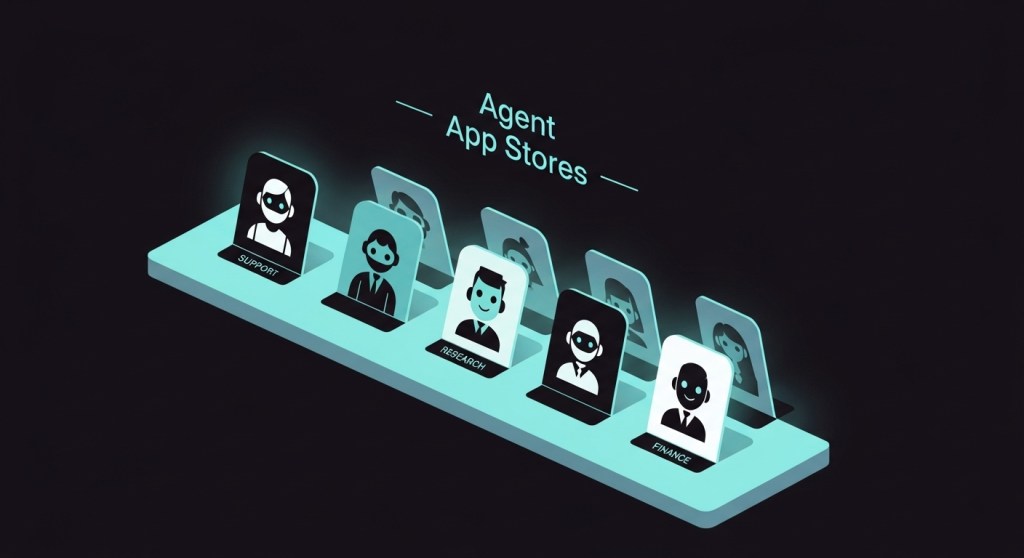
What an “agent app store” looks like (and where yours will live)
Expect multiple shelves for the same agent:
- Cloud marketplaces: List agents where enterprises already buy software. Package with billing, SLAs, observability, and policy controls.
- Enterprise catalogs: Companies are creating internal registries where approved agents are published, versioned, and monitored.
- Product surfaces: Search, docs, and chat apps will expose task‑specific agents as native actions. Your agent’s skills become “features” inside user workflows.
- Open standards rails: Use emerging standards (tool/skill contracts, context protocols) so your agent runs across vendors without rewrites.
Package your agent like a product, not a prompt
Great packaging reduces risk for buyers and increases approvals by Security, Data, and Finance. Ship these seven ingredients:
- Problem statement and outcome: e.g., “Deflect WISMO tickets by 40% in 30 days.” Include 2–3 validated use cases and expected lift.
- Skills library (tools): List callable skills with contracts: inputs, outputs, auth scopes, and latency SLOs. Keep skills modular so they can be reused across agents later.
- Policies and guardrails: Define what the agent can and cannot do. Include human‑in‑the‑loop thresholds (e.g., auto‑refund up to $100; escalate above).
- Data boundaries: Enumerate sources (CRM, ticketing, catalog), PII handling, and retention. Provide a one‑page DPIA template to speed procurement.
- Evals & telemetry: Ship a prebuilt eval suite (correctness, safety, tool‑use accuracy) and expose traces via OpenTelemetry. Buyers will ask.
- Rollout plan: Stage by group/region. Provide a 7‑day pilot with success criteria and rollback steps.
- Buyer docs: Admin guide, quickstart, and a one‑page architecture diagram. Less mystery = faster sign‑off.
Want a shortcut? Try deploying a pre‑built agent (“Ninja”) and customize only the skills and policies you need: Get started with HireNinja.
Pricing that clears procurement
Buyers hate unbounded usage. Anchor price to value, cap risk, and give Finance something to model:
- Per‑task bundles (e.g., “10k ticket triages/month”), with metered overages and hard caps.
- Per‑seat + usage for knowledge‑worker agents embedded in daily tools.
- Outcome‑based tiers (shared savings, conversion lift) once you have baselines.
- Environment tiers: sandbox, pilot, production—with stricter SLAs and policy packs as you move up.
Tip: create a pilot SKU with a fixed price and success checklist. The moment Procurement sees bounded risk, cycles compress.
Distribution playbook: 7 days to a publishable agent
Use this as your first GTM loop. Ship fast, measure, and iterate.
- Day 1 — Define the job: Pick one job‑to‑be‑done per agent (e.g., “reduce WISMO tickets”). Write the outcome, guardrails, and success metric.
- Day 2 — Assemble skills: Connect only the 3–5 tools you need (orders API, CRM, catalog, email). Keep credentials scoped and rotate keys.
- Day 3 — Add policy: Encode data access, spending limits, and escalation rules. Include a kill‑switch and human‑review paths.
- Day 4 — Evals & traces: Build an eval set from 50 historic tasks. Track step‑level traces and tool‑use accuracy. Set pass/fail gates for release.
- Day 5 — Package docs: Write the admin quickstart, architecture diagram, and a one‑page DPIA. Prepare a pilot SLA (latency, uptime, RTBF).
- Day 6 — Pilot SKU: Price the pilot, cap usage, and define go/no‑go metrics. Draft a 30‑minute onboarding script.
- Day 7 — Publish one channel: Submit to a marketplace or your customer’s internal catalog. Announce with a 200‑word launch note and a Loom demo.
Example agents you can ship this month: e‑commerce support automations, research/diligence agents, and refund/cancellation handlers with spending controls.
Security and compliance: win the CISO early
Bake security into your pitch, not just your stack:
- Agent firewalling: Gate tools behind policy checks; require approvals for privileged actions. See our guide: Agent Firewalls Are Here.
- Identity: Issue a distinct agent identity and rotate credentials. Map agent roles to least‑privilege scopes.
- Data governance: Log every tool call with purpose, input, and output. Honor RTBF/DSAR across caches and memory.
- Evals as change control: Ship model/skill updates behind eval gates. No eval pass, no deploy. For production runbooks, see Coding Agents in Production.
Standards that unblock distribution
Interoperability shortens your path to new shelves. Align with emerging conventions for skills/tools, context passing, and tracing. Our explainer covers what’s landing and why it matters: Open Standards for AI Agents.
Metrics that matter post‑launch
- Adoption: approved installs, active tenants, seats provisioned.
- Engagement: tasks per user/day, tool‑use success, time‑to‑completion.
- Quality: eval pass‑rate in production, intervention rate, escalation accuracy.
- Value: deflection %, AOV lift, cycle‑time saved, cost per resolved task.
- Reliability: p95 latency per skill, error budgets burned, rollback count.
Productize these as in‑product dashboards so buyers can see outcomes without exporting logs.
Two sample packages (copy/paste)
1) “WISMO Deflector” for e‑commerce
- Outcome: 40% ticket deflection in 30 days
- Skills: orders API, shipping API, knowledge base, email/SMS
- Policy: auto‑resolve under $100; escalate above; no free‑text PII
- Evals: 100 historic tickets, success = correct resolution + customer CSAT proxy
- Price: $2,500 pilot (10k tasks), then $0.12/task with caps
2) “Diligence Reader” for founders & investors
- Outcome: 4‑hour turnaround on 50‑page memos
- Skills: web crawl, PDF RAG, spreadsheet summary, call notes
- Policy: redact PII; never execute links; cite sources to reviewer
- Evals: 30 docs with rubric for coverage and correctness
- Price: $1,500 pilot (500 docs), then per‑doc bundles
Go further with this week’s key shifts
Deep research and higher‑fidelity models make long‑running tasks viable; enterprise hubs make agents manageable; cloud policy/evals reduce risk; and open standards improve portability. Put together, this is the moment to stop building bespoke bots and start shipping packaged agents where your buyers already shop.
Recommended next reads
- Deep Research Agent + GPT‑5.2: A 7‑Day Founder Plan
- OS‑Level Agents and the New Control Plane
- Open Standards for AI Agents (AAIF)
Call to action
Ship your first revenue‑ready agent without the yak‑shaving. Spin up a pre‑built Ninja, plug in your tools, and publish to your buyer’s catalog in a week. Try HireNinja or Schedule a quick demo.


Leave a Reply