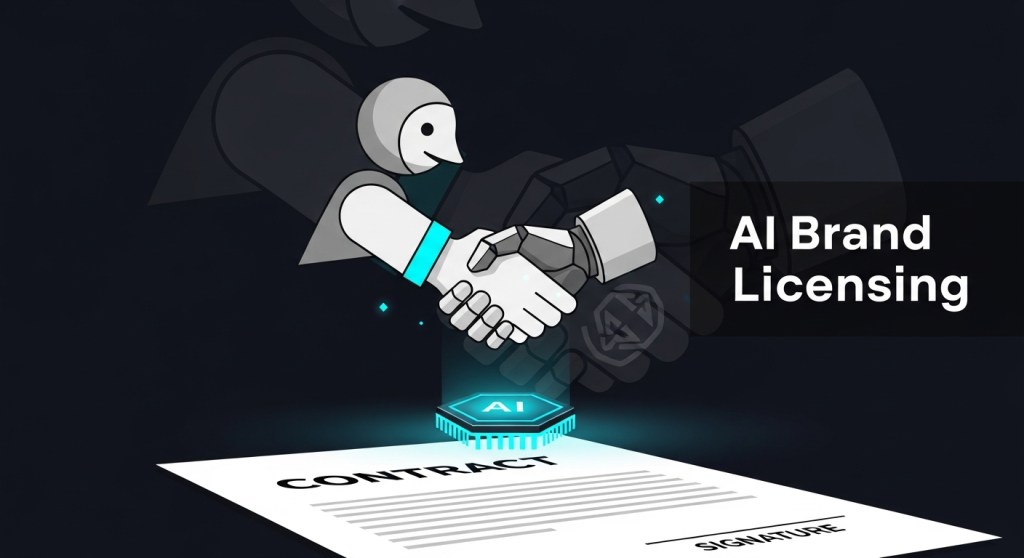
After Disney–OpenAI, AI Brand Licensing Is Here: A 7‑Day Playbook for Founders and CMOs
Published December 14, 2025
On December 11, 2025, Disney and OpenAI announced a licensing partnership that allows select Disney characters to be used inside OpenAI’s video models, alongside a strategic investment. Whether you run a DTC brand or a venture‑backed startup, this was the moment AI brand licensing went mainstream.
What does this mean for you? Two things:
- Brand IP will increasingly live inside AI models and agents—as “tokens,” styles, voices, and behaviors.
- Licensing and governance move from campaign‑by‑campaign to always‑on—with contracts, telemetry, and automated guardrails.
Below is a fast, founder‑friendly plan to protect your brand, monetize IP, and ship compliant AI experiences in one week—plus the tools you’ll need to execute.
Why this shift matters right now
Large models can now generate on‑brand video, audio, and interactive experiences at scale. In parallel, the U.S. moved to centralize aspects of AI policy at the federal level, signaling more consistent rules for interstate operations and marketing. For growth teams, this reduces uncertainty and makes it worth investing in licensed, brand‑safe generative content rather than gray‑area experiments.
For context on compliance and governance changes, see our recent guides:
- The New U.S. AI Executive Order: What Startups Must Ship in the Next 7 Days
- Agent Firewalls Are Here: Lock Down AI Agents
- Open Standards for AI Agents (AAIF) and What They Mean
Your 7‑Day Brand Licensing Playbook
Use this plan to move from reactive “AI content” to governed, licensable assets your team—and your partners—can safely use.
Day 1: Inventory your IP and usage rights
- List trademarks, characters, brand mascots, jingles, product imagery, fonts, and style guides.
- Map ownership and third‑party rights. Note stock assets, talent releases, and music licenses.
- Decide which assets can be turned into model tokens (style, voice, character behavior) and which must remain off‑limits.
Day 2: Draft your AI licensing terms
- Define allowed use (e.g., marketing, support, UGC remix) and prohibited use (political, medical, adult, unsafe claims).
- Set output controls: no synthetic minors, no illegal activity, respect for talent likeness and SAG‑AFTRA style terms if applicable.
- Require watermarking and provenance signals (e.g., C2PA) and allow automated takedown for violations.
- Specify telemetry you need: prompts, outputs, distribution channels, and performance metrics.
Day 3: Ship brand tokens and safety guardrails
- Create lightweight style/voice tokens (logos, palettes, tone, do/don’t lists) your models and agents can load at runtime.
- Enforce safety with an agent firewall (policy + evals) between prompts and tools. Start here: Agent Firewalls.
- Add disclosure in outputs: “AI‑assisted” label and a link to your model policy.
Day 4: Pilot with one high‑impact surface
Pick ONE channel where AI can move the needle quickly:
- E‑commerce: on‑brand product video loops, size/fit explainers, and localization.
- Support: character‑driven how‑to clips and refund explainer flows that your chat agent can send.
- Content: licensed character cameo for a seasonal campaign with strict output rules.
Day 5: Measurement and attribution
- Define success: CPA, ROAS, AOV lift, ticket deflection, NPS, and brand safety incident rate.
- Log every generation and distribution event. Keep a model bill of materials (model, version, token, prompt template, safety pass/fail).
Day 6: Lock the contract and scale distribution
- Convert your pilot into a standard licensing addendum for agencies, creators, and marketplaces.
- Enable distribution to agent app stores and partner catalogs. See: Agent App Stores Are Closer Than You Think.
Day 7: Ship the governance loop
- Run pre‑flight evals on prompts and outputs. Fail closed for risky queries.
- Set up weekly brand safety reviews and a takedown SLA.
- Publish a short, human‑readable AI Model Use Policy on your site.
A quick e‑commerce example
A DTC coffee brand licenses its friendly barista mascot as a voice + style token. The marketing team generates 12‑second product reels in multiple languages, each watermarked and linked to a model policy page. The support agent sends the same character—in a simpler illustration style—inside “how to brew” replies and returns explainers. Every output is logged with provenance, and ads are whitelisted only to family‑safe placements.
Risks and how to mitigate them
- Deepfake confusion: Require watermarking, add human‑readable disclosures, and keep raw assets off public buckets.
- Over‑blocking good content: Tune your agent firewall with staged policies (warning → block) and measure false positives.
- Talent and likeness rights: Use explicit releases. If a voice or face is involved, contract for AI usage, revocation, and royalties.
- Regulatory drift: Track updates and align with federal guidance. Start with our 7‑day compliance plan here.
Your toolkit
- Agent governance: policy engines, evals, and telemetry. See Agent Firewalls.
- Standards: adopt emerging schemas for skills and capabilities so partners can integrate safely. Our explainer on open agent standards is a good start.
- Distribution: package your brand agent for marketplaces with transparent pricing and sandbox demos. Guide here.
- Execution partner: HireNinja can help you turn brand assets into governed AI tokens, wire in firewalls/evals, and stand up pilot campaigns in days.
KPIs to watch
- Revenue impact: ROAS, AOV, LTV/CAC shift on AI‑assisted campaigns vs. control.
- Efficiency: time to produce new variants, localization speed, support ticket handle time.
- Safety: policy violations per 1,000 generations; takedown response time.
- Distribution: % of spend running through licensed models vs. generic UGC.
The bottom line
The market just validated a new reality: your brand will increasingly operate inside AI models and agents. Treat your logo, voice, and characters like software components—licensed, versioned, governed, and measured.
Want help shipping this in a week? Book a free 30‑minute consult with the team at HireNinja. If you’re preparing agents for distribution or tightening governance, start with our posts on agent app stores and agent firewalls. Then, turn your IP into brand tokens and light up your first licensed AI campaign.


Leave a Reply