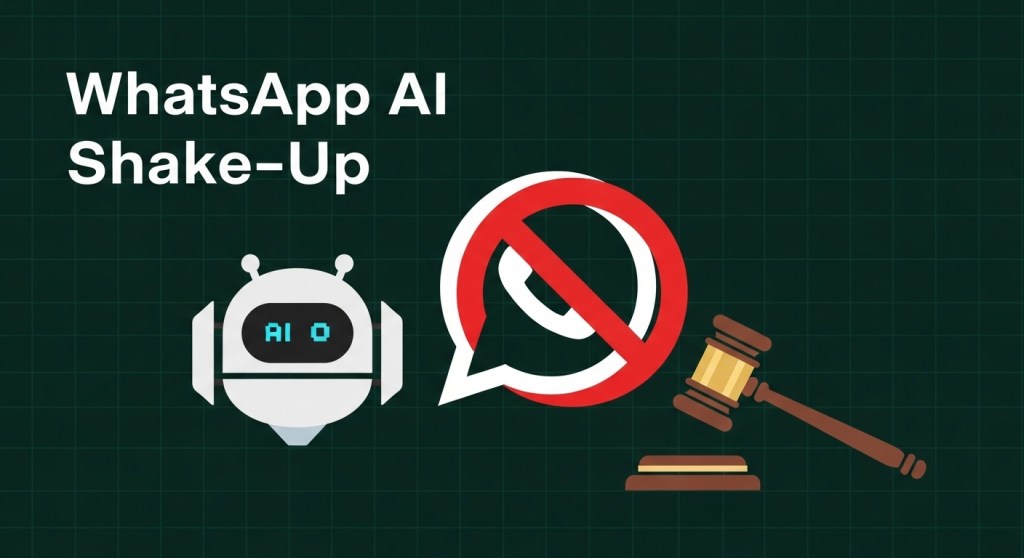
WhatsApp’s AI Chatbot Ban Meets a Legal Roadblock — Your 30‑Day Survival Plan
Published: December 27, 2025
Startups and e‑commerce teams have relied on WhatsApp for conversational support and growth. In October, Meta updated WhatsApp Business API terms to ban general‑purpose AI chatbots effective January 15, 2026. On December 24, 2025, Italy’s competition authority ordered Meta to suspend the terms that would restrict rival AI assistants on WhatsApp, pending review (Reuters). What should founders do now?
TL;DR
- The October policy change (effective Jan 15, 2026) threatens WhatsApp as a distribution channel for third‑party AI assistants.
- Italy’s Dec 24 order creates uncertainty — not a full global reversal yet — so you need contingency plans and quick wins.
- Prioritize support continuity, diversify channels, and harden your data governance to stay compliant across markets.
Why this matters for 2026
Assistant distribution is fragmenting. Google is pushing Gemini across surfaces — from Android Auto to in‑car pilots with Waymo (TechCrunch). OpenAI is tweaking ChatGPT distribution and defaults (Wired). If WhatsApp becomes Meta‑AI‑only in some markets, your growth and support funnels must shift — fast.
We’ve been tracking this new “assistants are the new app store” reality for weeks. If you missed it, read our 7‑day plan for assistant‑led growth here and our Assistant SEO playbook for 2026 here.
What exactly changed on WhatsApp?
Meta’s new WhatsApp Business API terms prohibit third‑party, general‑purpose AI chatbots from operating on WhatsApp beginning January 15, 2026. Business‑specific automations (e.g., a retailer’s order‑status bot) are allowed, but a standalone assistant from an AI model provider is not. Italy’s antitrust authority ordered a suspension of the restrictive terms in Italy while it investigates, but global outcomes may vary as other regulators weigh in.
Translation for founders: plan for regional differences and avoid single‑channel risk.
Your 30‑day survival plan
Week 1 — Triage and compliance
- Inventory your WhatsApp usage. Separate business‑specific support flows (order status, returns, FAQs) from any general‑purpose assistant behavior. The former is likely safe; the latter is at risk.
- Enable graceful fallback. If a feature becomes restricted in one market, auto‑route users to an allowed path: human handoff, web chat, SMS, email, or in‑app chat.
- Update disclosures. Refresh user notices on data handling and model providers. Align with evolving regulations. If you need a starter checklist, see our U.S. compliance guide here.
Week 2 — Channel diversification
- Double down on Instagram DMs and Messenger. Build journeys for pre‑purchase Q&A, order lookups, and re‑engagement with AI‑assisted, policy‑compliant automations.
- Add owned channels you control. Deploy a website chat widget and in‑app messaging for logged‑in users. Pair with proactive, opt‑in email for order updates and back‑in‑stock alerts.
- Prepare for voice and in‑car assistants. Start small: a trusted FAQ skill and a “where’s my order” workflow designed for hands‑free contexts, anticipating assistant distribution via cars and mobile projection.
Week 3 — CX hardening and measurement
- Instrument every path. Track containment rate, first‑response time, resolution time, CSAT, and deflection to human for each channel.
- Run red‑team tests on prompts and tools. Ensure your AI stays within scope (no unsanctioned purchases, no privacy leaks). Build fail‑safes for ambiguous intents.
- Localize policies. Mirror policy and feature toggles by country/region so you can switch behavior without code redeploys.
Week 4 — Growth and continuity
- Stand up an Assistant SEO plan. Optimize product content, policies, and FAQs so assistants like ChatGPT, Meta AI, and Gemini surface your answers with attribution. Here’s our field guide to get started.
- Offer choice and consent. Let users pick their preferred channel. Make switching frictionless: deep links from WhatsApp to web chat, email, or Instagram when needed.
- Document your risk posture. Keep a one‑pager per channel listing allowed intents, blocked intents, human‑handoff rules, logging, and retention. Investors and partners will ask.
Architecture that survives platform swings
Design your assistant layer to be channel‑agnostic and policy‑aware:
- One brain, many mouths. Centralize core reasoning, tools, and guardrails; expose only channel‑appropriate actions per platform policy.
- Feature flags by market. Gate high‑risk intents per region so you can react to rulings like Italy’s without code churn.
- Human in the loop. Provide agent dashboard controls for takeover, refunds, appeasements, and escalations.
Need help operationalizing this? HireNinja provides AI agents for support and growth with built‑in guardrails, analytics, and multi‑channel connectors. See plans on our Pricing page.
Messaging do’s and don’ts for 2026
- Do keep WhatsApp for transactional updates and customer‑specific flows.
- Do offer alternative channels for general Q&A assistants when necessary.
- Don’t rely on a single channel or a single model provider for core support KPIs.
- Don’t allow your bot to wander into general assistant territory where policies disallow it.
What to watch next
- Regulatory dominoes. Other EU regulators may follow Italy’s lead — or diverge. Track updates and be ready to geofence behavior.
- Assistant car/home surfaces. With Gemini in Android Auto and pilots in vehicles, commerce use cases will move into voice‑first contexts.
- Routing and defaults. Platform changes (e.g., OpenAI’s router adjustments) can shift performance and costs overnight. Monitor usage, not just headlines.
Founder checklist (print this)
- Map every customer intent to at least two channels.
- Turn on per‑country feature flags and logging.
- Pre‑write customer notices for channel changes and handoffs.
- Set weekly reviews of containment, CSAT, and escalations by channel.
- Document your lawful bases and retention across all surfaces.


Leave a Reply