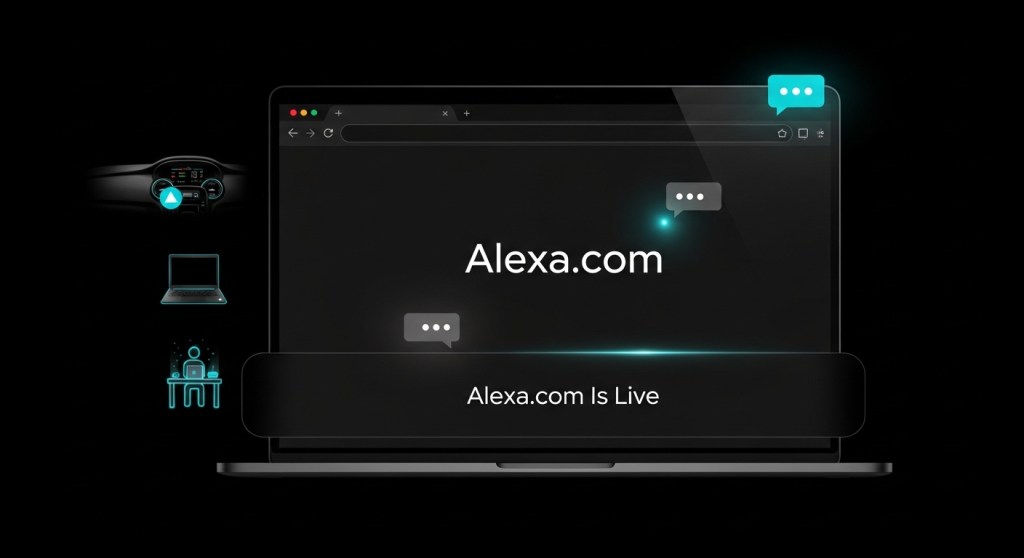
Alexa.com Is Live: Your 72‑Hour Founder Playbook (Plus Lenovo Qira, BMW’s Alexa+, and Razer AVA)
Updated: January 14, 2026
Quick plan for this post
- Scan what launched this week across Alexa.com, Lenovo Qira, BMW’s Alexa+, and Razer AVA.
- Clarify who should act now (founders, e‑commerce, and product teams) and why.
- Ship a 72‑hour launch plan to rank and convert from assistant traffic.
- Map the minimal Assistant Action API your site needs.
- Stand up measurement, consent, and attribution without killing conversion.
What changed this week
Three things turned ambient AI from hype into an actionable channel:
- Alexa.com is now on the web — you can access Alexa+ from a browser, which means your next customer may discover, plan, and transact without an Echo device. See coverage on TechCrunch.
- Lenovo Qira — a cross‑device, “ambient intelligence” layer spanning Lenovo PCs and Motorola devices. See Lenovo StoryHub.
- BMW’s Alexa+ in‑car — BMW is integrating Alexa+ into its Intelligent Personal Assistant, with rollouts starting later this year. Details via BMW Group Press.
- Razer AVA — a desk companion that brings a visual avatar and local context to daily workflows. Read the Razer announcement.
The bottom line: assistants just added new surfaces — web, cross‑device, in‑car, and on‑desk — that can discover your brand and complete tasks for your users. Treat them like a channel with rankings, actions, and attribution.
Who should act (and why)
- Startup founders: Early assistant rankings compound like SEO did in 2012. Being first with clean actions and inventory means lower CAC later.
- E‑commerce teams: Assistants can turn intent into carts and bookings from contexts where typing is inconvenient (car, TV, voice on desktop).
- Product & growth: Structured actions and receipts unlock real attribution and retargeting across channels.
Your 72‑hour launch plan
Day 1 — Ship actions and data
- Expose an Assistant Action API. Start tiny: three POST endpoints that assistants can call safely.
POST /assistant/actions/check-availability→ inputs: product_id or service_slug, date/time, location. Returns: availability, price, deep link.POST /assistant/actions/create-intent→ inputs: user_id (or anonymous token), items, notes. Returns: intent_id, payment_url, hold_expiry.POST /assistant/actions/confirm→ inputs: intent_id, payment_token. Returns: order_id, receipt_url.
Need a head start? Use our weekend blueprint: Ship an Assistant Action API in a Weekend.
- Add structured data to help assistants rank and resolve actions:
- For stores: Product, Offer, and AggregateRating schema with live price/stock.
- For services: Service and ScheduleAction/ReserveAction with a “Book” deep link.
- For content: FAQs with Speakable sections that point to your action routes.
- Stand up a consent banner tailored to assistants. Keep it short: what you collect (intent, device type, assistant surface), why (fulfillment, analytics), and controls. Use the 48‑hour policy checklist here: Consent‑First AI.
Day 2 — Optimize for ranking and conversion
- Assistant App Store Optimization (AASO) basics:
- Craft 5–7 canonical intents (“book a 60‑min massage in Austin”, “order a size M hoodie in black”).
- Map each intent to a single page and action route. Avoid duplicates.
- Use short, imperative copy: what the action does, time to complete, accepted payment types.
- List hard constraints in plain text (service areas, lead time, age limits) to reduce assistant retries.
Deep dive: Assistant App Store Optimization (AASO).
- Create assistant‑aware landing blocks on key pages:
- “Book with Alexa” button that drops into your
/assistant/actions/create-intentwithsource=alexa_web. - “Continue in car” note for services likely to be invoked in BMW’s assistant.
- “Works with Lenovo Qira” badge for cross‑device continuity.
- “Book with Alexa” button that drops into your
- Prep desk‑companion assets (Razer AVA, others): square, high‑contrast thumbnails and one‑line prompts your assistant can read out, e.g., “Order the ‘Founders’ Hoodie, size M — ship today.”
Day 3 — Measurement, attribution, and retargeting
- Add UTM discipline at the edge: tag assistant referrals with
utm_source(alexa_web, qira, bmw_alexa, desk_ava),utm_medium=assistant,utm_campaign=intent-{intent_name}. - Log an Assistant Context Object on every action:
{ "assistant_surface": "alexa_web|lenovo_qira|bmw_alexa|desk_ava", "client_capabilities": ["voice", "screen", "camera"], "consent_token": "...", "intent": "reserve_action|buy_action|support_action", "latency_ms": 412, "conversion": { "status": "succeeded", "order_id": "..." } } - Match receipts: when
/confirmreturns anorder_id, fire server‑side events to your analytics CDP and ad platforms for clean ROAS. - Build retargeting lists from abandoned intents by surface (e.g., alexa_web seen → email/SMS with a 24‑hour offer).
Real‑world examples
Local services (e.g., salon)
Canonical intent: “Book a haircut near me this Friday at 5 pm.” Your check-availability returns two stylists, one time that fits, and a deep link. Alexa.com or Qira reads a crisp confirmation and hands off to your confirm endpoint. In‑car via BMW’s Alexa+ is ideal for commute‑time booking — keep the flow three steps or fewer.
E‑commerce (e.g., apparel)
Canonical intent: “Buy the Founders Hoodie in black, size M.” Your action returns live price, inventory, shipping ETA, and checkout link with prefilled cart. Add a “finish on desktop” link in the receipt for cross‑device follow‑up (Qira will shine here).
Support automation
Expose GET /assistant/faq and POST /assistant/escalate for assistants to resolve issues or schedule callbacks. Keep PII out of logs; store only the consented token and a hashed user handle.
Ranking signals that matter now
- Actionability: You provide a clear, fast path to completion with minimal clarifications.
- Fresh inventory: Stock, price, and schedule are current within minutes.
- Trust: Visible policies, ratings, and a short, human privacy statement assistants can summarize.
- Speed: P95 under 800 ms for
check-availabilityandcreate-intent. - Coverage: 5–7 well‑defined intents beat 50 thin pages.
Avoid these pitfalls
- Ambiguous actions: “Book now” without duration, service area, or lead time makes assistants retry or abandon.
- Leaky attribution: If deep links drop UTM tags on login or checkout, you won’t know which surface drove revenue.
- Policy wall‑of‑text: Assistants summarize; write for summarization with bullet points and purpose‑built Speakable snippets.
Keep going
- 7‑day e‑commerce plan: Rank and Sell via Alexa.com, Qira, and Razer AVA.
- Build‑vs‑integrate framework: Ship your own or ride the platforms?
- Attribution fast start: 48‑Hour Attribution & Conversion Plan.
Try it with HireNinja
If you want this live by the weekend, our team can wire up your Assistant Action API, schema, consent banner, and analytics in days — then tune AASO so you rank on Alexa.com and play nicely with Qira, BMW’s Alexa+, and desk companions.
Get started with HireNinja — or drop us a note with your top 3 intents and we’ll propose the fastest path to revenue.


Leave a Reply