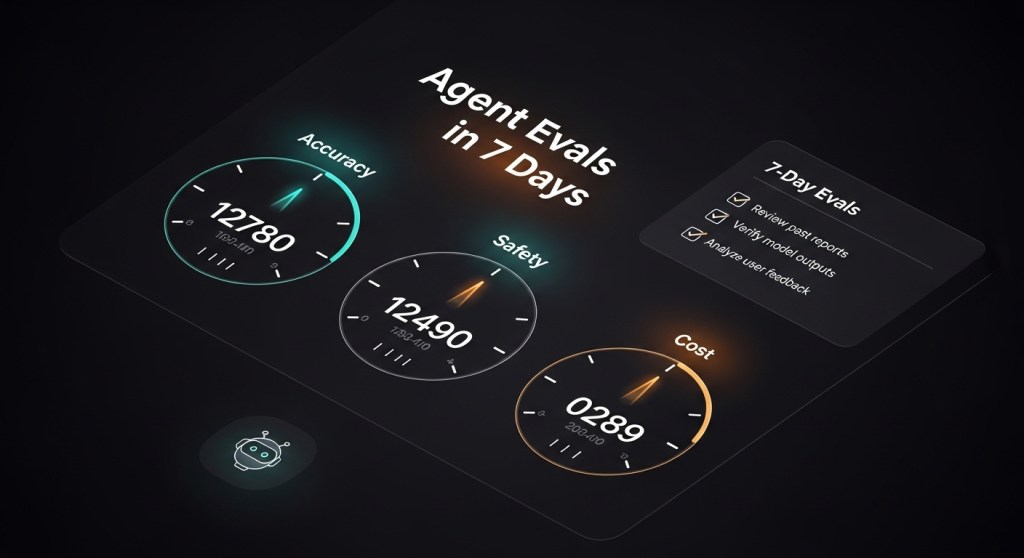
Agent Evals in 7 Days: Measure and Improve AI Agent Reliability with OpenAI Evals and AWS AgentCore
AI agents just leveled up. In early December 2025, AWS added AgentCore Evaluations and policy controls, while OpenAI expanded Agent Evals and trace grading. Microsoft, meanwhile, positioned Agent 365 as an agent control plane. Translation: the market is moving from demos to measurable, governed operations.
This 7‑day playbook helps startup founders and e‑commerce teams create a repeatable evaluation loop—so you can ship agents with confidence, not vibes.
Who this is for
- Founders making their SaaS “agent‑ready.”
- E‑commerce ops and CX leaders rolling out checkout, returns, or support agents.
- Engineering leads accountable for reliability, safety, and cost.
What you’ll set up in 7 days
- A small but meaningful eval dataset (inspired by GAIA) mapped to your workflows.
- Trace‑level telemetry and trace grading to see where agents succeed or fail.
- Automated runs via OpenAI Evals and AWS AgentCore Evaluations.
- Guardrails/policies for high‑risk actions (refunds, payouts, PII).
Day‑by‑Day Plan
Day 1 — Define outcomes, risks, and guardrails
Pick one high‑leverage workflow (e.g., Shopify refund approvals ≤$100, or drafting 1st‑reply emails for returns). Define three KPIs: Task success rate, Time‑to‑resolution, and Human handoff rate. Write policy rules for risky actions (e.g., auto‑approve refunds ≤$100; require human‑in‑the‑loop above $100; mask PII). If you use AWS, capture those constraints in AgentCore Policy; if you’re on OpenAI, document them in your orchestration layer for checks.
Related reads: Browsing Security Baseline and Secure Desktop Agents.
Day 2 — Instrument telemetry and traces
Enable request/response logging, tool‑call traces, and error events. Standardize fields like task_id, user_id, tools_invoked, latency_ms, tokens, cost, final_action, and handoff_reason. If you’re on AWS, use CloudWatch + OpenTelemetry; if you’re on OpenAI, ensure traces flow into your data store and/or their dashboard to support trace grading.
Related: Agent FinOps for cost fields you’ll want to track from day one.
Day 3 — Build a right‑sized eval dataset
Start with 25–50 real examples per workflow. For each, keep: input, expected outcome, policy notes, and a gold‑standard resolution. Use GAIA’s philosophy—simple for humans, realistic for agents—so you’re testing reasoning, tool use, and policy adherence, not edge‑case trivia. See GAIA.
Day 4 — Wire up OpenAI Agent Evals + trace grading
Run your dataset through Agent Evals and grade the trace (tool choices, policy checks, and final outcome). Add graders for: correctness, policy compliance, tool selection accuracy, and retries. Iterate prompts/tools until you hit target thresholds.
Day 5 — Configure AWS AgentCore Evaluations (if on AWS)
Mirror your eval dataset in AgentCore Evaluations. Use the 13 prebuilt evaluators (correctness, safety, tool use, etc.) to baseline your agent, then add custom checks for refunds, PII masking, or vendor‑specific steps. Source: TechCrunch coverage of AgentCore Evaluations and AWS’ re:Invent 2025 updates.
Day 6 — Compare variants (SLM vs LLM, tools, memory)
Set up A/B/C runs with a small, fast model for cheap tasks and a larger model for complex ones. Toggle features like memory and multi‑step planners. Track impact on success rate, latency, and cost per resolution. Lock in guardrails for any variant that increases autonomy.
Day 7 — Go/No‑Go and rollout plan
Publish a 1‑pager: KPI results, remaining risks, guardrail settings, and when to escalate to humans. Register your agents in a control plane for access control and monitoring—see Microsoft’s Agent 365—and plan a 14‑day pilot with a tight feedback loop.
Related reads: Agent Registries & Control Plane and the 2026 Agent Stack comparison.
Example: E‑commerce returns and refunds
Workflow: The agent reviews a return request, checks order history, classifies reason, approves refunds ≤$100, and escalates otherwise.
- Dataset: 50 past tickets with outcomes, SKU/price, and policy rules.
- Graders: Correctness of decision; policy compliance; tool selection (OMS, CRM, payments); PII handling; latency; cost.
- Guardrails: No payouts to new accounts without 2FA; no CSV export of PII; auto‑escalate mismatched RMA/IMEI.
Roll out behind a feature flag. Target: ≥92% correct approvals/denials, ≤15% escalations, and median resolution under 90 seconds.
KPIs and dashboards
- Reliability: Task success rate, tool‑error rate, policy violations per 100 tasks.
- Efficiency: Median latency, tokens per task, cost per resolution.
- Safety: PII redactions, blocked actions, sandbox vs. prod actions.
- Business impact: CSAT, AOV lift on assisted orders, refund leakage.
Tip: combine your metrics with cost controls from Agent FinOps.
Common pitfalls (and quick fixes)
- Overfitting to the eval set: Refresh 10–20% of examples weekly; add real errors back into the dataset.
- Black‑box scoring: Prefer trace grading so you can see why an agent failed.
- Unbounded autonomy: Use written policy gates. AWS AgentCore adds native policy checks; see coverage here.
- Skipping governance: Register agents and access in a control plane (see our control‑plane guide).
Further reading
- AWS re:Invent 2025 agent highlights (frontier agents, policy, evals): TechCrunch.
- OpenAI AgentKit and Evals updates: TechCrunch, Docs.
- Benchmark design inspiration: GAIA.
- Reality check on agents in teams: WIRED.
Where to go next
Once you can measure reliability, scaling becomes a product choice, not a gamble. Pilot one workflow for 14 days, expand to the next, and fold results into your agent pilot or AP2‑ready checkout. When you’re ready, use our A2A+AP2 blueprint to go cross‑vendor.
Call to action: Want help setting up evals, telemetry, and policy gates? Subscribe for weekly playbooks—or reach out to HireNinja for a 14‑day agent reliability pilot.
![Agent Firewalls Are Here: Lock Down AI Agents with Google Model Armor, AWS AgentCore Policy, and Microsoft Agent 365 [7‑Day Plan] – HireNinja: Blog Avatar](https://blog.hireninja.com/wp-content/uploads/2025/11/cropped-icon.jpg?w=50)

Leave a reply to Agent Firewalls Are Here: Lock Down AI Agents with Google Model Armor, AWS AgentCore Policy, and Microsoft Agent 365 [7‑Day Plan] – HireNinja: Blog Cancel reply