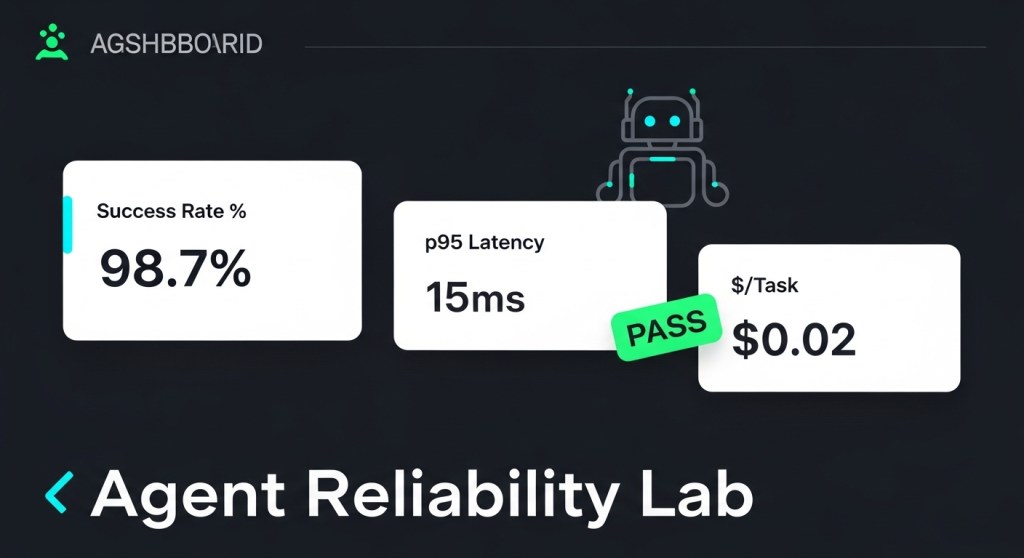
• Ship an Agent Reliability Lab in 7 Days: Evals, OpenTelemetry Tracing, and SLOs for A2A/MCP Workloads

    Quick plan for this article

    • Scan the landscape: what changed this week (Agent 365, Gemini 3, Antigravity, AgentKit Evals) and why it matters.
    • Define agent SLOs and KPIs founders can defend in a board meeting.
    • Instrument tracing with OpenTelemetry in under a day (no vendor lock‑in).
    • Stand up E2E evals using AgentKit’s Evals for Agents and trace grading.
    • Wire dashboards, red‑team tests, and CI/CD quality gates.
    • Ship in 7 days with a repeatable checklist and benchmarks.

    Why now: the agent floor just moved

    Microsoft unveiled Agent 365 to register, govern, and monitor fleets of enterprise agents—think RBAC, access, and oversight for bots at scale. That’s a signal: execs expect agent SLAs and audits, not demos. citeturn0news12

    Google launched Gemini 3 and Antigravity, an agent‑first IDE that produces verifiable “Artifacts” from agent actions. This raises the bar on observability and provenance for agentic dev. citeturn1search3turn1news12

    OpenAI’s AgentKit added Evals for Agents with datasets, trace grading, and automated prompt optimization—exactly what teams need to move from experiments to production reliability. citeturn3search2turn0search0

    Interoperability is accelerating (Google’s A2A, Microsoft adoption), and agentic checkout standards (Google’s AP2, OpenAI/Stripe’s ACP) are converging. If your agents touch payments or customer data, you’ll need consistent SLOs, evals, and traces—yesterday. citeturn0search7turn1search4turn2search0turn2search1

    Outcome first: SLOs and KPIs every agent team should track

    Before tooling, set targets you can defend with investors and compliance:

    • Task Success Rate (TSR): % of tasks meeting acceptance criteria without human rescue (target: ≥92%).
    • p95 Latency: end‑to‑end time per task (target: <8s for support/search; <20s for multi‑step ops).
    • Cost per Task: all‑in model + tools + retries (target: within budget envelope; see our cost‑control playbook).
    • Tool‑Call Accuracy: correct tool, correct params (target: ≥97%).
    • Deferral Rate: % of cases escalated to bigger model/human (target: stable near 5–10% with quality maintained).
    • Security Incidents: prompt‑injection/data‑exfil events per 1k tasks (target: 0; alert on any occurrence).

    These map cleanly to NIST AI RMF’s guideposts on measurement, risk tolerance, and human‑AI oversight—useful when you brief legal or GRC. citeturn3search0turn3search1turn3search3

    Day‑by‑day: build your Agent Reliability Lab in 7 days

    Day 1 — Define scope and acceptance tests

    • Pick 2–3 critical workflows (e.g., support triage, SEO brief, returns automation). Document inputs/outputs, guardrails, and success criteria.
    • Create a failure taxonomy (hallucination, wrong tool, unsafe action, cost spike, timeout).
    • Draft target SLOs (above) and an error budget (e.g., 5% monthly TSR error) to gate releases.

    Day 2 — Instrument OpenTelemetry traces

    • Add OTEL tracing to your agent runtime. If you use LlamaIndex or OpenLLMetry, you can be up in minutes; both emit standard OTEL that flows to Elastic, Grafana, SigNoz, etc. citeturn5search6turn5search0turn5search2turn5search5
    • Capture spans for: task, sub‑task, LLM call, tool call (with redacted params), A2A handoff, and external API I/O. Use emerging gen‑AI semantic conventions as a guide. citeturn4search0turn4search4

    Minimal Python sketch (illustrative):

    from opentelemetry import trace
    tracer = trace.get_tracer("agents.reliability")
    
    with tracer.start_as_current_span("task.support_refund", attributes={"channel": "email", "priority":"high"}):
        with tracer.start_as_current_span("llm.plan"):
            plan = llm.plan(ticket)
        with tracer.start_as_current_span("tool.fetch_order", attributes={"order_id": obfuscated_id}):
            order = oms.get(order_id)
        with tracer.start_as_current_span("llm.decide_refund"):
            decision = llm.decide(order, policy)
    

    Day 3 — Stand up E2E evals with AgentKit

    • Use AgentKit Evals for Agents to build datasets and trace grading for your workflows. Start with 30–50 golden cases per workflow; add hard negatives weekly. citeturn3search2
    • Score TSR, Tool‑Call Accuracy, p95 Latency, and Cost/Task; auto‑optimize prompts with the built‑in prompt optimizer for low‑performing cases. citeturn3search2

    Day 4 — Add security and red‑team tests

    • Simulate prompt injection and data exfiltration attempts; verify that the agent refuses unsafe actions and logs mitigations in traces. Research like AgentSight shows OS‑level boundary tracing can catch malicious behavior outside your app code—useful for high‑risk flows. citeturn5academia13
    • Record red‑team cases in your eval dataset; failures block promotion.

    Day 5 — Dashboards and alerts

    • Publish a single reliability dashboard: TSR, p95, Deferral Rate, Cost/Task, incidents by type. Feed from your OTEL backend (Elastic/SigNoz/Grafana). citeturn5search2turn5search5
    • Alert on SLO breaches and semantic-cascade drift signals (e.g., rising deferrals). Ensemble‑agreement methods can reduce cost while keeping quality. citeturn4academia13

    Day 6 — CI/CD gates + governance

    • Wire evals to CI: PRs or model swaps must meet SLOs on golden sets. Fail fast if cost or p95 regress >10%.
    • Connect to your agent registry + RBAC and identity to log who/what changed and why—helps with Agent 365‑style audits. citeturn0news12

    Day 7 — Ship, review, and set a 30‑day hardening plan

    • Run a 24‑hour canary with live traffic. Compare canary vs control on TSR, p95, Cost/Task; roll forward only if within error budget.
    • Publish a one‑pager to leadership with current SLOs, error budget burn, and top 3 fixes for the next sprint.

    A2A/MCP specifics: what to trace and test

    • Handoffs: record A2A intents, recipient, and outcome; assert the receiving agent’s first action is valid (e.g., safe tool call). Industry movement toward A2A makes this observable handoff core. citeturn0search7
    • Checkout: if you’re piloting AP2/ACP, trace mandate issuance/validation, tokenization, and completion webhooks; add evals for amount caps, merchant of record, and user confirmation. citeturn1search4turn2search1

    Pair this with our PCI/SCA mapping and agentic checkout guide for compliance guardrails. citeturn2search0

    What “good” looks like in week 2

    • TSR ≥92% on golden sets; p95 latency within 10% of target.
    • Cost/Task down 15–25% via prompt diet, routing, and deferrals—see our 14‑day cost playbook.
    • Zero unresolved security incidents; all red‑team prompts logged and mitigated.
    • Dashboards live; CI gates blocking regressions; change controls enforced via our registry/RBAC.

    Tools you can use without lock‑in

    • Tracing: OpenTelemetry + OpenLLMetry or LlamaIndex OTEL; send to Elastic, SigNoz, or Grafana Tempo. citeturn5search0turn5search6turn5search2turn5search5
    • Evals: AgentKit Evals for Agents (datasets, trace grading, prompt optimizer). citeturn3search2
    • Advanced: boundary tracing (AgentSight) for high‑risk agents. citeturn5academia13

    Internal resources

    The takeaway

    The agent platforms are maturing fast, but reliability is on you. In one week you can instrument traces, stand up evals, set SLOs, and wire CI gates—so when leadership asks “Are these agents safe, fast, and cost‑effective?”, you’ll have the dashboard—and the receipts—to answer yes.

    Call to action: Need help implementing this 7‑day lab or running a bake‑off across AgentKit, Agentforce, and Antigravity? Subscribe for weekly playbooks or contact HireNinja for a guided pilot.
  • Cut Your AI Agent Spend by 20–40% in 14 Days: A Cost‑Control Playbook for MCP/A2A Workloads

    Cut Your AI Agent Spend by 20–40% in 14 Days: A Cost‑Control Playbook for MCP/A2A Workloads

    Agent rollouts are accelerating. Microsoft just introduced Agent 365 for managing fleets of enterprise agents, while Google released Gemini 3 and Antigravity, an agent‑first coding IDE — both pointing to a near‑term surge in agent usage and costs (and scrutiny). Wired; The Verge; AP.

    Good news: with the right telemetry and guardrails, most teams can trim 20–40% from AI‑agent spend in two weeks without sacrificing outcomes. Below is a pragmatic, MCP/A2A‑aware plan you can start today.

    The 5 biggest cost drivers (and what to watch)

    1. Context bloat (especially with MCP tools). MCP‑enabled agents often ship huge prompts, tool schemas, and histories — ballooning tokens per call. A 2025 measurement study shows significant token inflation and cost trade‑offs for MCP agents. arXiv.
    2. Tool‑call retries and looped workflows. Browsing/web agents and long chains multiply calls; Google’s web agent initiatives highlight scale — and the need for throttling. TechCrunch.
    3. Over‑provisioned models. Using a frontier model for every step is expensive; research shows cost‑aware routing can maintain reliability with materially lower spend. CCPO; ECCOS.
    4. Underspecified prompts and RAG. Dumping large documents into context is wasteful. RAG and prompt compression techniques can cut tokens dramatically. Guide; CRAG.
    5. Lack of observability. Without span‑level traces (inputs, outputs, tool calls, token counts), costs drift. Native tracing and OTEL pipelines are now available. Vertex AI; Langtrace.

    KPIs to baseline before you optimize

    • Cost per successful task (CPS) = total agent cost / completed tasks.
    • Tokens per success (input, output, and tool schema tokens).
    • Tool‑calls per success and retry rate.
    • Success rate on your gold tasks (don’t optimize costs at the expense of outcomes).
    • MTTR for agent incidents and escalation rate to humans.

    Tip: if you’re adopting A2A (Agent‑to‑Agent), record per‑agent CPS so you can see which external agents are value‑accretive. See the spec’s enterprise security notes on identity/OAuth/OIDC. A2A Spec; A2A Enterprise.

    Your 14‑day cost‑control plan

    Days 1–2: Turn on tracing and cost telemetry

    • Enable native tracing for each platform (e.g., Vertex AI Agent Builder) and export to OTEL. Guide.
    • Add an external span processor (e.g., Langtrace) to capture tokens, model, tool, and retry metadata. How‑to.
    • If you’re on OpenAI’s AgentKit, confirm evals/telemetry are enabled for agents. TechCrunch.

    Days 3–4: Define budgets and hard limits

    • Create per‑agent cost budgets and caps per task (CPS thresholds). Kill or escalate on breach.
    • Throttle tool calls and browsing depth; add timeouts and max‑retries. Web agents love to wander.
    • For e‑commerce checkout pilots, use mandates and SCA‑ready patterns as you prep for agentic payments (AP2/industry frameworks). AP2 overview; Mastercard.

    Days 5–7: Right‑size models with cost‑aware routing

    • Route simple intents to small/cheap models; escalate to frontier models only when needed.
    • Use policy‑based orchestration to meet a reliability constraint at minimum cost (research shows 20–30% savings are feasible). CCPO; COALESCE.

    Days 8–9: Put your prompts and context on a diet

    • Replace “dump the whole doc” with targeted RAG; measure tokens saved and success rate. CRAG.
    • Adopt prompt compression or KV‑cache compression to cut context and reasoning tokens (when tasks allow). TreeKV; TokenSkip; Guide.

    Days 10–11: Tame MCP tool sprawl

    • Inventory MCP servers and tool definitions; remove unused tools and trim schemas to reduce tokens. Evidence shows MCP context inflation is a real cost driver. Study.
    • Cache stable tool metadata and responses; set TTLs to avoid re‑fetching heavy schemas.

    Days 12–13: Evaluate and lock in wins

    • Re‑run gold tasks and compare CPS, tokens/success, and success rate to your baseline.
    • Flip cost‑saving flags on by default; document fallbacks and human‑in‑the‑loop triggers.

    Day 14: Add governance and scaling hooks

    • Register agents and permissions centrally (Microsoft Agent 365 is designed for this). Wired; The Verge.
    • Adopt A2A identity practices (Agent Cards + OAuth/OIDC at transport layer) so you can track cost by agent and partner. A2A Spec.

    What good looks like (target outcomes)

    • 20–40% lower CPS on your top three agent workflows.
    • ≤10% change in success rate versus baseline (equal or better).
    • ≥25% fewer tool calls per success; retries capped at 1.
    • Dashboards in place for tokens, cost, retries, and escalations by agent.

    Real‑world example

    A Shopify brand’s support agent averaged $0.62 CPS with 28% retries. After tracing, model routing, RAG cleanup, and MCP schema pruning, CPS fell to $0.41 (‑34%), retries dropped to 9%, and resolution rate held steady. The team set a $0.45 CPS budget and added automatic human escalation at the cap.

    Related HireNinja playbooks

    Why act now

    Analysts warn that many agentic AI projects will be scrapped by 2027 due to cost and unclear value — the antidote is governance, observability, and disciplined cost controls from day one. Reuters/Gartner. With Agent 365, Gemini 3, and AgentKit maturing, the winning teams will pair speed with spend discipline.

    Call to action: Want help instrumenting cost telemetry and routing on your stack (AgentKit, Agentforce, Vertex, or Nova Act)? Subscribe for our templates or talk to HireNinja about a 14‑day cost cut sprint.


    Sources: Microsoft Agent 365 (Wired, The Verge); Google Gemini 3 & Antigravity (AP, The Verge); OpenAI AgentKit (TechCrunch); A2A (Spec, Enterprise); MCP costs (arXiv); Routing & cost‑aware control (CCPO, ECCOS); Observability (Vertex, Langtrace); Prompt/RAG compression (CRAG, TreeKV, TokenSkip); Analyst risk (Reuters).

  • Gemini 3 and Google Antigravity vs AgentKit and Agentforce: What Founders Should Ship in the Next 14 Days

    On November 18, 2025, Google introduced Gemini 3 and Antigravity—an agent‑first coding IDE that lets multiple AI agents plan, edit code, run terminals, and produce verifiable artifacts of their actions. That puts Google squarely into the agent platform race alongside OpenAI’s AgentKit and Salesforce’s Agentforce 360. If you’re a founder or engineering leader, the question isn’t who “won launch day,” but how to turn this into working software, safely, in the next 14 days.

    Who this is for: startup founders, e‑commerce tech leaders, and engineers evaluating agent platforms for 2026 roadmaps.

    What’s new—and why it matters

    • Google Antigravity is an agent‑first IDE built around Gemini 3 Pro. It exposes editor, terminal, and browser access to agents and generates “Artifacts” (plans, screenshots, recordings) for human verification. Public preview is available on Windows/macOS/Linux. Coverage. Gemini 3 launch. Google blog.
    • OpenAI AgentKit (launched Oct 6, 2025) focuses on building, deploying, and evaluating production agents with connectors and an admin control panel. TechCrunch.
    • Salesforce Agentforce 360 positions for enterprise deployment, governance, and Slack integration with reasoning model options and an upcoming Builder. TechCrunch.

    Why this matters now: The agent category is moving from demos to deploy—funding and production rollouts are accelerating (e.g., Wonderful’s $100M Series A to put agents on the front lines of customer service). TechCrunch. At the same time, experts warn about impersonation and safety risks in autonomous systems—so governance must ship with your prototype. Business Insider.

    Antigravity vs AgentKit vs Agentforce: When to use which

    Skip the platform tribalism; choose by job‑to‑be‑done and org constraints:

    Choose Antigravity (Gemini 3) if you need…

    • Agentic coding workflows inside an IDE with first‑class multi‑agent orchestration and artifacting for review.
    • Google ecosystem leverage (Vertex, Search AI Mode) or you’re already piloting Gemini for research/retrieval.
    • Fast team experiments before you commit to enterprise governance. Antigravity is ideal for controlled, developer‑led bake‑offs. Details.

    Choose AgentKit if you need…

    • Production deployment primitives (evals for agents, connector registry, admin control panel) and an OpenAI‑centric stack.
    • A2A/MCP‑friendly builds (see our interoperability guide) with a growing ecosystem of tools and RAG components.
    • Rapid path to customer‑facing agents (support, SEO, checkout) where you want tight evals and rollout controls. Our SEO agent playbook. TC coverage.

    Choose Agentforce 360 if you need…

    • Salesforce‑native governance, Slack surfaces, and enterprise RBAC/compliance out of the box.
    • Reasoning model choice across Anthropic/OpenAI/Gemini within Salesforce guardrails. TC coverage.
    • Exec‑level accountability for agents handling sensitive CX workflows.

    Architecture implications: A2A, MCP, and governance

    Regardless of platform, your agents should participate in a consistent agent‑to‑agent (A2A) and tool‑calling fabric, with MCP connectors for systems and a light AP2‑style action protocol for high‑risk steps (payments, PII, policy‑gated actions). Start here:

    A pragmatic 14‑day experiment plan

    Use this to compare Antigravity vs AgentKit vs Agentforce on one contained workflow (e.g., triage GitHub issues, generate a patch, open PR, run checks, and post a Slack summary).

    1. Days 1–2: Scope and guardrails
      • Pick one measurable workflow; document inputs/outputs and deny‑by‑default permissions.
      • Stand up an agent registry + RBAC (sandbox tenants for each platform).
      • Define KPIs: task success rate, time‑to‑resolution, human edits per task, escape rate (policy violations), and infra cost per task.
    2. Days 3–5: Antigravity pilot
      • Install Antigravity; enable multi‑agent orchestration and artifacting. What Antigravity offers.
      • Create agents for plan, code, and test; ensure each logs artifacts (diffs, terminal transcripts, screenshots).
      • Run 10–20 tasks; capture baseline KPIs and operator feedback.
    3. Days 6–8: AgentKit pilot
      • Build the same workflow with AgentKit; connect GitHub/CI/Slack via connectors; set up Evals for Agents.
      • Enable MCP connectors where relevant; add approval gates for PR merges.
      • Run 10–20 tasks; record KPIs and audit logs.
    4. Days 9–10: Agentforce 360 pilot
      • Deploy the workflow with Agentforce Builder (beta); surface results in Slack; apply Salesforce RBAC.
      • Log traces and approvals; run 10–20 tasks; record KPIs.
    5. Days 11–12: Head‑to‑head bake‑off
      • Compare success rate, edit rate, MTTR, escape rate, and cost per completed task.
      • Qualitative: developer experience (DX), artifact quality, ease of guardrails.
    6. Days 13–14: Decision + rollout plan
      • Pick a winner for this workflow; document why.
      • Define a 30‑day expansion plan; promote to a controlled production cohort with observability. See our observability blueprint.

    Risk and compliance: ship safety with speed

    • Impersonation and overreach: restrict identities; require signed “AgentCards” and scoped OAuth/OIDC where agents act on your behalf. See our Agent Identity guide. External risk commentary: Cohere’s Joelle Pineau.
    • Payments and checkout: if your agents touch PCI/PSD2 flows, map AP2/ACP intents to PCI DSS 4.0 + SCA. Use our 10‑step mapping.
    • Customer service: for peak season, scope a narrow CX agent with guardrails; see our 7‑day CX agent playbook.

    How we’d recommend you proceed (Founder’s checklist)

    1. Pick one workflow and run the 14‑day bake‑off above.
    2. Adopt a single registry/RBAC model across platforms to avoid agent sprawl.
    3. Standardize traces/evals and review Antigravity Artifacts vs AgentKit/Agentforce logs weekly.
    4. Track business KPIs: cycle time, cost/task, and revenue impact for CX or SEO automations (see our SEO agent guide).
    5. Plan your 2026 stack with optionality: keep A2A/MCP connectors portable; avoid hard locks unless governance demands it.

    Bottom line

    Antigravity is a strong agentic development environment; AgentKit and Agentforce are strong for deployment and governance. Most teams will trial Antigravity for DX and prototyping, then ship customer‑facing workflows on AgentKit or Agentforce with shared A2A/MCP rails and uniform guardrails. Use the 14‑day plan to get signal quickly—and make 2026 decisions with data, not demos.


    Want help standing this up? Subscribe for our weekly agent ops playbooks—or reach out to HireNinja to design your bake‑off and ship a production pilot in two weeks.

  • AI Agent Platforms in 2026: The Founder’s Buyer’s Guide and 14‑Day Bake‑Off (AgentKit vs Agentforce 360 vs Vertex Agent Builder vs Nova Act)

    AI Agent Platforms in 2026: The Founder’s Buyer’s Guide and 14‑Day Bake‑Off

    Who this is for: startup founders, e‑commerce operators, and tech leads choosing an AI agent platform before peak season.

    Why now: Microsoft just announced Agent 365 to manage autonomous agents at scale, signaling that 2026 will be the year agents become a first‑class enterprise surface. Meanwhile, OpenAI, Salesforce, Google, Amazon, and Notion each offer different ways to build, deploy, and govern agents. Source.

    What changed in late 2025

    • Microsoft Agent 365 brings centralized oversight (authorize, quarantine, secure agents; third‑party coverage) and lands in early access via Ignite. Reuters.
    • OpenAI AgentKit focuses on fast prototyping to production with a connector registry and agent evals; OpenAI also added MCP (Model Context Protocol) support in core APIs and Realtime for voice agents. TechCrunch, OpenAI.
    • Salesforce Agentforce 360 deepens enterprise agent workflows, Slack integration, and a Builder for deploy‑test cycles. TechCrunch.
    • Google Vertex AI Agent Builder/Engine adds A2A (Agent‑to‑Agent) interoperability, code execution sandbox, memory bank, and managed runtime (GA/updates in 2025). Google Cloud, Release notes.
    • Amazon Nova Act (research preview) is a browser‑control agent + SDK for developers. TechCrunch.
    • Notion Agents bring agentic workflows into a popular productivity stack for data analysis/task automation. TechCrunch.

    Related reads on HireNinja for deeper implementation details:

    The evaluation rubric (use this for your RFP)

    1. Identity & RBAC — first‑class agent identity, credential isolation, OAuth/OIDC patterns.
    2. Registry & approvals — catalog of approved agents/tools, change control, and audit trails.
    3. Interoperability — support for MCP and A2A to avoid lock‑in and enable multi‑agent handoffs. OpenAI MCP, Google A2A.
    4. Tooling & connectors — native connectors, search/RAG, code execution sandbox, SIP/voice if you need phone agents. OpenAI tools & Realtime, Vertex updates.
    5. Observability — traces (OpenTelemetry‑style), evals, step logs, red‑flag alerts.
    6. Safety & compliance — PII handling, policy checks, PCI/PSD2 scope for checkout, EU AI Act readiness.
    7. Performance — latency, success rate on tool use, fallbacks, cost per successful task.
    8. Workflow fit — channels (web, chat, email, voice), human‑in‑the‑loop, and escalation.
    9. Data & residency — regional control and model routing options.
    10. TCO — platform fees + model costs + logging/observability + security review.

    For governance controls to pair with this rubric, start with our 2025 Agent Governance Checklist.

    Platform snapshots (fast facts for shortlisting)

    OpenAI AgentKit

    • Best for: speed from prototype to production; strong evals; growing connector registry; Realtime voice agents.
    • Interoperability: supports MCP (remote servers) across Responses and Realtime APIs. OpenAI.
    • Consider: governance add‑ons (registry/RBAC/observability) and cost controls at scale. TechCrunch.

    Salesforce Agentforce 360

    • Best for: enterprises already on Salesforce + Slack; predefined GTM/Service workflows; enterprise IT alignment.
    • Interoperability: reasoning model choice (OpenAI/Anthropic/Google) and Slack integration road‑map. TechCrunch.
    • Consider: platform lock‑in to CRM stack; ensure external tool coverage via connectors.

    Google Vertex AI Agent Builder / Agent Engine

    • Best for: multi‑cloud teams seeking managed runtime, sandboxed code execution, memory bank, and A2A agent‑to‑agent flows.
    • Interoperability: embraces A2A and OSS frameworks (LangGraph, CrewAI) with governance primitives. Product; Release notes.
    • Consider: align costs for managed runtime + evals; train team on Agent Engine concepts.

    Amazon Nova Act (research preview)

    • Best for: browser‑automation patterns and developers exploring web‑control agents with an SDK.
    • Interoperability: complements AWS data/infra strategy; watch for governance maturity.
    • TechCrunch.

    Notion Agents

    • Best for: teams living in Notion who want agentic analysis and task automation on workspace data.
    • TechCrunch.

    Where Microsoft Agent 365 fits

    Think of Agent 365 as the management and governance layer over your agent ecosystem—authorize, quarantine, audit, and measure agents across vendors (including Salesforce), not the place you build agents. Reuters.

    A 14‑day bake‑off plan (bring your own use cases)

    Goal: identify a primary build platform and a governance stack you can run in production, safely, before year‑end.

    1. Days 1–2: Define success. Pick 2–3 measurable use cases (e.g., customer support auto‑reply, SEO brief generation, agentic checkout handoff). Write acceptance criteria (task success rate, time to resolution, human‑in‑the‑loop thresholds, PCI/PII rules). See our SEO Agent in 7 Days and Agentic Checkout plan.
    2. Days 3–4: Stand up governance. Create an agent registry + RBAC, logging, and guardrails. If you’re a Microsoft shop, map supervision to Agent 365 scopes.
    3. Days 5–7: Build thin slices on each platform. Implement the same use case on 2–3 contenders (AgentKit, Agentforce 360, Vertex). Keep integrations identical (same RAG index, same tools, same channels). Document build effort.
    4. Days 8–10: Run evals + load tests. Capture task completion, latency, cost per successful task, and fallbacks. Add observability (traces + step logs). Use MCP/A2A where available to keep swaps cheap. OpenAI tools, Vertex Agent Engine.
    5. Days 11–12: Security & compliance. Validate OAuth/OIDC flows, data residency, PII/PCI scopes, and approval workflows. Keep a change log in your registry.
    6. Days 13–14: Decide + rollout. Choose 1 primary platform + 1 backup. Publish an internal SOP, SLAs, escalation runbooks, and KPIs. Connect to Agent 365 (if applicable) for fleet oversight.

    Copy‑paste RFP snippet (edit for your company)

    Section 1: Scope & Use Cases
    - Channels: web chat, email, helpdesk, voice (SIP optional)
    - Data: existing RAG index (vector + keyword), knowledge bases
    - Tools: order status API, CRM, CMS, payments (tokenized)
    
    Section 2: Security & Governance
    - Agent identity model, OAuth/OIDC, secret isolation
    - Registry, approvals, audit logs, incident response
    - Observability: traces, step logs, eval harness, red‑flag alerts
    
    Section 3: Interoperability
    - Support for MCP servers and/or A2A protocol
    - Import/export of agent specs and policies
    
    Section 4: Performance & Cost
    - Task success rate at P95 latency target
    - Cost per successful task, rate limits, autoscaling behavior
    
    Section 5: References
    - Production case studies in similar verticals
    - Compliance attestations (SOC 2, PCI scope notes)

    Recommendations by scenario

    • Early‑stage SaaS: Start with AgentKit for speed, layer a light registry/RBAC, and keep MCP connectors portable. Add Agent 365 later if you’re already on Microsoft 365.
    • Salesforce‑centric enterprise: Pilot Agentforce 360 + Slack. Ensure external tool coverage and exportability of agent specs.
    • Data‑heavy, multi‑cloud teams: Evaluate Vertex Agent Builder/Engine for A2A flows, sandboxed code execution, and managed runtime.
    • Retail/e‑commerce checkout: Prioritize governance patterns and PCI/SCA mapping; keep agents discoverable via your registry and route oversight into Agent 365 if you’re on Microsoft. See our PCI + SCA guide.

    Key takeaways

    • Pick the platform that fits your workflow and governance today, but design for swap‑ability tomorrow via MCP/A2A.
    • Measure cost per successful task, not just model pricing.
    • Treat Agent 365 (or equivalent) as your control plane; treat the build platform as interchangeable.

    Call to action: Need help running the bake‑off or setting up your registry, RBAC, and observability? Subscribe for our next deep‑dive or contact us to run a 14‑day pilot with your stack.

  • Build a Holiday‑Ready AI Customer Service Agent in 7 Days: A2A + MCP Playbook

    Quick plan:

    • Scan the latest agent platform moves and pick a stack.
    • Scope intents, guardrails, and KPIs for holiday spikes.
    • Wire channels (email, chat, WhatsApp) to an agent registry and identity controls.
    • Build with AgentKit or Agentforce 360; connect tools via MCP; orchestrate via A2A.
    • Ship evals, observability, and incident playbooks.
    • Pilot on one queue; expand with spend limits and rollback.

    Build a Holiday‑Ready AI Customer Service Agent in 7 Days: A2A + MCP Playbook

    AI agents just went enterprise‑mainstream. Microsoft unveiled Agent 365 to inventory, govern, and secure fleets of bots inside companies—underscoring that agent management is now a first‑class IT concern. citeturn0news12 Gartner says 85% of service leaders will explore or pilot customer‑facing GenAI in 2025, which matches what we’re seeing across e‑commerce support. citeturn2search1 Meanwhile, a new wave of tooling—from OpenAI’s AgentKit to Salesforce’s Agentforce 360—has made it feasible to ship production agents in a week, not months. citeturn0search0turn0search2

    This guide gives founders and support leaders a pragmatic 7‑day path to launch a compliant, measurable customer service agent in time for the U.S. holiday spike—without causing agent sprawl.

    Who this is for

    • E‑commerce operators on Shopify/WooCommerce needing 24/7 pre‑sales and order support.
    • B2B SaaS teams that want to deflect L1 tickets and speed triage.
    • Startup founders who need fast ROI but can’t compromise on security/governance.

    Outcome in 7 days

    • A channel‑ready agent for chat + email (optional: WhatsApp/voice).
    • Connected tools via MCP (data access) and A2A (agent‑to‑agent collaboration). citeturn1search0turn2search3
    • Agent registry + RBAC + audit trails, ready for scale.
    • Dashboards for deflection rate, FCR, CSAT, AHT, and cost per resolution.

    Architecture at a glance

    Pick one of two primary build paths:

    1. OpenAI AgentKit for flexible, code‑first builds and rich connectors. citeturn0search0
    2. Salesforce Agentforce 360 for CRM‑native teams and Slack integration. citeturn0search2

    In both cases, use MCP to safely connect the agent to your data sources (orders, inventory, knowledge base) and A2A to coordinate specialized agents (e.g., refunds, shipping, VIP escalations). citeturn1search2turn2search3

    7‑Day build plan

    Day 1 — Scope, KPIs, and guardrails

    • Define top intents: Where is my order?, returns/refunds, discount codes, product Q&A.
    • Set targets: 40–60% deflection, +5 pts CSAT, AHT −20%, no‑touch refund cap (e.g., ≤ $50). Freshworks’ 2025 benchmarks show large gains when copilots handle first responses and routing. citeturn2search2
    • Establish policies: PII handling, refund limits, escalation triggers, audit retention.

    Day 2 — Agent registry + identity

    • Stand up an agent registry with unique IDs, purposes, scopes, and owners; require RBAC and change approvals. See our internal guide Stop Agent Sprawl.
    • Issue AgentCards and require OAuth/OIDC client credentials; log all actions. For patterns, review Agent Identity in 2025.
    • Note: Microsoft’s Agent 365 signals registries and access monitoring becoming table stakes. citeturn0news12

    Day 3 — Build the agent core

    • Choose AgentKit (code‑first) or Agentforce 360 (CRM‑native). citeturn0search0turn0search2
    • Connect data via MCP: orders DB, CMS/KB, ticketing. Start read‑only; expand rights later. citeturn1search0
    • Wire channels: Zendesk/Intercom chat, support@ inbox, and a sandbox WhatsApp number.

    Day 4 — Workflows, A2A, and payments

    • Create narrow tools: get_order_status, issue_refund_limited, generate_return_label.
    • Use A2A to hand off across agents: policy‑agent approves exceptions, refund‑agent processes payouts, cx‑agent owns conversation. citeturn2search3
    • Keep refund tools in a JIT‑scoped sandbox with per‑transaction caps and human approval above thresholds.

    Day 5 — Evals and red‑team

    • Author 50–100 test cases covering intents, policies, and adversarial prompts (prompt injection, data exfiltration). Academic work shows multi‑turn tasks remain brittle—test for regressions. citeturn2academia14
    • Simulate spikes: 10× traffic on shipping‑delay scenarios; check timeouts, fallbacks, and CSAT scripts.

    Day 6 — Observability and incident response

    • Enable OpenTelemetry traces, structured event logs, and replay. Follow our Agent Observability blueprint.
    • Add safety rails: allow/deny tool lists, content classifiers, and auto‑rollback on policy violations. Recent reports of AI‑assisted cyber operations raise the bar on monitoring. citeturn0news13

    Day 7 — Pilot and expand

    • Go live on one queue (e.g., pre‑sales chat) with a clear kill switch.
    • Set spend limits and daily caps; require change tickets for scope upgrades.
    • Publish a known‑issues page and escalate novel intents to humans.

    What good looks like (KPIs)

    • Deflection rate: 40–60% for L1 within 2–4 weeks.
    • FCR: ≥ 75% on supported intents; Freshworks reports large FCR and time‑to‑resolution gains with AI copilots. citeturn2search2
    • AHT: −20% on mixed queues.
    • CSAT: +3 to +5 points on order status and returns.
    • Cost per resolution: track with agent wallet spend + compute + refunds.

    Tooling landscape (fast take)

    • OpenAI AgentKit: fastest path for custom logic and connectors; strong eval tooling. citeturn0search0
    • Salesforce Agentforce 360: native to CRM and Slack; enterprise guardrails; beta rolling out. citeturn0search2
    • Microsoft Agent 365: governance layer (registry, access, monitoring) for multi‑agent fleets. citeturn0news12
    • CS specialists (e.g., Wonderful): purpose‑built for frontline support at global scale; well‑funded and growing. citeturn0search1

    Security, compliance, and trust

    • Least privilege by default: start read‑only; elevate via approvals and time‑boxed scopes.
    • Prompt‑injection defenses: content filters, tool allowlists, and policy‑agent approvals on high‑risk actions. Threat reports show attackers are experimenting with AI‑orchestrated intrusions—log everything. citeturn0news13
    • Auditability: persist tool inputs/outputs with request IDs; exportable to SIEM.
    • Governance: if you’re adopting Agent 365, align your registry/controls now; our 2025 governance checklist maps the essentials.

    Costs and ROI (simple model)

    Estimate cost per resolution as: (LLM + infra + agent wallet losses + human review) ÷ AI‑resolved tickets. For a deeper model and rollout cadence, use our ROI playbook.

    Implementation checklist

    • Agent registry with RBAC and change approvals (link: Stop Agent Sprawl).
    • MCP servers for orders, KB, and ticketing; read‑only to start. citeturn1search0
    • A2A handoffs for policy and refunds; human‑in‑the‑loop over threshold. citeturn2search3
    • Observability: traces, evals, anomaly alerts (link: Agent Observability).
    • Incident runbook for prompt injection and data‑leak attempts; log to SIEM. citeturn0news13

    FAQ

    How is this different from a chatbot?
    Agents can act—issuing refunds, updating orders, and coordinating with other agents via A2A. Chatbots typically just reply. citeturn2search3

    Which stack should I choose?
    If you want speed and flexibility, start with AgentKit. If you live in Salesforce and Slack, Agentforce 360 is efficient. Either way, add MCP and an agent registry. citeturn0search0turn0search2turn1search0

    Will customers accept AI‑only support?
    Most leaders are piloting customer‑facing GenAI in 2025; the key is clear handoff to humans and strong CSAT monitoring. citeturn2search1


    Next steps: If you want this shipped in a week, our team can help you stand up the stack—registry, MCP/A2A wiring, evals, and dashboards—without the sprawl. Book a 30‑minute automation audit to get started.

  • Microsoft Agent 365 is here: What it means for your AI stack (and a 14‑day prep plan)
    • Scan competitors for breaking agent news and standards.
    • Map audience needs: founders, e‑commerce, and ops leaders fighting agent sprawl.
    • Check our content gaps and align with MCP/A2A governance best practices.
    • Pick a timely topic with search demand and low competition.
    • Deliver a practical, standards‑aware 14‑day rollout plan.

    Microsoft Agent 365 is here: What it means for your AI stack (and a 14‑day prep plan)

    On November 18, 2025, Wired reported Microsoft’s launch of Agent 365, an early‑access product to register, control, and monitor fleets of AI agents—complete with real‑time security and access oversight. For teams already piloting MCP/A2A‑enabled agents, this marks a clear push toward enterprise‑grade agent governance inside the Microsoft 365 ecosystem. citeturn0news12

    Why this matters

    Agent adoption is accelerating—and so is agent sprawl. Multiple departments spin up agents for research, finance ops, marketing, and customer support. Without a registry, RBAC, and telemetry, you’ll see duplicated skills, unknown access scopes, and mounting compliance risk. Microsoft’s move follows a broader pattern: Workday shipped an Agent System of Record earlier this year, and Microsoft has also aligned with Google’s A2A interoperability standard, signaling that multi‑vendor agent fleets are the new normal. citeturn0search8turn0search2

    What’s Agent 365 (and how is it different)?

    • Central registry of agents with functions/identifiers, plus access controls to curb over‑permissioned agents. citeturn0news12
    • Security oversight focused on threats like prompt‑injection and unsafe tool use. citeturn0news12
    • Microsoft 365 integration to meet enterprises where they already manage users, apps, and compliance. citeturn0news12

    Bottom line: it’s an ops layer for agents, not another agent builder. If you’re already experimenting with OpenAI’s AgentKit or third‑party agents, Agent 365 aims to help you bring them under one roof—with a governance model that can coexist with open standards like MCP and A2A. citeturn0search1turn2search20

    How this fits the emerging standards landscape

    • MCP (Model Context Protocol): standardized tool and context interfaces; increasingly supported across vendors. citeturn2search20
    • A2A: cross‑vendor agent‑to‑agent handoffs; Microsoft publicly committed to support earlier this year. citeturn0search2
    • Marketplace distribution: Microsoft consolidated marketplaces now list thousands of AI apps and agents with rapid provisioning. citeturn2search1

    What to do now: a 14‑day prep plan

    This plan assumes you’re running pilots with AgentKit‑ or MCP‑enabled agents, and you want to be Agent 365‑ready while staying portable across vendors.

    Days 1–3: Inventory and identity

    • Inventory every agent, its capabilities, data scopes, and tools. Normalize descriptions into an AgentCard‑style profile to prepare for A2A discovery.
    • Bind agent identities to your IdP (OAuth/OIDC) and map owners and break‑glass procedures. See: Agent Identity in 2025.

    Days 4–6: Stand up a registry + RBAC

    • Create a lightweight agent registry (service catalog for agents) and implement role‑based access control for tools, data, and actions.
    • Define change controls: approval workflows for new skills/tools; rollbacks; version pinning.
    • Use our 7‑day blueprint: Stop Agent Sprawl: Agent Registry + RBAC.

    Days 7–9: Wire up interoperability

    • Adopt MCP servers for tool access to keep connectors portable across vendors.
    • Enable A2A handoffs for multi‑agent workflows (e.g., research → brief → publish).
    • Follow our practical interop guide: A2A Interoperability in 2025. Microsoft’s A2A alignment means these investments will carry forward. citeturn0search2

    Days 10–12: Observability and evals

    • Instrument OpenTelemetry traces per agent, with red‑flags for tool calls, escalations, and policy violations.
    • Adopt task‑level evals and SLAs. Logics to auto‑pause agents on repeated failures.
    • Use our blueprint: Agent Observability in 2025.

    Days 13–14: Governance, risk, and rollout

    • Adopt a 12‑control baseline (identity, audit, approvals, data minimization, incident response, vendor SLAs). See: 2025 Agent Governance Checklist.
    • Shadow‑deploy agents behind feature flags; enable canary cohorts; set KPIs (cycle time, first‑contact resolution, safe‑completion rate, cost per task).

    E‑commerce teams: actionable wins in 2 weeks

    • Agentic checkout guards: If you’re piloting agent‑assisted checkout, require intent confirmation + cart previews + 2‑step approvals for high‑risk actions. Pair with registry + observability to meet PCI/SCA obligations. See our guides on Agentic Checkout and PCI + SCA mapping.
    • SEO content ops: Use AgentKit + MCP connectors to automate briefs and publishing to WordPress—then govern via your registry. Our 7‑day playbook: Always‑On SEO Agent. citeturn0search1

    How Agent 365 could integrate with today’s stack

    Expect Agent 365 to function as an administrative control plane over your existing agents rather than a replacement for your build stack. In Microsoft‑centric shops, it may centralize policy, identity, and monitoring for AgentKit bots, vendor agents, and MCP connectors—especially as Microsoft expands marketplace distribution of AI apps and agents. citeturn0news12turn2search1

    Risks and mitigations

    • Vendor lock‑in: Keep skills behind MCP servers; use A2A for cross‑platform workflows.
    • Shadow skills: Enforce registry checks at deployment; require change approvals.
    • Compliance drift: Map controls to your frameworks (e.g., PCI, SOX). Use our governance checklist and observability KPIs to catch regressions.

    The bigger trend

    Enterprises are converging on agent systems of record—from Workday’s platform to Microsoft’s Agent 365—backed by interoperability standards like A2A and MCP. If you stand up a registry, identity, and telemetry now, you’ll be able to adopt Agent 365 (or competitors) without rewiring your entire stack. citeturn0search8turn0search2turn2search20

    TL;DR action list

    1. Stand up a basic registry + RBAC in 7 days (guide).
    2. Adopt MCP for connectors; enable A2A handoffs (interop playbook). citeturn0search2
    3. Instrument traces, evals, and incident response (observability).
    4. Run a 2‑week shadow launch with governance controls (checklist).

    Note: Microsoft’s Agent 365 is in early access as of November 18, 2025; details may evolve. We’ll update this post as the product and documentation mature. citeturn0news12


    Ready to tame agent sprawl? Subscribe for weekly playbooks—or talk to HireNinja about an Agent 365‑ready registry, MCP/A2A integration, and guardrails tailored to your stack.

  • Stop Agent Sprawl: Ship an AI Agent Registry and RBAC in 7 Days (MCP/A2A‑Ready)

    Editorial checklist (what you’ll get)

    • Competitor scan: latest on agent management/orchestration.
    • Audience: founders, e‑commerce, and tech leads shipping agents.
    • Gap we fill: concrete rollout for an agent registry and RBAC.
    • SEO: “AI agent registry,” “agent sprawl,” “AI agent governance.”
    • Deliverable: 7‑day implementation plan + KPIs + templates.

    Stop Agent Sprawl: Ship an AI Agent Registry and RBAC in 7 Days (MCP/A2A‑Ready)

    Enterprise AI is rapidly shifting from single chatbots to fleets of task‑specific agents. Microsoft’s new Agent 365 underscores the trend: companies need a way to inventory, govern, and secure hundreds or thousands of agents—just like people and apps. citeturn1news12

    If you’re a startup founder or e‑commerce operator, you don’t need a mega‑suite to get started. In one week, you can stand up a lightweight Agent Registry plus role‑based access controls (RBAC), wired for today’s interoperability standards—MCP for tool connectivity and A2A for agent‑to‑agent handoffs—so you can scale without chaos. citeturn2news15turn0search7

    Who this is for

    • Technology startup founders shipping agentic workflows in product or ops.
    • E‑commerce leads enabling agentic support, merchandising, or checkout.
    • Platform/infra teams asked to “make agents safe” without slowing velocity.

    What counts as “agent sprawl”

    • No single inventory of agents, owners, or environments.
    • Undefined scopes: agents can access tools/data they shouldn’t.
    • Shadow agents launched from prototypes with no reviews or logs.
    • Hard‑to‑reproduce failures; no traces, no rollback, no approvals.

    Today’s landscape in 60 seconds

    • Build/ship kits: OpenAI AgentKit (builder, evals, connector registry). citeturn0search0
    • Enterprise suites: Salesforce Agentforce 360. citeturn0search2
    • Interop: A2A is gaining traction across clouds. citeturn0search7
    • Connectivity: MCP support is rolling into Windows and developer stacks. citeturn2news15

    The core: an Agent Registry + RBAC

    Your registry is a single source of truth for every agent in each environment (dev, staging, prod). Minimum viable schema:

    {
      "agent_id": "seo-brief-writer-v3",
      "purpose": "Generate briefs & publish drafts to WordPress",
      "owner": "growth@acme.com",
      "environments": ["dev","staging","prod"],
      "model": "gpt-4.x-reasoning",
      "tool_scopes": ["wordpress.posts:create","serp:read"],
      "data_domains": ["marketing","public-web"],
      "a2a_capabilities": ["handoff:reviewer","handoff:publisher"],
      "mcp_servers": ["serp","drive","github"],
      "identity": {"auth": "OIDC client","audience": "wp-admin"},
      "risk_rating": "medium",
      "human_in_the_loop": true,
      "status": "approved",
      "version": "3.2.1",
      "changelog_url": "https://…/CHANGELOG.md"
    }
    

    Back it with RBAC and policy‑as‑code so that scopes, data access, and high‑risk actions require approvals. Open Policy Agent (OPA) is a proven engine for expressing these rules in Rego. citeturn3search2turn3search1

    7‑Day rollout plan (startup‑friendly)

    1. Day 1 — Inventory and owners. Crawl repos and clouds for agents, prompts, and background jobs. Create a basic registry (even a spreadsheet) with owner, purpose, environment, model, tools, data, and risk. Map each agent to a human owner and Slack channel for incidents.
    2. Day 2 — Choose your path.
      • Managed: Pilot Microsoft Agent 365 (if eligible) for catalog and access oversight. citeturn1news12
      • Build‑first: Use OpenAI AgentKit’s connector registry + evals for a product‑embedded approach. citeturn0search0
      • CRM‑centric: If you live in Salesforce, evaluate Agentforce 360. citeturn0search2
      • DIY: Postgres + Backstage‑style service catalog, exposed via a thin API.
    3. Day 3 — Identity and scopes. Issue distinct OIDC clients/service principals per agent. Enforce least‑privilege scopes (e.g., orders:refund vs orders:read). Require human approval for PII or money‑movement scopes. Tie each agent to an identity card in your registry (owner, client_id, allowed audiences). See our Agent Identity guide.
    4. Day 4 — Policy as code. Author guardrails in OPA/Rego: allowed tools, data domains, environment‑by‑environment toggles, rate limits, and approval gates for destructive actions. Store policies in Git; require PR reviews for policy changes. citeturn3search2
    5. Day 5 — Observability and audit. Emit OpenTelemetry traces and structured audit logs: who/what/when, prompts, tool calls, decisions, outputs, and approvals. Pipe to your SIEM and APM. This enables SLOs and post‑mortems. citeturn3search4

      Deep dive: Agent Observability blueprint.
    6. Day 6 — Interop and change control. Define A2A handoffs in the registry (which agents can call which, and for what intents). Register MCP servers centrally and restrict which agents can use them. Ship canary releases and approval workflows for agent version bumps. citeturn0search7turn2news15

      Related: A2A Interoperability guide.
    7. Day 7 — Launch, KPIs, and runbooks. Put two agents behind the registry gate in staging, then production. Track: task success rate, human‑approval rate, incident rate, MTTR, and ROI. Publish runbooks for rollback and incident response. See our ROI Playbook and Governance Checklist.

    Governance you can defend

    Map your controls to the NIST AI Risk Management Framework so leadership and auditors recognize the structure (govern, map, measure, manage). Keep a profile that shows where the registry, RBAC, policies, and logs satisfy each function. citeturn2search0turn2search3

    Tooling quick picks

    • Agent catalog/management: Agent 365 (early access). citeturn1news12
    • Build/deploy agents: OpenAI AgentKit (builder, evals, connector registry). citeturn0search0
    • Suite option: Salesforce Agentforce 360. citeturn0search2
    • Policy engine: OPA/Rego. citeturn3search2
    • Tracing/logs: OpenTelemetry. citeturn3search4
    • Interop: A2A protocol, MCP servers. citeturn0search7turn2news15

    Example: e‑commerce “agentic checkout” guardrail

    Goal: allow a checkout‑assistant agent to apply coupons and generate orders, but require human approval for refunds over $50 or shipping‑address changes after payment.

    package agents.checkout
    
    # Only allow approved environment and scopes
    allow_tool_call if {
      input.agent_id == "checkout-assistant"
      input.env == "prod"
      input.scope in {"cart:apply_coupon","orders:create"}
    }
    
    # Require human approval for sensitive actions
    require_approval if {
      input.action in {"orders:refund","orders:update_address"}
      input.amount > 50
    }
    

    Pair this with observability spans for each tool call and include the registry’s version + changelog in every trace to speed up incident response. See our Agentic Checkout playbook.

    KPIs to prove it’s working

    • Task success rate (by agent, by environment)
    • Approval rate and time‑to‑approve for sensitive actions
    • Incident rate and MTTR (trace‑linked)
    • Unauthorized call blocks (policy prevented)
    • Agent ROI: hours saved, cost per successful task

    Common pitfalls

    • One service principal for “all agents” (blast radius too large)
    • Policies in docs, not code (no reviews, no drift detection)
    • No versioning or canaries (silent regressions in production)
    • Unregistered MCP servers (shadow tool access)

    What’s next

    Once the registry and RBAC are in place, layer in automated evals and red teaming, and expand A2A handoffs to cover end‑to‑end flows (e.g., support → billing → logistics). For deeper vendor comparisons across platforms, see our 2025 Enterprise Guide to AI Agent Platforms.


    Call to action: Want a production‑ready Agent Registry in two weeks? Talk to HireNinja—our team can implement the blueprint, wire up MCP/A2A, and hand you dashboards and runbooks. Start with our 7‑day SEO Agent and expand from there.

  • Build an Always‑On SEO Agent in 7 Days: AgentKit + MCP + A2A Playbook
    Editorial checklist (what you’ll get)
    • Competitor trend scan and why agents are hot now.
    • Audience & intent fit for founders and e‑commerce teams.
    • Content gap filled: AI for Marketing & SEO.
    • SEO research: keywords, SERP gaps, on‑page structure.
    • Step‑by‑step 7‑day build using AgentKit + MCP + A2A.
    • Governance, KPIs, and a 30‑day optimization loop.

    Build an Always‑On SEO Agent in 7 Days: AgentKit + MCP + A2A Playbook

    AI agents moved from hype to production in 2025: OpenAI shipped AgentKit for building and deploying agents, Salesforce rolled out Agentforce 360 for enterprise use, and Amazon introduced Nova Act for reliable browser actions. Microsoft added MCP support to Windows, while the MCP team pushed toward a GA registry—making agent connections to tools simpler and safer. citeturn5search1turn0search3turn0search2turn1news15turn4view0

    This guide shows founders, marketers, and e‑commerce operators how to launch a measurable SEO agent in just seven days—automating research, briefs, on‑page checks, and WordPress publishing with human approval gates.

    What this solves (and for whom)

    • Founders/marketing leads: Turn chaotic keyword research into a weekly, evidence‑based backlog.
    • E‑commerce teams: Publish more product/category content with consistent briefs and internal linking.
    • Ops & analytics: Standardize evals, alerts, and rollbacks when agents drift.

    The stack

    • OpenAI AgentKit for designing workflows, embedding chat UIs, and running evals. citeturn5search1
    • MCP (Model Context Protocol) to connect the agent to Search Console, GA4/BigQuery, CMS, and knowledge bases via MCP servers/registry. citeturn4view0
    • A2A handoffs to coordinate a “Research Agent” → “Brief Agent” → “Publish Agent” without bespoke glue. citeturn1search1
    • Optional: Browser‑use agent for competitive diffing (Nova Act/AgentKit computer‑use). citeturn0search2turn5search5

    7‑Day rollout

    1. Day 1 — Define KPIs, guardrails, and roles
      Pick KPIs you can measure weekly: new top‑20 keywords, briefs published, organic sessions to targeted pages, CTR lift. Add guardrails: max pages/day, mandatory human approval for titles, change logs, and rollback switch (see our 2025 Agent Governance Checklist).
    2. Day 2 — Wire data via MCP
      Connect Google Search Console and GA4/BigQuery through MCP servers (or REST connectors) so the agent can pull impressions, CTR, and conversions. Prefer read‑only scopes at first; enable writes for CMS only after approvals. MCP’s registry/roadmap accelerates discovery and identity of servers. citeturn4view0
    3. Day 3 — Research Agent
      In AgentKit, create a Research Agent with tools for SERP scrape, GSC query, and competitor diff. Output: a CSV/JSON of opportunities with intent, difficulty proxy, and internal match (existing page or net‑new). Save traces and evals so you can compare runs over time. citeturn5search1
    4. Day 4 — Brief Agent
      Add a Brief Agent that turns the short‑list into structured briefs: H1/H2s, FAQs, entities, internal link targets, and compliance notes. Require a human sign‑off before a draft moves forward (learn how to enforce approvals and audit trails in our Agent Observability Blueprint).
    5. Day 5 — Drafting & on‑page checks
      Use the Brief Agent to produce a first draft and run on‑page checks (title length, headings, links, schema suggestions). For competitive pages that require web navigation, route to a browser‑capable agent (e.g., Nova Act or computer‑use in AgentKit) behind explicit guardrails for allowed domains/actions. citeturn0search2turn5search5
    6. Day 6 — Publish Agent (WordPress)
      Create a Publish Agent that converts briefs/drafts to HTML, validates internal links, attaches tags, and posts to WordPress in “pending review.” After approval, it schedules publication and pings Search Console. Keep a per‑post audit log with source data and model/version used (see Agent System of Record guide).
    7. Day 7 — Dashboard, alerts, iteration
      Ship a Looker/Metabase view that tracks briefs created, posts published, sessions, and rankings vs. the backlog. Add weekly evals that grade draft quality and detect regressions; tie to a 30‑60‑90 plan (see our ROI Playbook).

    Architecture at a glance

    • Identity & handoffs: Use A2A AgentCards to declare capabilities/ownership for each agent and enable safe, typed handoffs (research → brief → publish). citeturn1search1
    • Tooling: Prefer MCP servers for Search Console/GA4/WordPress so access is auditable and reversible. citeturn4view0
    • Browser actions: When you must navigate competitor pages, route through a dedicated browser agent with narrow permissions and timeouts (e.g., Nova Act). citeturn0search2

    Safety, compliance, and change control

    Production agents need strong guardrails. Follow a minimal set:

    • Approvals: No title/meta change or publish without human approval; all changes are logged (see governance checklist).
    • Observability: Trace every step and store evals; alert on anomaly spikes (see observability blueprint).
    • Standards: Use MCP where possible and keep agents discoverable/typed via A2A cards. citeturn4view0turn1search1
    • Browser risk: Treat browser‑use as high‑risk; constrain to allow‑lists and session caps. citeturn0search2

    Why now? (Market signals)

    • OpenAI’s AgentKit provides end‑to‑end building blocks, including evals and ChatKit embeds. citeturn5search1
    • Salesforce’s Agentforce 360 pushes enterprise‑grade agent deployment. citeturn0search3
    • Amazon’s Nova Act emphasizes reliable, scoped browser actions. citeturn0search2
    • Microsoft’s Windows support for MCP and the MCP roadmap/registry reduce integration friction. citeturn1news15turn4view0

    KPIs to track from week 1

    • Throughput: briefs/week, drafts/week, approved/published posts.
    • Quality: eval scores on structure/entity coverage; human editorial pass rate.
    • Impact: new top‑20 rankings, CTR lift on updated pages, organic sessions to targeted URLs.
    • Ops: incidents/rollbacks, mean time to approve, cost per published post.

    FAQ

    Do I need AP2 for SEO? Not for publishing. AP2 matters when agents transact (e.g., buying datasets, subscriptions, or running paid campaigns with spend mandates). If you later extend your agent to transact, AP2’s mandate model provides auditability and authorization. citeturn3view0

    Can I run this with Salesforce data? Yes—pair AgentKit/MCP with Agentforce data and keep strict scopes. citeturn0search3

    Next steps

    1. Clone your SEO agent workspace in AgentKit; import MCP servers for GSC/GA4/WordPress.
    2. Launch a 2‑week pilot on one category or collection.
    3. Adopt the governance checklist and add observability before scaling across your catalog.

    Want this done for you? Book a working session and we’ll help you stand up a compliant, measurable SEO agent in a week—complete with evals, dashboards, and guardrails. Or subscribe to get our weekly agent playbooks.


    Related reads:

  • PCI + SCA for Agentic Checkout: Map AP2/ACP to PCI DSS 4.0 in 10 Steps

    Publishing checklist

    • Scan competitor coverage and trends (agentic checkout, AP2, ACP).
    • Clarify audience and intent (merchants, e‑commerce leads, compliance).
    • Map content gaps vs. our recent AP2/MCP posts.
    • Do focused SEO (agentic checkout + PCI/SCA terms).
    • Draft an audit‑ready, step‑by‑step guide with KPIs and a 14‑day plan.
    • Cite authoritative sources and link to our related playbooks.

    PCI + SCA for Agentic Checkout: Map AP2/ACP to PCI DSS 4.0 in 10 Steps

    Agent‑driven commerce just moved from demo to production. OpenAI is piloting in‑chat checkout and open‑sourcing the Agentic Commerce Protocol (ACP), while Google’s Agent Payments Protocol (AP2) aims to standardize how agents authorize and pay on our behalf. For merchants, the question is no longer “if,” but “how to do this safely and compliantly.” citeturn1search0turn2search2turn1news12

    This guide maps AP2/ACP flows to PCI DSS 4.0 and PSD2 Strong Customer Authentication (SCA), so you can launch agentic checkout without blowing up audits, fraud rates, or customer trust. We’ll also share a 14‑day rollout plan, KPIs, and common pitfalls.

    Who this is for

    • Heads of e‑commerce/ops enabling agentic checkout on Shopify, WooCommerce, or custom stacks.
    • Risk, security, and compliance leads who own PCI/SCA, fraud, and audit evidence.
    • Founders/PMs validating agentic channels before peak season.

    Quick primer: AP2 and ACP

    AP2 (Agent Payments Protocol) is a partner‑backed proposal from Google and payments networks to let agents execute purchases using cryptographically signed mandates and standardized authorization flows. Think: a trusted, auditable way to say “buy this on my behalf,” with clear accountability. citeturn1news12

    ACP (Agentic Commerce Protocol), open‑sourced with Stripe and piloted via ChatGPT Instant Checkout, lets agents present checkout, collect payment credentials safely, and hand the transaction to the merchant of record—without exposing raw card data to the agent. citeturn1search0turn2search2

    Regulatory backdrop in 2025

    • PCI DSS 4.0 is the active standard, with future‑dated sub‑requirements that became effective on March 31, 2025 (for example, authenticated internal scans and payment‑page tamper detection). citeturn2search1turn2search4turn2search3
    • PSD2 SCA still governs EU/UK remote payments: two‑factor auth (knowledge/possession/inherence) and dynamic linking to the amount and payee, with limited exemptions. The EBA clarifies scope and responsibilities, including when SCA can be outsourced and when it cannot. citeturn2search6turn2search0

    10 steps to map AP2/ACP to PCI DSS 4.0 + SCA

    1. Define your data flows and scope boundary. With ACP, the agent shows checkout but the merchant (and PSP) remain the card data processors. Document that agents receive tokens, not PAN, and keep agents out of your Cardholder Data Environment (CDE) by design. Map to PCI DSS Req. 3–4 (protect and transmit account data). citeturn2search2
    2. Use signed mandates for delegated purchases. AP2’s cryptographically signed “mandates” express user intent and the agent’s delegated authority. Store mandate artifacts and link them to order IDs for disputes and audits (PCI Req. 10/12: logging and policy). citeturn1news12
    3. Enforce MFA for admin and service access to CDE. PCI DSS 4.0 requires MFA for all access into the CDE. Ensure privileged access pathways (admin panels, CI/CD, secrets managers) require phishing‑resistant MFA. citeturn2search1
    4. Implement payment‑page tamper detection. Add change/tamper detection for payment pages (e.g., script integrity, CSP, SRI, runtime checks). This aligns with Req. 11.6.1. citeturn2search4
    5. Run authenticated internal vulnerability scans. Meet Req. 11.3.1.2 by configuring credentials for your VA scanner (covering agent‑exposed admin endpoints, too). citeturn2search4
    6. Differentiate “good agents” from bad bots. ACP anticipates new fraud signals so merchants can decide to accept/decline. Add risk features that verify agent identity (key pinning, signed claims), rate‑limit, and maintain an allowlist for approved agent origins. citeturn2search2
    7. Design SCA flows that won’t crush conversion. Support 3DS2 with exemptions (TRA, low‑value, MIT where applicable). Document who triggers SCA (issuer/acquirer) and how agent‑collected credentials map to dynamic linking. The issuer remains responsible for SCA even when parts are outsourced. citeturn2search0turn2search6
    8. Instrument end‑to‑end observability. Trace the agent’s tool calls, mandate presentation, SCA challenge outcome, and PSP auth/settlement. Keep immutable logs for forensics and chargeback defense. Pair with our Agent Observability blueprint.
    9. Harden your approval UX. For high‑impact actions (subscriptions, high AOV, address changes), require explicit user confirmation (e.g., signed AP2 mandate + out‑of‑band confirm). Log the consent artifact with the order. citeturn1news12
    10. Codify incident response for agentic flows. Extend your IR plan: prompt‑injection playbooks, agent key rotation, mandate revocation, SCA failure spikes, and PSP failover. Start with the controls in our 2025 Agent Governance Checklist.

    14‑day rollout plan (merchant edition)

    Days 0–3: Baseline

    • Data‑flow diagram: agent → ACP checkout → PSP → order system (mark token vs. PAN).
    • Enable 3DS2 in test; define exemption policy with acquirer/PSP.
    • Turn on CSP/SRI; deploy payment‑page tamper detection.

    Days 4–7: Controls + sandboxes

    • Authenticated internal scans (cover admin, webhooks, agent endpoints).
    • Log mandate artifacts; wire to order and dispute objects.
    • Add bot/agent fingerprinting; create allowlist for approved agent origins.

    Days 8–14: Pilot + go/no‑go

    • Run an agentic checkout pilot on 5–10 SKUs with A/B against your standard checkout. Use our Agentic Checkout in 14 Days playbook for guardrails.
    • Evaluate: SCA challenge rate, auth rate, drop‑off, fraud review time, chargebacks.
    • Finalize runbooks for mandate revocation, SCA retries, PSP failover.

    KPIs to watch

    • Checkout conversion (agentic vs. baseline) and SCA challenge rate.
    • Authorization rate and post‑auth fraud/chargeback rate.
    • Time‑to‑refund and dispute win rate (mandate/log evidence quality).
    • Mean time to detect (MTTD) payment‑page tampering; MTTR to rollback.

    Common pitfalls (and fixes)

    • Letting agents touch PAN: keep agents at token boundaries; merchant remains MoR. citeturn2search2
    • No proof of delegated intent: store signed mandates; link to order and risk review. citeturn1news12
    • Skipping tamper detection: PCI 4.0 expects it for payment pages—ship it. citeturn2search4
    • Unclear SCA ownership: issuers can outsource steps, not responsibility—document roles. citeturn2search0

    Go deeper

    Bottom line

    Agentic checkout is safe to ship in 2025—if you keep agents outside the CDE, enforce mandate‑based consent, meet PCI 4.0’s new controls, and design SCA to minimize friction. AP2/ACP give you the rails; your security and ops make it production‑ready. citeturn1news12turn2search2

    Need help? HireNinja helps teams launch AP2/ACP‑ready checkout with observability, governance, and fraud guardrails. Talk to us or subscribe for weekly playbooks.

  • Agent Identity in 2025: Implement A2A AgentCards, AP2 Mandates, and OAuth/OIDC in 14 Days

    Checklist for this guide

    • What just changed in agent identity and delegated authority
    • Architecture: human identity, agent identity, mandates, audit
    • 14‑day rollout plan with code‑level controls
    • KPIs, guardrails, and common pitfalls
    • Links to deeper playbooks on governance, observability, and checkout

    Why identity is the missing piece for AI agents

    In 2025, AI agents moved from demos to production workflows. Two standards are making that shift tangible: Google’s Agent Payments Protocol (AP2), which formalizes intent and cart approvals for agent‑driven purchases, and the Agent‑to‑Agent (A2A) protocol, which standardizes discovery and interop via AgentCards. For teams that sell, support, or operate online, this means you can finally give agents limited, auditable authority—without handing them the keys to the kingdom. citeturn0search0turn1search4

    What just changed

    • Purchases require explicit mandates. AP2 separates a user’s intent mandate (permission to search/negotiate) from the cart mandate (final approval), giving buyers and merchants a shared audit trail for every agent transaction. citeturn0search0
    • Interop via AgentCards. A2A requires servers to publish an AgentCard (often at /.well-known/agent.json) that declares identity, capabilities, and auth schemes—so agents can discover and invoke each other safely. citeturn1search4
    • Enterprise support is arriving. Microsoft joined the A2A working group and is adding support in Azure AI Foundry and Copilot Studio, signaling cross‑vendor momentum. citeturn0search1
    • Agents are getting better at computer use. Amazon’s Nova Act model reports state‑of‑the‑art results on agentic computer‑use benchmarks, raising the stakes for robust identity and authorization. citeturn0search3

    The practical identity stack for agents

    Here’s a simple, defensible structure you can implement this month:

    1. Human identity (passkeys/WebAuthn + your IdP).
    2. Agent identity (A2A AgentCard describing capabilities, endpoints, required auth).
    3. Delegated authority (OAuth 2.1/OIDC tokens scoped to specific tools and workflows; AP2 intent/cart mandates for purchases).
    4. Auditability (A2A + AP2 logs tied to user, agent, scopes, and outcomes).

    Note: passkeys authenticate people, not software agents. Agents should receive scoped tokens via OAuth/OIDC, not raw credentials. citeturn1search2

    14‑day rollout plan

    Use this plan to add delegated authority to one high‑value workflow (e.g., refund approvals, RMA creation, or cart recovery offers):

    1. Days 1–2 — Inventory and scope. Pick a target flow. List the exact actions the agent must perform and data it must touch. Define scopes like orders.read, refunds.create, offers.apply.
    2. Days 2–3 — Publish your AgentCard. Create /.well-known/agent.json with identity, capabilities, and security schemes (e.g., OAuth 2.1 Authorization Code + PKCE). citeturn1search4turn1search5
    3. Days 3–5 — Wire OAuth/OIDC. Use your IdP to mint short‑lived, least‑privilege tokens for the agent; require proof‑of‑possession (DPoP or MTLS) for sensitive actions; bind tokens to the AgentCard’s client_id.
    4. Days 5–6 — Implement AP2 mandates for purchases. Record both intent and cart approvals with timestamps, scope, and who/what approved (user, policy, or human‑in‑the‑loop). citeturn0search0
    5. Day 7 — Add agent attestation claims. Include immutable attributes (tool set, version, config hash) in tokens or via an Agent‑JWT/A‑JWT pattern to prevent in‑process impersonation and replay. citeturn1academia12
    6. Days 8–9 — Safety and evals. Run MCP‑tooling evals (e.g., LiveMCP‑101 style tasks) and red‑team with an MCP safety scanner to catch prompt‑injection or tool‑abuse paths. citeturn0academia14turn0academia15
    7. Day 10 — Observability and incident response. Emit OpenTelemetry traces for every tool call and mandate; define incident runbooks (rollback, token revocation, scope quarantine). For a blueprint, see our Agent Observability post.
    8. Days 11–12 — Governance controls. Map controls to the 2025 Agent Governance Checklist (identity, approvals, audit, retention, privacy).
    9. Days 13–14 — Pilot and review. Launch to 5–10% of traffic; review KPIs and logs; prepare a 30‑day scale‑up plan.

    KPIs that prove it’s working

    • Mandate coverage: % of agent transactions with both intent and cart mandates logged (target: >99%).
    • Token hygiene: average token TTL (95%).
    • Scope adherence: violations per 1,000 actions (target: 0); automated revocations executed within minutes.
    • Checkout uplift: for agentic offers/assists, measured A/B lift in conversion or AOV. See our Agentic Checkout playbook.
    • Safety metrics: Live task success rate and tool‑misuse detections per 100 tasks. citeturn0academia14

    Common pitfalls (and fixes)

    • Letting agents “use passkeys.” They can’t; only humans can. Always delegate via OAuth/OIDC with least privilege and PoP. citeturn1search2
    • Identity in payloads. Keep identity at the transport/HTTP layer per A2A; advertise auth in the AgentCard. citeturn1search1turn1search5
    • No attestation of the agent itself. Bind tokens to agent configuration (hash of prompt/tools) or use an Agent‑JWT style approach to prevent config drift impersonation. citeturn1academia12
    • Unobserved tool calls. Trace every action; define SLOs and rollback criteria. See Observability.
    • Assuming interop equals security. Interop makes scale possible; security still needs scopes, mandates, PoP, and continuous evaluation. citeturn1search4turn0search0

    Where this fits in your stack

    Pair identity and delegation with your broader agent platform choices and system of record. If you’re evaluating platforms, start with our Enterprise Guide to Agent Platforms and Agent System of Record. When you’re ready to wire up across vendors, use our A2A Interoperability blueprint.

    Resources to go deeper

    • AP2 overview and intent/cart mandates. citeturn0search0
    • A2A specification (AgentCards, discovery, enterprise features). citeturn1search4turn1search5
    • OIDC for Agents and Agent‑JWT proposals (identity, attestation, delegation). citeturn1academia15turn1academia12
    • LiveMCP‑101 and MCP security audit (evals and red‑teaming). citeturn0academia14turn0academia15
    • State of computer‑use agents (Nova Act). citeturn0search3

    Call to action: Want help implementing mandates, AgentCards, and scoped tokens fast? Book a working session with HireNinja—ship a secure pilot in 14 days.