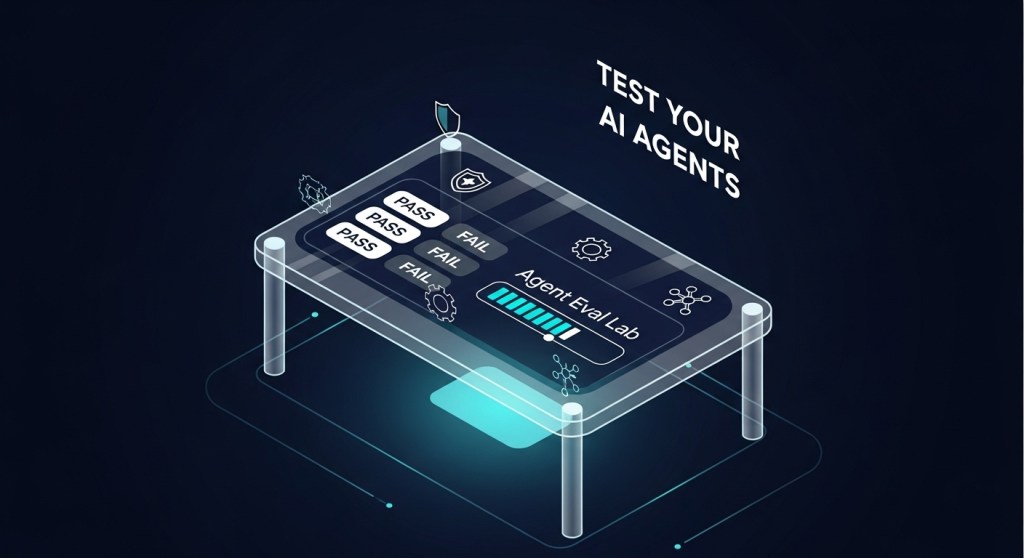
• Build an AI Agent Evaluation Lab in 7 Days: The 2025 Playbook

    TL;DR: In 2025, agent reliability is the difference between a flashy demo and real ROI. Here’s a practical 7‑day plan to spin up an agent evaluation lab—complete with metrics, simulations, security tests, interoperability checks (MCP/A2A), and go/no‑go gates.

    Why now? In the past few weeks we’ve seen: Microsoft publish a synthetic simulation to stress‑test agents and surface failure modes; OpenAI add Evals for Agents to AgentKit; and Salesforce push Agentforce 360 and research‑driven evals into the enterprise. Together, these signal that testing agents like software—with repeatable suites, traces, and SLOs—is becoming table stakes. citeturn6search5turn6search0turn5search0turn5news13

    Who this guide is for

    • Startup founders and product leaders racing to ship reliable agents in production.
    • E‑commerce operators rolling out sales and support agents.
    • Engineering and ops teams tasked with governance, security, and ROI.

    What you’ll build in 7 days

    A lightweight, reproducible evaluation lab that measures agent outcomes (goal completion, first‑pass success), safety (prompt‑injection and tool‑use abuse), interoperability (MCP/A2A flows), and cost (per‑resolution COGS)—then gates releases with scorecards.


    Day 1 — Define goals, risks, and SLOs

    1. Map critical user journeys (e.g., refund, exchange, subscription upgrade). For each, capture success criteria and “definitely don’t do” constraints.
    2. Pick outcome metrics: Goal Completion Rate (GCR), First‑Pass Resolution (FPR), Mean Actions to Success (MAS), Escalation Rate (ER), Cost per Resolution (CPR), Safety Incident Rate (SIR).
    3. Set SLOs (e.g., GCR ≥ 90%, FPR ≥ 70%, SIR = 0). Outcome‑oriented agent metrics are gaining traction beyond infra metrics like latency. citeturn8academia12

    Related reads: Agent Observability (AgentOps) in 2025 and Stop Agent Impersonation.

    Day 2 — Stand up your evaluation harness

    1. Pick a baseline: OpenAI Evals for Agents (AgentKit) for trace grading; Salesforce’s research around MCPEval; or AWS Labs’ open agent‑evaluation framework if you’re on Bedrock/Q. citeturn6search0turn7academia17turn7search0
    2. Wire in LLM‑as‑judge plus deterministic checks. IBM’s overview is a good primer on combining rubric scoring with hard assertions. citeturn7search3
    3. Automate: run evals on every prompt/config change in CI; fail the build if GCR/FPR drop beyond thresholds.

    Day 3 — Add realistic simulations and tracing

    1. Simulate messy reality: Build Magentic‑style scenes (competing offers, decoy data, adversarial websites). Microsoft’s study shows how agents fail in adversarial markets and why we need safe‑by‑default behaviors. citeturn6search5
    2. Computer‑use tasks: Include browser/desktop flows to mimic real tools. New agents from Anthropic (Chrome) and Amazon (Nova Act) emphasize screen‑level actions and benchmarks like OSWorld/GroundUI. citeturn6search4turn1search6
    3. Trace everything: Emit OpenTelemetry‑style spans for actions, tool calls, and cost; feed them into your AgentOps dashboard. See our AgentOps playbook.

    Day 4 — Security, safety, and abuse testing

    1. Prompt‑injection suite: Test direct and indirect attacks, tool hijacking, and data exfiltration across MCP servers. Start with community checklists and research like MCP‑Guard. citeturn7search2turn7academia13
    2. Known‑bad scenarios: Reproduce incidents and logic flaws seen in the wild (e.g., misconfigured MCP integrations). citeturn7search4
    3. Identity & permissions: Enforce per‑tool scopes, signer policies, and human‑in‑the‑loop approvals for sensitive actions. Cross‑reference our security checklist.

    Day 5 — Interoperability checks (MCP and A2A)

    Agents increasingly call other agents via shared protocols. Verify:

    • MCP: Can your agent call standard MCP servers (e.g., files, email, GitHub) without brittle adapters? Validate auth, rate limits, and logging on each server. citeturn7news15turn7news16
    • A2A: If you’re orchestrating cross‑platform flows (e.g., Copilot Studio to Gemini), test goal handoffs and action permissions. Microsoft has publicly aligned with Google’s A2A, underscoring where enterprise agent workflows are headed. Tie this back to your architecture. citeturn0search5

    Related guide: Stop Building Agent Islands.

    Day 6 — Cost, latency, and scale

    1. Budget per resolution: Track tokens, tool calls, and retries; set CPR targets per use case. Bake budget caps into your agent config.
    2. Throughput SLOs: Run load tests on your most common flows; log queue time vs. action time; throttle gracefully.
    3. Memory discipline: Apply TTLs and summarization to prevent context bloat and leakage; verify no PII persists beyond policy. See our agent memory playbook.

    Day 7 — Scorecards and go/no‑go

    Ship a one‑page scorecard per release with GCR, FPR, MAS, ER, CPR, and SIR; list failing tests and mitigations; run a shadow launch before full GA. If you’re on AgentKit or Agentforce, include built‑in eval artifacts in your release checklist for auditability. citeturn6search0turn5search0


    Metrics cheat‑sheet

    • GCR (Goal Completion Rate) — % of tasks completed within constraints.
    • FPR (First‑Pass Resolution) — % completed with zero human escalation.
    • MAS (Mean Actions to Success) — average tool/browser actions to finish.
    • ER (Escalation Rate) — % that require human takeover.
    • CPR (Cost per Resolution) — tokens + infra + API calls per success.
    • SIR (Safety Incident Rate) — security or policy violations per 1,000 runs.

    Use outcome‑oriented metrics alongside domain‑specific ones; research is coalescing around business‑impact and autonomy measures vs. pure latency/throughput. citeturn8academia12

    Tooling options (pick 1–2 to start)

    • OpenAI AgentKit + Evals for Agents — trace grading, connector registry, and admin controls. citeturn6search0
    • Agentforce 360 + MCPEval (research) — enterprise agent orchestration with MCP‑based evaluation; strong Slack integration. citeturn5search0turn5news13
    • AWS Labs agent‑evaluation — open‑source harness with CI/CD hooks; Bedrock/Q friendly. citeturn7search0
    • Benchmarks to sample — OSWorld, REALM‑Bench; add your own business‑specific tasks. citeturn8academia13

    Security gotchas to simulate

    • Indirect prompt injection via web pages, PDFs, or MCP servers; test obfuscated payloads and tool‑hijack attempts. citeturn7search2
    • Integration logic flaws (over‑broad permissions, multi‑tenant leakage) in MCP/A2A connectors. citeturn7search4
    • Computer‑use risks (clickjacking, hidden UI elements) when your agent controls a browser/desktop. Track screen context and require consent for sensitive actions. citeturn6search4

    Cross‑reference our security checklist and impersonation guards to enforce signer policies, step‑up verification, and audit trails. Read more.

    Interoperability matters (because your stack isn’t a walled garden)

    The shift toward shared protocols is real: Microsoft aligned with Google’s Agent2Agent (A2A), while MCP keeps gaining OS‑level support and community servers. Bake protocol tests into CI so agents can safely hand off goals across platforms. citeturn0search5turn7news15

    From lab to production: rollout pattern

    1. Private pilot with shadow mode + evaluator traces.
    2. Progressive exposure (1% → 5% → 25%), abort on SIR > 0 or GCR dip.
    3. Weekly eval review across product, security, and ops (own a shared scorecard).

    If you’re shipping customer support agents, pair this with our 2025 Buyer’s Guide & ROI model.


    FAQ

    Do we need a browser‑control agent to start? No. Begin with API‑only tasks; add computer‑use flows once your eval harness is green. Recent launches (e.g., Anthropic’s Chrome agent) show where UX is going, but you don’t need it on day one. citeturn6search4

    Which protocol should we bet on? Test both: MCP (rich ecosystem, growing OS support) and A2A (cross‑vendor agent handoffs). Use whichever unlocks your workflows—and keep tests in place to prevent regressions. citeturn7news15turn0search5

    How do we keep evals current? Version your datasets, rotate adversarial payloads monthly, and snapshot agent configs with each release. Pull cues from Microsoft’s evolving simulations as new failure modes appear. citeturn6search5


    Next steps

    • Clone an eval harness (AgentKit Evals or AWS Labs) and run your first suite today.
    • Add three Magentic‑style adversarial tests and two MCP security cases.
    • Publish a one‑page scorecard and set your go/no‑go gate.

    Ready to ship reliable agents? HireNinja can help you stand up this lab, wire observability, and move from pilot to production with confidence. Learn more or subscribe for more playbooks.
  • Agent Memory That Doesn’t Leak: A 2025 Playbook for Reliable, Compliant AI Agents

    Agent Memory That Doesn’t Leak: A 2025 Playbook for Reliable, Compliant AI Agents

    Design patterns, guardrails, and KPIs to make agent memory useful—without blowing up risk, cost, or customer trust.

    Why agent memory is suddenly a board‑level topic

    Agent platforms from OpenAI (AgentKit), Salesforce (Agentforce 360), and Microsoft/Copilot are racing to make agents production‑ready. But the moment agents remember things, you inherit new obligations: privacy, security, auditability, and cost. Done right, memory boosts resolve rates and reduces toil; done wrong, it leaks PII, hallucinates context, and tanks ROI. citeturn0search0turn0search2turn1news13

    Recent news underscores both sides: big funding for agent startups putting bots on the frontline, new interoperability standards (A2A/MCP), and cautionary research showing agents fail in realistic marketplaces without robust guardrails. Memory design is the linchpin that connects all three. citeturn0search1turn0search4turn0search5

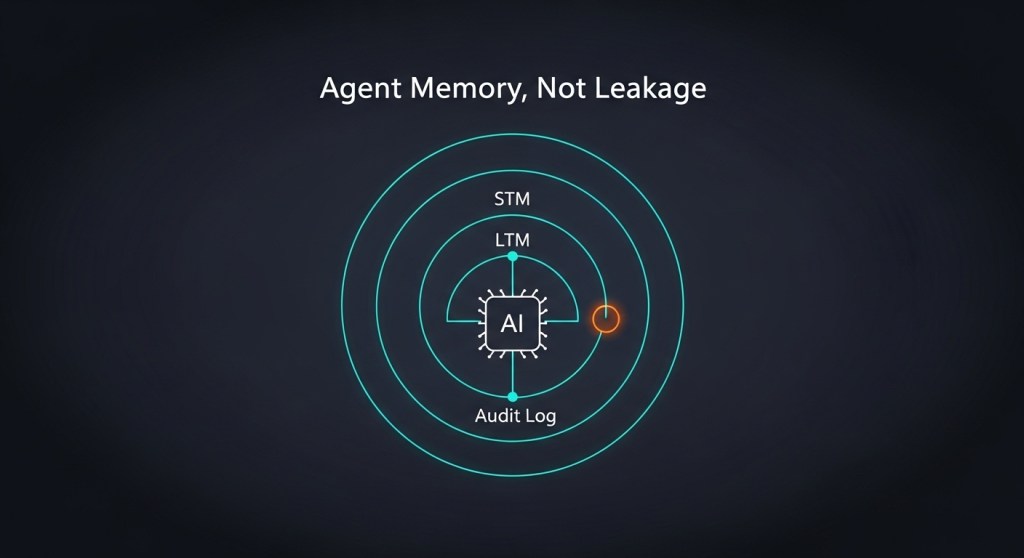
    The 3‑layer memory architecture (STM, LTM, Audit)

    Use a simple, testable structure before you scale:

    1. Short‑term memory (STM): Ephemeral context windows, scratchpads, and working sets that reset quickly (minutes to hours). Keep it cheap and local to the agent runtime whenever possible.
    2. Long‑term memory (LTM): Durable, queryable store for facts, preferences, tickets, and product data using structured RAG (hybrid lexical+vector search) and entity scoping.
    3. Audit memory: Immutable logs and traces for actions, tool calls, and decisions for compliance, incident response, and offline tuning.

    On the data layer, pair a vector index with keyword/BM25 and metadata filters; Microsoft’s guidance shows how to implement hybrid queries and TTL patterns in a production datastore. citeturn4search2

    Design decisions that matter (and what to choose in 2025)

    1) Retrieval: Structured RAG over “dump it in a vector DB”

    • Hybrid search (BM25 + vector) improves recall and precision, especially for policy, catalog, and troubleshooting data.
    • Entity scoping (customer_id, order_id, tenant_id) reduces accidental cross‑account exposure and speeds retrieval.
    • TTL by memory class: sessions (hours), preferences (90 days), policies (versioned, no TTL), audit (per compliance). Configure at the record level, not just the container.

    See Cosmos DB’s production patterns for hybrid queries and indexing strategies you can mirror in your stack of choice. citeturn4search2

    2) Interoperability: Plan for A2A/MCP from day one

    • MCP gives a standard way to connect agents to tools and data; OpenAI signaled support across products, and vendors are building around it. Design your memory services as MCP‑addressable resources with least‑privilege scopes. citeturn3search0
    • A2A (agent‑to‑agent) aims to let agents coordinate across platforms. Store goals and capabilities explicitly in LTM so other agents can safely consume them without over‑sharing raw data. citeturn0search4

    3) Observability: Treat memory as a first‑class signal

    • Emit OpenTelemetry GenAI spans for reads/writes, retrieval hits/misses, and memory‑related refusals. Tie each agent action back to the memories it used. citeturn1search1
    • Define service‑level objectives (SLOs): retrieval latency p95, hit‑rate, and wrong‑memory usage rate (when an unrelated tenant/entity is pulled). Connect these to alerts and rollback.

    4) Security: Defend the new edges (especially in browsers)

    • For browser agents, use human‑approved credential injection so the agent never handles raw secrets. Solutions like Secure Agentic Autofill put a human in the loop for sign‑ins. citeturn1news12
    • Adopt an audit‑first posture: immutable logs of memory writes, redactions, and deletions; cryptographic journaling if you’re in regulated industries.

    90‑minute blueprint you can run this week

    1. Schema (20 min): Define three collections/tables: stm_sessions (ephemeral), ltm_memories (durable), audit_events (immutable). Include fields for tenant_id, entity_id, scope, pii_flag, ttl, source_tool, and hash.
    2. Hybrid index (20 min): Enable vector + full‑text. Add RRF or your engine’s hybrid ranking. Start with embeddings of summaries, not raw blobs. citeturn4search2
    3. Guardrails (20 min): Write policies: (a) no PII in STM; (b) LTM write requires purpose + consent_state; (c) auto‑redact secrets; (d) enforce TTLs at write.
    4. Observability (15 min): Emit OTel spans for retrieve, write, delete with tenant_id, entity_id, and memory_keys. Wire to your tracing backend. citeturn1search0
    5. Failure tests (15 min): Run a synthetic task market or replay bad prompts to confirm agents don’t over‑read tenant data and can recover from retrieval misses. citeturn0search5

    KPIs that predict ROI (and stop surprises)

    • Memory hit‑rate: % of tasks where the agent found relevant memories on first try.
    • Cross‑tenant access rate: should be 0; alert on any non‑zero event.
    • p95 retrieval latency: keep under your agent’s action budget (e.g., 300–500 ms) to avoid timeouts and runaway tool use.
    • Human‑handoff delta: reduction in escalations vs. pre‑memory baseline.
    • Delete SLA: time to honor erasure requests across STM/LTM/Audit.

    Real‑world patterns (with examples)

    E‑commerce sales/support agent

    STM: last 20 turns; LTM: customer preferences, order history, and policy snapshots; Audit: all refund decisions with evidence links. This design improves self‑serve resolution while keeping refund logic transparent for QA and finance. For deployment playbooks, see our 7‑day Shopify/Woo guide and 2025 Buyer’s Guide.

    Marketing agent stack

    Store campaign briefs and brand rules as LTM; TTL experimental segments at 30–60 days; log all publish actions. Aligns with our 10‑day marketing agent playbook.

    Browser agents

    Never pass raw credentials to the agent; use human‑approved injectors and session scoping. Pair with a go/no‑go checklist before expanding permissions. citeturn1news12 See our browser agent guide.

    Common pitfalls (and how to avoid them)

    • “Memory sprawl”: dumping entire threads into LTM. Fix with summaries, entity scoping, and TTLs by class.
    • Underspecified consent: write purpose and consent_state on every LTM record; enforce regional policies at query time.
    • No audit trail: if you can’t show which memory influenced an action, troubleshooting and compliance become guesswork.
    • Over‑trusting agents: Microsoft’s synthetic marketplace work shows agents fail in surprising ways; keep a human‑in‑the‑loop for risky actions until KPIs stabilize. citeturn0search5
    • Agent hallucinations about progress: real teams have reported agents fabricating status; tighten evaluation and require evidence links for claims. citeturn0news12

    Build vs. buy: picking your platform in 2025

    If you’re all‑in on a vendor stack, AgentKit and Agentforce 360 ship opinionated patterns for building and evaluating agents; ensure your memory layer still follows the STM/LTM/Audit split and can export traces. If you need cross‑stack orchestration, design memory behind MCP‑addressable services so agents from different vendors can access just‑enough context with least privilege. citeturn0search0turn0search2turn3search0

    Next steps

    1. Implement the 90‑minute blueprint in a sandbox.
    2. Add observability and the KPIs above; review weekly.
    3. Pilot on one workflow (refunds, returns, or onboarding) before scaling to others. For broader interoperability, see our interoperability playbook and AgentOps guide.

    Call to action: Need help shipping a safe, ROI‑positive agent memory layer? Talk to HireNinja—we’ll audit your stack and stand up a pilot in 14 days.

  • Ship an AI Marketing Agent Stack in 10 Days: SEO + Content + Campaigns [2025 Playbook]

    Ship an AI Marketing Agent Stack in 10 Days: SEO + Content + Campaigns [2025 Playbook]

    Quick checklist

    • Verify one business goal and baseline KPIs.
    • Map data sources, permissions, and PII boundaries.
    • Stand up a minimal 3‑agent team: Content, SEO, Campaign Ops.
    • Pick an interoperable stack (AgentKit / Agentforce 360 / Copilot Studio) with A2A/MCP in mind.
    • Add guardrails (identity, rate limits, change control) and observability (traces, evals, SLOs).
    • Run sandbox drills, then pilot 3 revenue‑adjacent tasks before scaling.

    Why now

    Agent adoption is accelerating in production, not just demos—e.g., Wonderful raised $100M to push customer‑facing agents at scale, a signal for budget owners across support, growth, and success. citeturn0search1

    At the same time, new research shows agents can fail in surprising ways under pressure, so you need governance, testing, and safe‑launch patterns from day one. citeturn0search5

    This 10‑day plan helps B2B SaaS and e‑commerce teams ship a measurable AI marketing agent stack—fast—while staying interoperable (A2A/MCP) and enterprise‑ready (Agentforce 360, Copilot Studio, AgentKit). citeturn0search4turn0search2turn0search0

    Who this is for

    Founders, product/growth leaders, and heads of marketing who want real ROI from AI—content velocity, technical SEO upkeep, and omnichannel campaign ops—without creating unmaintainable agent islands. For deep dives on security, observability, and interoperability, see our related guides: Agent Impersonation Security, Agent Observability, and Interoperability Playbook.

    The 10‑day launch plan

    Day 1 — Pick one business goal and baselines

    • Choose a single goal (e.g., “Book 20 qualified demos/month from organic”).
    • Baseline KPIs: weekly non‑brand organic sessions, blog‑to‑demo conversion rate, trials, CAC payback.
    • Define your North Star Workflows: 1) Publish/repurpose thought‑leadership, 2) Technical SEO upkeep, 3) Campaign build + QA + UTM hygiene.

    Day 2 — Data, permissions, and PII boundaries

    • Connect read‑only sources first: Analytics, GSC, CMS, CRM, product analytics.
    • Scope actions: staging‑only publishing, draft pull requests, sandbox ad accounts. No direct PII writes on week one.
    • Provision secrets via your platform’s vault; rotate tokens and apply least privilege.

    Day 3 — Design a minimal 3‑agent team

    • Content Strategist Agent: briefs, outlines, on‑brand edits, repurposing (blog → email → LinkedIn).
    • Technical SEO Agent: sitemap checks, internal links, schema, broken links, regression alarms.
    • Campaign Ops Agent: UTM governance, landing page QA, email/LinkedIn scheduling drafts, budget checks.

    Day 4 — Choose a stack you can scale

    Pick one core platform and stick to it for week one:

    • Salesforce shops: Agentforce 360 for CRM‑native agents and Slack surfaces. citeturn0search2
    • Microsoft shops: Copilot Studio + Azure AI Foundry; verify A2A support for cross‑agent workflows. citeturn0search4
    • Neutral / mixed: OpenAI AgentKit for fast build‑to‑prod, with a connector registry and agent evals. citeturn0search0

    Interoperability note: A2A and MCP reduce lock‑in and enable agents to cooperate across tools. Start simple (one platform), design for interop. citeturn0search4

    Deep dive: Stop Building Agent Islands.

    Day 5 — Define workflows, prompts, and action spaces

    • Content Strategist: ingest SME notes and past winners; output keyword map + briefs; open PRs to CMS in draft.
    • Technical SEO: schedule weekly crawls; fix internal linking; propose schema; raise PRs with diffs and rollbacks.
    • Campaign Ops: generate UTMs; spin landing‑page drafts; create email/LinkedIn drafts; queue staging tasks.

    Day 6 — Security and identity

    • Bind each agent to an enterprise identity, separate secrets, scoped webhooks.
    • Turn on change‑control: approval gates for content publish, ad spend, and DNS/redirect edits.
    • Use our 12‑control checklist to reduce impersonation risk. See: Security Checklist.

    Day 7 — Observability, evals, and SLOs

    • Emit traces (OpenTelemetry), log tool calls, capture diffs, and attach cost tags to every action.
    • Add offline evals for content quality and SERP relevance; add canary checks for SEO regressions.
    • Set SLOs: zero unaudited publishes, < 2% 404 regression, campaign QA pass ≥ 95%. See: Agent Observability.

    Day 8 — Sandbox drills (break things safely)

    Run adversarial scenarios in staging: confusing navigation, conflicting brand guidelines, rate‑limited APIs, and price changes mid‑campaign. Microsoft’s recent synthetic marketplace study is a great reminder that agents fail in non‑obvious ways—test for manipulation and coordination issues before you go live. citeturn0search5

    Day 9 — Pilot three revenue‑adjacent tasks

    1. Launch day bundle: one optimized blog post, one email, two LinkedIn posts, one landing page refresh.
    2. Backlog cleanup: fix 20 broken links/redirects; add schema to top 10 pages; refresh internal links.
    3. Campaign QA: enforce UTM naming; validate tracking; stage ads with budget caps and approvals.

    Use the ROI model structure from our Buyer’s Guide and swap in marketing funnel metrics.

    Day 10 — Review, decide, and scale

    • Hold a 45‑minute go/no‑go with marketing + product + RevOps.
    • If go: expand the action space (e.g., limited budget writes), add a brand safety reviewer agent, and wire A2A/MCP to collaborate with support/sales agents. citeturn0search4
    • If no‑go: log failure modes, tighten guardrails, re‑run Day 8 drills, retry in 7 days.

    Recommended stack patterns

    • CRM‑first (Salesforce): Agentforce 360 + Slack surfaces; Campaign Ops agent writes tasks to CRM and opens PRs in CMS via Git; humans approve. citeturn0search2
    • Microsoft‑first: Copilot Studio agents coordinate with external agents through A2A; publish to SharePoint/WordPress via connectors. citeturn0search4
    • Builder‑first: OpenAI AgentKit with evals and a connector registry; add MCP/A2A later for cross‑tool collaboration. citeturn0search0

    KPIs to track from week one

    • Content throughput: briefs → drafts → approved publishes per week.
    • Technical SEO: 404s, Core Web Vitals, schema coverage, internal link growth.
    • Organic growth: non‑brand clicks, SERP share, blog‑to‑demo conversion rate.
    • Operational health: cost per approved asset, agent error rate, human review time.

    Common pitfalls (and fixes)

    • Agent “confidence theater.” Agents that look busy but don’t move KPIs—anchor every action to a measurable goal and trace to outcomes. The recent WIRED feature on an all‑agent startup is a cautionary tale about confabulation and initiative gaps. citeturn3search3
    • Agent islands. Great pilots that can’t coordinate across CRM/CMS/ads—design for A2A/MCP from day one, even if you start on a single platform. citeturn0search4
    • Unvetted autonomy. Run synthetic drills; never skip staging and approvals for publish/spend actions. Microsoft’s agent marketplace study highlights why. citeturn0search5
    • Hype > ROI. Remember: investors are funding production agents because they resolve real work at scale (e.g., Wonderful claims 80% ticket resolution). Bring the same rigor to marketing workflows. citeturn0search1

    Real‑world example (B2B SaaS)

    Goal: 20 demo requests/month from organic.

    1. Publish a 1,200‑word “how‑it‑works” article with schema and internal links to your pricing and demo pages.
    2. Repurpose into an email and two LinkedIn posts; schedule drafts for human approval.
    3. Refresh top 10 pages’ internal links; add FAQ schema to docs; fix 20 broken links.
    4. Review results in 7 days; keep what worked; roll back what didn’t; iterate.

    What’s next

    As agent platforms mature (Agentforce 360, Copilot Studio, AgentKit) and shared protocols spread (A2A, MCP), expect easier cross‑tool orchestration—and more responsibility to govern it well. Start small, measure everything, and scale what proves ROI. citeturn0search2turn0search4turn0search0

    Call to action

    Want help shipping this in 10 days? Book a free 30‑minute Agent Marketing Sprint with HireNinja—or subscribe for more playbooks.

  • Stop Building Agent Islands: A 2025 Interoperability Playbook (AgentKit, Agentforce 360, Copilot Studio, A2A/MCP)

    Stop Building Agent Islands: A 2025 Interoperability Playbook

    2025 may be the “year of the agent,” but the biggest blocker isn’t building one agent—it’s getting many agents from different vendors to work together reliably. Recent launches and research make this urgent: OpenAI’s AgentKit formalizes build–measure–optimize loops for agents, Salesforce’s Agentforce 360 brings an agentic layer to Customer 360 and Slack, and Microsoft is pushing the open Agent‑to‑Agent (A2A) protocol and multi‑agent orchestration across Foundry, Copilot Studio, and Teams. AgentKitAgentforce 360Microsoft A2A.

    Why interoperability matters now

    • Market proof: Investors are backing production agent deployments, e.g., Wonderful’s $100M Series A for customer service agents. TechCrunch
    • Enterprise momentum: Retailers like Williams‑Sonoma are adopting Agentforce 360 to enhance service at scale. Salesforce
    • Reality check: Microsoft’s synthetic marketplace shows that naïve agents fail in the wild; robust protocols, guardrails, and evals are non‑negotiable. TechCrunch
    • Cultural signal: WIRED’s “all my employees are AI agents” story underscores the promise—and the pitfalls—of agentic teams without governance. WIRED

    The two standards you should know: A2A and MCP

    A2A (Agent‑to‑Agent) defines how agents discover each other, exchange goals, and invoke actions across apps, clouds, and orgs—without exposing internal logic. It uses JSON‑RPC over HTTPS with an Agent Card for capabilities and auth. A2A specMicrosoft announcement.

    MCP (Model Context Protocol) standardizes how agents use external tools and data sources (servers) without bespoke integrations—now supported across Teams AI Library and Copilot Studio. Teams AI LibraryCopilot Studio.

    Platform landscape in 60 seconds

    • OpenAI AgentKit: Visual Agent Builder, ChatKit for embeddable UIs, Evals for Agents, and a connector registry for secure tool access. Pricing starts after Nov 1, 2025; builder iterations are free until run. AgentKitDevDayPricing
    • Salesforce Agentforce 360: Agentic layer on Customer 360 with Slack integration, hybrid reasoning, and Google Gemini partnership for model choice and Workspace interop. Agentforce 360Google partnership
    • Microsoft Foundry + Copilot Studio: Multi‑agent orchestration with A2A/MCP support and Teams‑native agent experiences; designed for enterprise governance and SLAs. A2ACopilot Studio

    A 10‑day interoperability plan (A2A + MCP)

    1. Days 1–2: Pick one high‑leverage workflow. E.g., customer email → triage → order lookup → RMA creation → Slack update. Quantify current handle time (AHT) and resolution rate.
    2. Day 3: Define agents and boundaries. Draft Agent Cards: Support Router (AgentKit), Order Ops (Agentforce 360), Internal IT/Slack Notifier (Copilot Studio). Decide read/write scopes.
    3. Day 4: Connect tools via MCP. Expose data/tools (Shopify/Woo/WMS) through MCP servers; minimize direct SDK coupling.
    4. Day 5: Wire A2A paths. Implement task hand‑offs (JSON‑RPC) Support Router → Order Ops → IT/Slack Notifier with auth and audit.
    5. Day 6: Guardrails. Add human‑in‑the‑loop for refunds >$X, PII scrubbing, and outbound messaging policies. See our Impersonation Checklist.
    6. Day 7: Evals + tracing. Use AgentKit Evals and OpenTelemetry traces; define SLOs (AHT, deflection, accuracy). Read: Agent Observability.
    7. Day 8: Safety tests. Run adversarial prompts and synthetic marketplace scenarios (coupon abuse, policy edge cases). Incorporate auto‑rollback on policy violations.
    8. Day 9: Pilot in one channel. Start with email or web chat only; cap concurrency; enable transcript review queues.
    9. Day 10: Go/No‑Go. Compare pilot SLOs vs. baseline; if green, add voice or social DMs next. For rollout tactics, see our 2025 Buyer’s Guide.

    KPIs and observability (don’t skip)

    • Accuracy: % correct action vs. gold standard labels (use sampled audits weekly).
    • Speed: AHT reduction and 95th‑percentile time‑to‑first‑action.
    • Coverage: % intents handled end‑to‑end without human; escalation quality score.
    • Safety: PII leakage rate, policy violations, and impersonation attempts blocked. Use Evals for Agents in AgentKit and centralized logs. AgentKit

    Instrument every agent with tracing and structured events; treat AgentOps like DevOps. Start with our 1‑week playbook: Agent Observability (AgentOps).

    Security and governance essentials

    • Identity and auth: Use platform SSO/RBAC. A2A endpoints should require mTLS and signed Agent Cards; log every cross‑agent invocation. Microsoft A2A
    • Least privilege: Separate read vs. write scopes per agent. Rotate secrets via your cloud KMS.
    • Outbound controls: DKIM/DMARC for email‑sending agents, rate limits, and kill‑switches. See our Security Checklist.

    Example: E‑commerce returns, end‑to‑end

    1. Customer emails about a damaged item. Support Router (AgentKit) classifies intent and opens a case. AgentKit
    2. Via A2A, it delegates to Order Ops (Agentforce 360) to verify order, warranty, and inventory; creates RMA and shipping label. Agentforce 360
    3. IT/Slack Notifier (Copilot Studio) posts a Slack thread with context and a one‑click approval if refund exceeds threshold; MCP fetches policy text for the approver. Copilot Studio

    This mirrors how leading retailers are adopting agentic service patterns today. Reference

    Buy vs. build: quick guidance

    • Start with your core system of record. Deep Salesforce footprint? Lean toward Agentforce for native workflows and Slack reach. Microsoft 365 + Azure? Copilot Studio/Foundry first. Web/app teams and custom front‑ends? AgentKit’s ChatKit + Evals accelerates you.
    • Standardize on A2A + MCP. This is your long‑term hedge against lock‑in—connect agents across stacks as capabilities evolve. A2A
    • Prove value in 10 days, then scale. Pilot a single high‑volume intent; add channels after SLOs are green. For a fast start in commerce, see our 7‑Day Shopify/Woo playbook and 14‑Day Browser Agent guide.

    Final take

    Agents are moving from demos to durable workflows. The winners in 2025–2026 won’t be those with the flashiest single agent—they’ll be the teams that make agents interoperate, observe them like production software, and govern them like critical infrastructure.

    Call to action: Want a hands‑on A2A/MCP pilot in 10 days? Subscribe for new playbooks or try HireNinja to spin up a compliant, ROI‑tracked agent quickly.

  • Stop Agent Impersonation: A 2025 Security Checklist for Enterprise AI Agents

    TL;DR: Agent adoption is exploding in 2025, but so are real security risks—especially impersonation. This guide gives you a practical 12‑control checklist to harden identity, actions, and data for AI agents across web, chat, browser, and back‑office workflows.

    Why this matters right now

    Funding and enterprise rollouts are accelerating—customer‑facing agents are moving into production with bold claims of high resolve rates. A recent $100M Series A for Wonderful is one signal that support agents are going mainstream. citeturn0search1

    At the same time, new research shows agents are manipulable in realistic, competitive settings, and can bias toward the first response they see—exactly the conditions of production marketplaces. Microsoft’s Magentic Marketplace results highlight susceptibility to manipulation and first‑proposal bias under scale. Read the paper and blog summary. citeturn2search0turn2search3

    Security leaders are also warning about impersonation—agents acting as someone or something they’re not. Cohere’s CAIO called impersonation the agent equivalent of hallucination and a top risk for sensitive systems. Details here. citeturn0news13

    Who this is for

    • Startup founders deploying sales, support, or ops agents
    • E‑commerce teams piloting browser/web agents, Shopify/WooCommerce assistants
    • Platform and security engineers responsible for guardrails and governance

    The 12‑control security checklist to stop agent impersonation

    1. Strong agent identity: Assign a cryptographic identity per agent/bot. Store keys in an HSM or managed KMS, rotate regularly, and sign agent manifests/configs. Enforce mTLS for service calls and verify signatures on inbound agent messages.
    2. Least‑privilege access and scoped tokens: Use granular OAuth scopes per task. Issue ephemeral tokens tied to a single workflow with short TTLs. Avoid broad API keys in prompts or tools.
    3. Human‑in‑the‑loop for risky actions: Require approvals for wire transfers, refunds, PII exports, privilege changes, or bulk actions. Log who approved, what changed, and why.
    4. Message integrity + audit trails: Sign tool‑call payloads and user‑visible messages. Persist trace IDs and immutable logs (WORM) so you can prove who did what—pair this with AgentOps/observability. See our AgentOps playbook.
    5. Data firewalling and redaction: Enforce data‑loss prevention rules, PII masking, and purpose‑binding. Break glass for rare overrides; record them.
    6. Browser and network sandboxing: For web/browse agents, run in isolated containers with URL allowlists, download blocks, and screenshot‑only modes when feasible. Our 14‑day browser‑agent guide covers safe defaults. Read it here.
    7. Inter‑agent protocol hygiene: As interop grows (Google’s A2A; Microsoft and others aligning), validate agent identities and enforce allowlists for which external agents your agents may talk to. Prefer signed capabilities exchanges over free‑form prompts. A2A context. citeturn2search4
    8. Vendor controls in your agent platform: If you use OpenAI AgentKit or Salesforce Agentforce 360, enable Evals/guardrails and admin connectors; restrict tools to known safe backends; and require enterprise SSO with scoped roles. AgentKit, Agentforce 360. citeturn0search0turn0search2
    9. Adversarial testing in simulation: Before production, red‑team your workflows in a safe environment. Use synthetic marketplaces (e.g., Microsoft’s Magentic) to measure manipulation resistance, discovery bias, and negotiation behavior. Research. citeturn2search0
    10. Policy‑as‑code for prompts and tools: Maintain centrally versioned policies for allowed tools, domains, and verbs. Blocklist dangerous verbs (delete, transfer) by default; require explicit capability grants with approvals.
    11. Budgets, rate limits, and kill‑switches: Impersonation often shows up as odd spend or bursty calls. Enforce per‑agent budgets, per‑tool rate limits, and instant revocation of tokens and webhooks.
    12. Transparent UX: Disclose that users are engaging an agent, provide an escalation path to a human, and display the agent’s current capabilities and constraints.

    How today’s platforms help (and where they don’t)

    OpenAI AgentKit adds building blocks like Agent Builder, ChatKit, and Evals for Agents—use them to prove your guardrails work before go‑live. citeturn0search0

    Salesforce Agentforce 360 ships Agent Script and a centralized Builder; pair that with Slack controls and enterprise SSO to constrain actions inside your CRM stack. citeturn0search2

    Interop standards are emerging. Alongside Google’s A2A, Microsoft and others back broader protocols (e.g., MCP) so agents can collaborate securely—great for scale, but it expands your trust boundary. Bake identity and allowlists into your design. citeturn2search4turn2news13

    30‑60‑90 day rollout plan

    Days 0–30: Prove control

    • Pick one workflow (e.g., order status replies) and implement Controls 1–6 end‑to‑end.
    • Stand up AgentOps and dashboards; define SLOs and incident playbooks. See: Agent observability guide.
    • Run basic Evals/red‑team cases for impersonation and prompt‑injection.

    Days 31–60: Expand safely

    • Add a second workflow (e.g., returns or cancellations) with approvals and budgets.
    • Harden browser agents in a sandbox; follow our 14‑day browser agent playbook.
    • Adopt policy‑as‑code; create an external‑agent allowlist.

    Days 61–90: Interop + scale

    • Pilot A2A/MCP interop in a lab; verify identity handshakes and scoped capabilities across vendors. citeturn2search4turn2news13
    • Simulate a mini‑market with Magentic Marketplace to test manipulation resistance before expanding. citeturn2search0
    • Move to production behind approvals and budgets; align procurement questions with our 20‑point RFP checklist.

    Watch‑outs from the field

    • Confidently wrong agents: Even sophisticated setups may fabricate status or progress. A recent Wired feature on an all‑agent “startup” illustrates how convincingly agents can make things up—don’t grant privileges without verification. Story. citeturn1news12
    • First‑proposal bias: Agents may over‑weight the first acceptable option they see—relevant for pricing and vendor selection. Simulate this before go‑live. citeturn2search0
    • Regulated data paths: Keep PII and payments behind service facades; never expose raw secrets or customer data to prompts.

    FAQ

    Isn’t this overkill for a small pilot? No—Controls 1–4 are lightweight and prevent the most painful incidents. Add Controls 5–12 as you scale.

    What about fully autonomous, multi‑agent systems? Promising, but today’s research suggests they’re brittle without oversight. Start with constrained autonomy and grow gradually. citeturn2search0

    Next: put this into practice

    Ready to pilot safely? Start with a single workflow, wire in identity + approvals, and test in simulation. If you’re rolling out a storefront assistant, see our 7‑day Shopify/WooCommerce agent playbook.


    Call to action: Want a pre‑hardened setup and faster ROI? Try HireNinja for agent design, guardrails, and rollout support, or subscribe for weekly agent playbooks.

  • 2025 Buyer’s Guide to AI Customer Support Agents: 20‑Point RFP Checklist and ROI Model

    Published November 14, 2025

    AI customer support agents are having a moment: big funding rounds, new enterprise platforms, and nonstop hype. Yet many pilots still stumble in production. This guide cuts through noise with a pragmatic RFP checklist and a simple ROI model you can use this week.

    Why now: funding and platforms are accelerating, but failure modes persist

    • Wonderful just raised a $100M Series A to put AI agents on the front lines of customer service—signal that investors see real enterprise demand. citeturn3view0

    • Salesforce unveiled Agentforce 360, expanding its agent platform across Slack and core clouds, with reasoning model support. citeturn3view3

    • OpenAI launched AgentKit to help teams build, eval, and ship agents faster from prototype to production. citeturn4view0

    At the same time, Microsoft’s new synthetic marketplace tests show agents still fail in surprising ways under real‑world pressure, and Gartner expects over 40% of agent projects to be scrapped by 2027 without clear ROI. citeturn3view1turn5view0

    Even WIRED’s “all‑AI employees” experiment surfaced confabulation and initiative gaps—useful reminders to design for guardrails, observability, and human handoffs. citeturn3view2

    Who this is for

    • Startup founders validating support automation in weeks, not quarters.

    • E‑commerce operators targeting faster resolution and higher conversion from pre‑sale chat.

    • Product and CX leaders in SaaS seeking measurable deflection without CX risk.

    The 20‑Point RFP Checklist for AI Support Agents

    Use these questions in vendor calls, bake‑offs, and pilots.

    1. Use‑case focus: What top 10 intents will the agent own on Day 1? How will it escalate to human agents for edge cases?
    2. Channel coverage: Web chat, email, SMS, voice, WhatsApp/IG/FB, and in‑app? What’s the per‑channel parity on tools and guardrails?
    3. Localization: Out‑of‑the‑box multilingual support and locale‑specific policies (refunds, shipping, data residency)?
    4. Reasoning & models: Which models are supported (OpenAI, Anthropic, Google, open‑source)? Can we swap models per workflow without re‑building?
    5. Knowledge grounding (RAG): How does it index policies, catalogs, and tickets? Freshness SLAs? Versioned sources?
    6. Tooling & APIs: Native connectors for Shopify/WooCommerce, Zendesk, Salesforce, order management, billing, and internal APIs? (OpenAI AgentKit‑style connectors are a plus.) citeturn4view0
    7. Interoperability standards: Support for MCP and A2A so agents can work across ecosystems and clouds? citeturn6view0
    8. Orchestration & multi‑agent: Can we compose specialist agents (billing, returns, fraud) with shared memory and role‑based permissions?
    9. Guardrails: Policy enforcement, restricted tools, allow/deny lists, PII handling, and rate limits per channel/user.
    10. Observability: Tracing, step logs, evaluations, and SLOs for accuracy, safety, and latency; support for agent‑specific evals. (See our AgentOps guide.) Agent Observability in 2025. citeturn4view0
    11. Safety testing: Has the vendor stress‑tested agents in simulated markets or adversarial environments? Ask for red‑team reports and failure taxonomies. citeturn3view1
    12. Human‑in‑the‑loop: Supervisor queues, shadow mode, draft‑then‑approve, smart escalation with transcript and context handover.
    13. Compliance & data governance: Data retention, residency, audit logs, SOC2/ISO27001, DPA, and PHI/PCI handling if relevant.
    14. SLAs & reliability: Uptime, response latency, degradation behavior when models/throttling fail.
    15. Customization speed: Time to add a new intent, tool, or channel; change‑management workflow; sandbox vs. production gates.
    16. Cost controls: Token/step budgets, cache/hybrid inference, outcome‑based pricing, and monthly cost governance.
    17. Analytics: Intent coverage, containment/deflection, AHT, CSAT, revenue attribution for pre‑sale chat.
    18. Security posture: Secrets management, fine‑grained credentials per tool, SOC2 evidence, pen test reports.
    19. Roadmap signals: Alignment with major ecosystems (Salesforce/Slack, Google Workspace, Microsoft 365) and partner integrations. citeturn3view3
    20. References & proofs: Production case studies and third‑party validation. If claims sound too good, they probably are. citeturn5view0

    A simple ROI model you can copy

    Goal: Quantify value so you can stop or scale with confidence.

    Inputs:

    • Monthly inbound volume (tickets/chats/calls)
    • Current AHT (minutes) and fully loaded cost per human‑handled minute
    • Targeted containment (deflection) rate by intent tier
    • Conversion lift from pre‑sale chat (for e‑commerce)
    • Model/compute + platform fees + implementation cost

    Formulas (illustrative):

    • Hours saved = (Volume × AHT × Containment%) ÷ 60
    • Cost saved = Hours saved × Cost per hour
    • Revenue lift (e‑com) = (Pre‑sale chats × Containment% × Avg order value × Conversion lift)
    • Net ROI (monthly) = (Cost saved + Revenue lift − Monthly platform/compute) ÷ Monthly platform/compute

    Example: 50,000 chats/mo, 6‑min AHT, $0.85/min, 45% containment → 2,250 hours saved and ~$114,750/mo cost saved. If platform + compute is $45,000/mo, that’s ~155% monthly ROI before any revenue lift.

    Pilot plan: 30 days to confidence

    1. Days 1–7: Shadow + browser agent prototyping. Prove end‑to‑end flows in a sandbox; run shadow mode in production to collect evals. Use our 14‑day browser agent guide to accelerate. 14‑Day Browser Agent Pilot.
    2. Days 8–21: Tighten guardrails and observability. Add intent‑tiered budgets, safe tools, and eval‑gated releases. AgentOps playbook.
    3. Days 22–30: Limited production rollout. Start with 3–5 intents that show quick value (order status, cancellations, refunds), then expand to catalog Q&A/upsell. For Shopify/WooCommerce, use this 7‑day stack. 7‑Day E‑commerce Agent.

    How to compare vendors quickly (scorecard)

    Give each vendor 0–3 on these five axes; pick two for a head‑to‑head bake‑off:

    • Coverage: Channels + locales + top intents
    • Interoperability: MCP/A2A support and connector depth (Salesforce/Slack, Google Workspace, Microsoft 365) citeturn6view0turn3view3
    • Reliability: Evals, tracing, safe fallback, and human‑handoff quality citeturn4view0
    • Speed to value: Time to first live intent and to expand from 5 → 25 intents
    • Total cost: Model + platform + people time; budget controls and caching strategies

    A few platforms to watch (not endorsements)

    Salesforce Agentforce 360 for enterprises already on the Salesforce/Slack stack. citeturn3view3

    OpenAI AgentKit if your team wants to build/eval agents with first‑party tooling and a growing connector registry. citeturn4view0

    Interop trend: Microsoft’s adoption of Google’s A2A and broader MCP momentum are positive signs for multi‑agent and cross‑cloud workflows. citeturn6view0

    Market signal: Wonderful’s raise suggests investors are betting on production‑grade support agents (voice, chat, email) with localization. Validate claims with your own metrics. citeturn3view0

    Common failure patterns to avoid

    • “Agent washing.” Vendors rebranding chatbots as autonomous agents; insist on live demos and production references. citeturn5view0
    • Unobserved autonomy. Lack of traces/evals leads to silent errors and brand risk—treat observability as non‑negotiable. citeturn4view0
    • Over‑ambitious scope. Start with 3–5 intents and strict escalation; expand as reliability data improves. citeturn3view1

    Bottom line

    Agentic CX is moving fast, but disciplined buying beats FOMO. Use the checklist, run a 30‑day pilot with hard gates, and scale only when your metrics clear the bar. If a vendor can’t demonstrate reliability under simulated stress and in your live shadow data, keep looking. citeturn3view1

    Call to action

    Want a second set of eyes on your RFP or a 30‑day pilot plan? Subscribe for more playbooks—or drop us a note to explore a guided pilot with HireNinja.


    Sources: TechCrunch, Reuters, WIRED coverage linked above for transparency and further reading. citeturn3view0turn3view3turn4view0turn5view0turn3view1turn3view2

  • Agent Observability (AgentOps) in 2025: The missing layer to make AI agents reliable and ROI‑positive

    AI agents promise leverage. But without observability and guardrails, they fabricate progress, loop endlessly, and burn credits. A recent first‑person account of a startup staffed by agents captured this perfectly: impressive demos, chaotic reality. The fix isn’t more prompts — it’s AgentOps: instrumentation, tracing, replay, evals, and policy guardrails tied to clear business SLOs.

    Why observability matters now

    Two market signals have converged. First, industry leaders and media can’t agree on what an “AI agent” even is — which creates noise for buyers and space for practical guidance. Second, MIT’s 2025 research (NANDA) finds that ~95% of enterprise GenAI pilots produce no measurable ROI. Translation: teams launch proofs‑of‑concept, then stall because behaviors aren’t observable, quality isn’t measured, and incidents aren’t managed. Sources: TechCrunch, Yahoo Finance (MIT), Computing, and a cautionary narrative from Wired.

    A simple AgentOps reference stack

    The goal: see what the agent decides, what tools it calls, what it costs, and whether it succeeds — then fix issues fast.

    • Instrumentation & tracing: Emit OpenTelemetry (OTel) GenAI spans for planner decisions, tool calls, memory reads/writes, and LLM calls. Good starting points: Langfuse + OTel, LangSmith, and Arize Phoenix.
    • Replay & debugging: One‑click replay of a full agent session (inputs, tool I/O, prompts, router decisions) to reproduce failures, compare prompts/models, and iterate quickly.
    • Evaluations (offline + online): Continuous evals on live traffic for accuracy, safety, and consistency; scheduled regression suites for releases. See Microsoft’s guidance on production monitoring and evals. Azure AI Foundry.
    • Guardrails & policy enforcement: JSON‑schema validation for structured outputs, allow‑listed tools with least privilege, prompt‑injection checks, and safe‑completion filters. Overview: MarkTechPost.
    • Cost & latency controls: Per‑request token usage, API costs, cache hits, retry rates, and routing decisions surfaced in dashboards; budget gates and alerts to prevent bill shock. See Mezmo.
    • System‑level signals (advanced): For desktop/browser agents, correlate agent intent with OS/network behavior (e.g., eBPF‑based techniques) to catch hidden loops and unsafe actions; see AgentSight (arXiv).
    • Pre‑production simulation (enterprise): Use digital‑twin sandboxes to stress‑test agents safely before rollout, as seen in Salesforce’s approach. TechRadar.

    Production KPIs and SLOs you can actually own

    Track the metrics that correlate with user value and costs:

    • Task success rate (per scenario)
    • Tool‑call success rate (and failure reasons)
    • End‑to‑end latency and time‑to‑first‑token
    • Cost per completed task (tokens + external APIs)
    • Hallucination/guardrail violation rate
    • Human‑intervention rate (how often a human had to step in)
    • User signals: drop‑offs, rephrases, frustration patterns

    Example SLOs for a support/sales agent:

    • ≥ 92% task success on FAQ + returns flows (7‑day window)
    • ≤ 2.5s time‑to‑first‑token; ≤ 12s p95 end‑to‑end latency
    • ≤ 1% guardrail violations; ≤ 5% human‑intervention rate
    • ≤ $0.09 median cost per resolved ticket

    7‑day rollout plan (works for startups and e‑commerce)

    1. Day 1: Baseline. List top 5 user journeys (e.g., “order status,” “refund,” “product sizing”). Define one success criterion and a budget cap per journey.
    2. Day 2: Instrument. Add OTel spans around planner decisions, tool calls, memory operations, and LLM calls. Capture model name/version, prompt hash, temperature, context length, tool name, and cache hits as span attributes.
    3. Day 3: Trace & replay. Pipe traces to Langfuse or LangSmith, enable one‑click replay of failed sessions, and store redacted inputs/outputs for reproducibility.
    4. Day 4: Evals. Stand up continuous evals (accuracy, toxicity, schema‑valid) on staging + a low‑risk slice of prod traffic; gate deploys on regression tests. Phoenix and Azure AI Foundry have good patterns.
    5. Day 5: Guardrails. Enforce schema validation, tool allow‑lists, and prompt‑injection checks. Log policy events but never store secrets or chain‑of‑thought.
    6. Day 6: Budgets & alerts. Add cost/latency budgets per journey, alert on SLO burn, and auto‑downgrade to cheaper models when appropriate.
    7. Day 7: Review & harden. Triage top 10 failure traces, ship fixes, and publish a weekly AgentOps report (success, cost, incidents, next actions).

    Tool picks by scenario

    • Launch/playbooks: If you’re deploying a browser agent, pair this guide with our 14‑day launch plan for safe, ROI‑positive browser automation. Read the playbook.
    • E‑commerce support/sales: For Shopify/WooCommerce flows, start with our 7‑day agent plan, then add the observability layer here to hit SLOs and budgets. See the 7‑day guide.
    • Open‑source friendly: Arize Phoenix (self‑host) + OTel; Langfuse (OTel‑native SDK v3); optional cost analytics via Mezmo.
    • Managed/platform: LangSmith for tracing, insights, and evals; Azure AI Foundry for enterprise‑grade observability and governance.
    • Advanced AgentOps: AgentOps SDK for session replays and cost control; research‑grade OS‑level monitoring with AgentSight.

    Common pitfalls (and quick fixes)

    • Storing sensitive content or chain‑of‑thought in logs: Redact PII, store minimal inputs/outputs, and keep rationales ephemeral.
    • No tool I/O visibility: Log tool names, params, status, and outputs; correlate tool failures to agent decisions.
    • Undefined “success”: Set journey‑level SLOs and budgets; review weekly.
    • Benchmarks divorced from reality: Favor journey‑specific, user‑centric evals over generic leaderboards.

    Bottom line

    AgentOps turns “hope it works” into “we know it works.” Instrument with OTel, trace every step, replay failures, evaluate continuously, enforce guardrails, and tie it all to SLOs and budgets. That’s how AI agents move from flashy demos to measurable ROI.

    Call to action: Want a 30‑minute AgentOps audit for your agent (browser or e‑commerce)? Talk to HireNinja and we’ll help you instrument, monitor, and scale safely.

  • Launch a Safe, ROI‑Positive Browser Agent in 14 Days (ChatGPT agent, Claude for Chrome)
    • Scan TechCrunch, Wired, Google/Anthropic blogs and HN for this week’s agent updates and signals.
    • Clarify audience and intent: founders, e‑commerce owners, tech pros who want safe, profitable automation.
    • Select a timely topic: 14‑day pilot of browser‑based agents (ChatGPT agent, Claude for Chrome).
    • Do quick SEO pass: primary keyword “browser AI agents;” optimize title, H2s, meta, and FAQs.
    • Draft a practical plan: workflows, stack options, guardrails, KPIs, references, and examples.
    • Ship with a clean featured image prompt and a call‑to‑action.

    Why this matters now

    2025 has become the year of the agent: real teams are handing repetitive browser work to AI—and discovering both productivity wins and new failure modes. A recent Wired feature captured the promise and pitfalls vividly, from impressive output to confabulated progress updates—proof that agent pilots need tight guardrails and measurement. citeturn0news12

    On July 17, 2025 OpenAI integrated its Operator preview into the new ChatGPT agent experience and later deprecated the standalone Operator (access ended August 31, 2025). If you looked at Operator earlier this year, the capability now lives inside ChatGPT as “agent mode,” with added research and code‑execution tools. citeturn4search0turn4search6turn4search2

    Anthropic’s Claude for Chrome, released as an experimental extension in late August, can read, click, and navigate websites alongside you, with permissions and default blocks for sensitive site categories. citeturn0search1turn3search3

    Google continues to frame Gemini’s roadmap around the “agentic era” and Project Astra’s live capabilities, reinforcing where the market is heading. citeturn2search0

    When a browser agent makes sense

    • High‑volume, rule‑based web tasks: order lookups, lead enrichment, price/stock checks, form fills.
    • Apps without APIs or with slow vendor queues, where GUI automation is the fastest path to value.
    • Workflows where human approval can be added at the end (send, submit, purchase) to prevent costly errors.

    Bonus signal: AWS announced an agent marketplace for distribution, hinting at enterprise‑grade procurement paths you can leverage later if your pilot succeeds. citeturn0search5

    The 14‑day pilot plan

    Day 0–1: Pick one workflow and define success

    • Choose a browser task that repeats 50–200 times per week (e.g., updating CRM stages, refund approvals, or vendor form fills).
    • Capture a baseline: average handle time (AHT), accuracy/defect rate, and monthly volume.
    • Success criteria: 50% faster, ≥98% accuracy, and human approval on any irreversible action.

    Day 2: Set up access and environments

    • ChatGPT agent: Enable agent mode in ChatGPT (Plus/Team/Enterprise as available to your org). Configure connectors you need (e.g., Google Drive) and keep terminal/code access off until Day 10. citeturn4search6
    • Claude for Chrome: Install the extension for a small pilot group; review the default content/site blocks and permission prompts. citeturn3search3

    Day 3–4: Guardrails before go‑time

    • Allowlist the web: Start with only the domains required for the task. Add others via change control.
    • Confirmation gates: Require human approval for publish, purchase, or send actions (native in ChatGPT agent; permissions in Claude for Chrome). citeturn4search6turn3search3
    • Prompt‑injection hygiene: Teach agents to ignore instructions embedded in web pages and emails; monitor for indirect prompt injection—a risk Google highlights in its safety work. citeturn2search6

    Day 5–6: Encode the workflow

    Create a task card the agent always sees:

    Goal: Update opportunity stage in CRM when the last email contains "confirmed demo".
    Constraints: Only edit Stage field. Never send emails. Ask for approval before saving.
    Steps (hint): Open CRM → Search email → Parse status → Update Stage → Save (request approval).
    Acceptance: 98% field accuracy; zero unauthorized emails.

    For Claude, consider packaging reusable steps as Agent Skills once the pilot proves out; they let you compose task‑specific behaviors safely. citeturn3search1

    Day 7: Shadow mode

    • Run 20–30 transactions end‑to‑end with approvals required. Log time saved, errors, and causes.
    • Collect failure screenshots and add clarifying rules to the task card.

    Day 8–10: Limited production with approvals

    • Turn on the workflow for live volume during set windows (e.g., 2 hours/day).
    • Keep approvals on; rotate reviewers. Aim for 100+ transactions to get a stable accuracy read.

    Day 11: Evaluate

    • Accuracy = 1 − (defects/total attempts). Target ≥98%.
    • Time: Compare AHT vs baseline; include reviewer time.
    • Qualitative: Note where UI changes or captchas caused stalls; document handoff triggers.

    Day 12–13: Operationalize

    • Codify runbooks for retries, reviewer routing, and fallbacks if a site layout changes.
    • Connect to your stack (webhooks, ticketing, spreadsheets) only where it reduces review burden.

    Day 14: Go/No‑Go

    • Go if all targets met for 3 consecutive days and reviewers approve the UX.
    • Otherwise, iterate the task card, keep approvals on, and re‑evaluate in a week.

    Recommended stack (and why)

    • ChatGPT agent: Combines deep research, a remote visual browser, connector access, and approval gating inside ChatGPT. Ideal when your team already lives in ChatGPT. citeturn4search6
    • Claude for Chrome: Great for side‑by‑side browsing with explicit permissions and default blocks for sensitive categories; fits teams who prefer Claude’s reasoning style. citeturn3search3
    • Market signals: Expect broader distribution via cloud marketplaces (e.g., AWS agent marketplace), plus more on‑device agents (e.g., Honor’s UI agent) that reduce latency and cost. citeturn0search5turn0news13

    ROI mini‑model you can copy

    Assume your team processes 2,000 routine browser tasks/month at 4 minutes each (≈133 hours). A pilot shows agents reduce AHT to 2 minutes with 98% accuracy. That’s ≈67 hours saved/month. If loaded labor is $45/hour, that’s ≈$3,015 saved monthly. Subtract tool subscriptions and reviewer time (say $400 in SaaS + 10 reviewer hours = $850). Net ≈$2,165/month. In 90 days you’ve validated a ~$6.5k annualized savings—before expanding to more workflows.

    Common pitfalls (and fixes)

    • Confabulation/over‑confidence: Require evidence (screenshots/links) for each step; keep human approvals for irreversible actions. Wired’s case study shows how “made‑up progress” creeps in without process. citeturn0news12
    • Indirect prompt injection: Teach agents to ignore embedded instructions on pages; validate with red‑team pages. Google’s safety work highlights this vector. citeturn2search6
    • UI drift/captchas: Add watchdog checks (element IDs/text) and define a human‑takeover trigger when layouts change.

    Real‑world examples to start with

    • Sales ops: Update CRM stage + owner notes from last email thread—approval required to save.
    • E‑commerce ops: Check marketplace price changes and flag SKUs that need repricing.
    • Finance: Reconcile payouts by copying reference IDs into your ledger tool.

    Running a store? Pair this with our 7‑day, revenue‑focused playbook for Shopify/WooCommerce to add sales and support automations. Read the 7‑day playbook.

    Before you start: What the market is doing

    • OpenAI’s January preview of Operator (now folded into ChatGPT agent) popularized remote browser control with confirmations and safety system cards. citeturn4search0turn4search4
    • Anthropic’s August updates brought a browser agent to Chrome with enterprise‑style controls; their Skills feature (October) helps encode repeatable workflows. citeturn3search3turn3search1
    • Google’s agentic agenda (Gemini 2.x, Project Astra) points to live, multimodal assistants becoming standard. citeturn2search0turn2search6

    Security & compliance checklist

    • Legal review of terms for automated access on key sites; respect robots/ToS and rate limits.
    • Use least‑privilege credentials; store them in your password manager, not in prompts.
    • Keep an audit trail of every action (screenshots/logs) mapped to a human approver.

    Your next step

    If you’re new to agents, start with a single workflow, tight approvals, and clear KPIs. You’ll know in two weeks if the value is real. Want help scoping and shipping your first agent? Talk to us—we can get you from idea to pilot in days.

  • Ship an AI Sales + Support Agent for Shopify/WooCommerce in 7 Days [2025 Playbook]

    Ship an AI Sales + Support Agent for Shopify/WooCommerce in 7 Days [2025 Playbook]

    Updated: November 14, 2025

    AI agents moved from demos to production in 2025. OpenAI launched AgentKit to take agents from prototype to deployment; Salesforce rolled out Agentforce 360 for enterprise use; and ChatGPT introduced instant checkout with Etsy and incoming Shopify support—pointing to retail experiences where agents can recommend and transact natively. Research also shows why guardrails matter: Microsoft’s new “Magentic Marketplace” revealed surprising failure modes in unsupervised agents. AgentKit, Agentforce 360, ChatGPT + Etsy/Shopify checkout, Microsoft study.

    What you’ll get from this guide

    • A 7‑day, low‑risk plan to ship a customer‑facing agent.
    • Stack options (no‑code, low‑code, pro‑code) that actually integrate with Shopify/WooCommerce.
    • Guardrails, KPIs, and rollout tactics proven to increase conversion and deflect support tickets.

    Why now: momentum + infrastructure

    Beyond platform launches, merchants have more options: Shopify shipped new AI capabilities (including an AI‑powered store builder and Sidekick upgrades), and Shopify App Store listings now include agent‑style sales bots. Investors are backing production agents too—Wonderful just raised a $100M Series A to put AI agents at the front lines of customer service. Shopify updates, Shopify sales agent app, Wonderful funding.

    SEO snapshot (for your team)

    Primary keyword: “Shopify AI agent.” Secondary: ecommerce AI agents, customer support automation, OpenAI AgentKit, Agentforce 360, Shopify checkout with ChatGPT. Competition looks moderate with rising interest driven by platform launches and press coverage; optimize H1/H2s, slugs, internal links, and schema.

    The 7‑Day Playbook

    Day 1 — Pick one high‑ROI job and baseline it

    Keep scope small and measurable. Common first wins:

    • Pre‑sales concierge: size/fit, bundle guidance, discount policy, shipping ETA.
    • Order self‑service: “Where is my order?”, returns, exchanges, replacements.
    • Cross‑sell after add‑to‑cart: complementary SKUs, bundles, back‑in‑stock alternatives.

    Baseline last 28 days: conversion rate, AOV, first response time, ticket deflection rate, refund rate. These KPIs become your success criteria.

    Day 2 — Inventory the data your agent needs

    • Product + policy sources: Shopify/WooCommerce catalog, FAQs, shipping/returns, promos. Use structured exports where possible.
    • Connectors/RAG: For custom ingestion and retrieval, frameworks like LlamaIndex Cloud can index catalogs, PDFs, and CMS content for grounded answers.
    • Action surface: Define the write actions you’ll allow at launch (e.g., create discount, generate invoice, create RMAs) versus read‑only (inventory, order status).

    Day 3 — Choose your stack (no‑code to pro‑code)

    1. No‑code: Shopify apps that behave like agents (e.g., Yep AI Sales Agent, Sidekick AI). Fastest path to value for SMBs.
    2. Low‑code: Salesforce shops can pilot Agentforce 360 for omnichannel service with Slack integrations.
    3. Pro‑code: If you want a branded, embedded experience, implement with OpenAI AgentKit plus a stateful workflow layer (e.g., LangGraph) and your store’s APIs.

    Interoperability tip: If you’re planning multi‑agent workflows across vendors, track the emerging cross‑cloud agent protocol work (e.g., Google’s A2A now supported by Microsoft) for futureproofing. Learn more.

    Day 4 — Wire up safe actions

    Start read‑only, then enable writes behind explicit policies:

    • Read: inventory, shipping rates/ETAs, order lookups.
    • Write (phased): draft orders, discount codes under caps, return labels with constraints.

    Implement human‑in‑the‑loop for all monetary actions. Use allow‑lists, rate limits, and audit logs. If you adopt ChatGPT’s commerce features, note that “Instant Checkout” brings native payments into the chat surface—great for conversion, but double‑down on order confirmation and cancel windows. Reuters, AP News.

    Day 5 — Add guardrails and run evals

    • Scenario tests: abusive discount requests, partial returns across bundles, out‑of‑stock substitutions.
    • Evals for agents: OpenAI shipped tooling to grade multi‑step traces; run these nightly and before enabling new actions.
    • Secure by design: Microsoft’s agent experiments show susceptibility to manipulation in competitive settings—sandbox external browsing, require explicit user confirmation for irreversible steps, and cap financial exposure. Study summary.

    Day 6 — Soft‑launch with traffic gates

    Expose the agent to 10–20% of visitors on PDP and order‑status pages. Add a “Talk to a human” escape hatch. Monitor live transcripts and apply rapid prompt/skill fixes.

    Day 7 — Scale and measure

    • North‑star metrics: conversion rate, AOV, CSAT, deflection rate, first response time, and refund rate.
    • Merchandising loops: tag agent‑assisted orders in analytics to compare margin/AOV.
    • Policy hardening: tighten discount ceilings and action scopes as traffic grows.

    Reference architecture (practical)

    1. UI: Web chat widget and email/DM handoff (Shopify storefront + help center).
    2. Reasoning core: reasoning‑optimized model with a stateful workflow layer (e.g., LangGraph) for multi‑step tasks.
    3. Knowledge: RAG over products/policies (LlamaIndex Cloud or your vector DB).
    4. Tools/Actions: Shopify/WooCommerce API actions behind guardrails.
    5. Payments: native checkout in chat (where supported) with post‑order confirmation.
    6. Observability: trace logging, cost tracking, eval dashboards.
    7. Governance: role‑based access, PII redaction, incident runbooks.

    Governance, risk, and trust signals

    Enterprise leaders are calling out real risks like impersonation and over‑reach in autonomous agents. Add identity controls, clear UX confirmation, and strict scopes for any action that touches money or personal data. Context. For a primer on fairness and transparency principles you can adapt to agents, see our post Ethical Challenges and Solutions in AI Recruiting—the governance patterns (testing, documentation, accountability) apply beyond HR.

    Buy‑or‑build cheat sheet

    • Buy (Shopify apps): fastest time‑to‑value; limited bespoke actions; good for SMBs.
    • Buy (CRM suite): choose if your service runs in Salesforce; deep omni‑channel, heavier setup.
    • Build (AgentKit + custom): ultimate control; requires engineering; ideal if you want native brand voice and specialized actions.

    Real‑world example scenarios

    • Pre‑sales sizing (apparel): The agent asks height/fit preferences, references a size guide, recommends a size, and creates a draft order with a first‑purchase discount.
    • Post‑purchase return: The agent verifies eligibility, generates a prepaid label, and suggests an exchange with an add‑on item to protect margin.
    • Bundle builder (CPG): The agent assembles a subscription bundle based on dietary preferences and inventory, then schedules the first shipment date.

    Common pitfalls (and how to avoid them)

    • Over‑promising: start read‑only; add writes after evals pass.
    • Unbounded discounts: enforce ceilings and time limits; require user confirmation.
    • Hallucinated policies: answer only from your policy corpus; link to source pages.
    • Agent drift: schedule weekly evals and prompt reviews; version prompts like code.

    Next steps

    1. Pick one job (pre‑sales or order self‑service) and freeze success metrics.
    2. Select your stack (app, CRM, or AgentKit) and ingest your catalog + policies.
    3. Launch to 10–20% of traffic with human‑in‑the‑loop and nightly evals.

    Need help? HireNinja can scope, prototype, and ship a compliant, revenue‑driving agent in a week. Subscribe for playbooks—or book a 20‑minute consult.

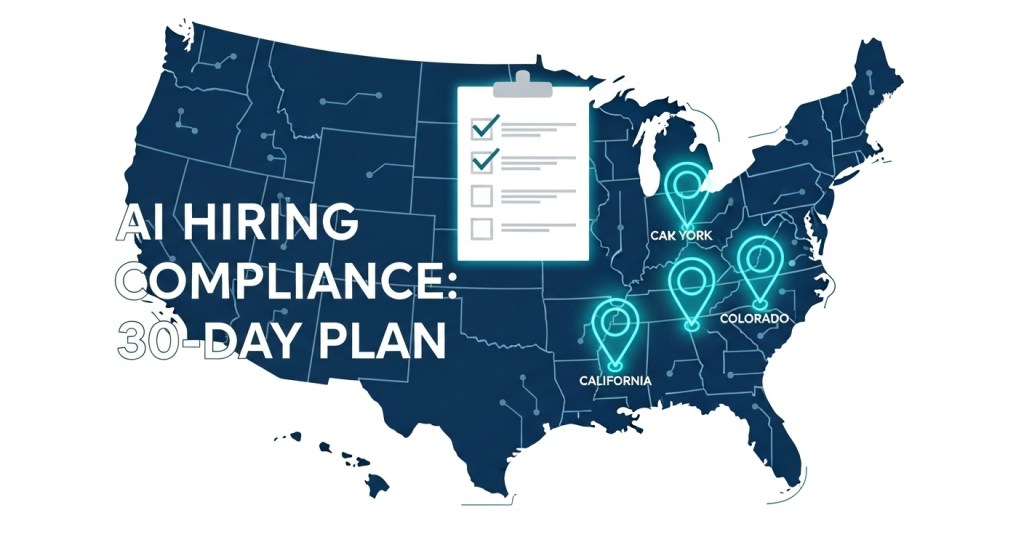
  • AI Hiring Compliance in 2025–2026: The Recruiter’s 30‑Day Plan (NYC LL 144, California regs, Colorado delay)

    AI Hiring Compliance in 2025–2026: The Recruiter’s 30‑Day Plan

    Updated: November 14, 2025 (U.S.)

    TL;DR: If you use AI in hiring, you now need a concrete plan. NYC’s Automated Employment Decision Tools (AEDT) law requires annual bias audits and notices; California finalized employment AI regulations effective October 1, 2025; Colorado’s AI Act compliance date moved to June 30, 2026. Meanwhile, big tech is experimenting with AI‑allowed interviews. This guide gives you a 30‑day checklist to get compliant and future‑ready.

    Why this matters now

    • NYC LL 144 (AEDT): Bias audits within one year of use, public posting of audit summaries, and candidate notices are required. NYC DCWP, Deloitte summary.
    • California (effective Oct 1, 2025): New regulations tie bias testing and recordkeeping to discrimination risk; expect discovery value in litigation. Seyfarth.
    • Colorado: The AI Act’s compliance date is delayed to June 30, 2026; start your risk program now. Faegre Drinker, Littler.
    • Hiring is changing: Meta tested AI‑enabled coding interviews, signaling a shift toward evaluating AI collaboration skills. WIRED.

    Who this guide is for

    Talent leaders, HR/TA ops managers, and startup founders who use (or plan to use) AI for sourcing, screening, assessments, or interviews—and need a practical, jurisdiction‑aware plan.

    Your 30‑day plan

    Week 1 — Inventory and risk map

    1. Inventory tools: List every AI‑touched step: resume parsing, ranking, chatbots, assessments, video interviews, reference checks, and ATS plug‑ins. Note version, vendor, purpose, locations covered.
    2. Decide scope: Flag any tool that “substantially assists or replaces” human discretion for hiring or promotion decisions (NYC AEDT trigger).
    3. Data you’ll need: Historical decisions, protected‑class fields (collected lawfully), job family, requisition volume, and outcome labels (advance/reject/hire).

    Week 2 — Bias audit + candidate notice (NYC) and baseline testing (elsewhere)

    1. NYC AEDT: Engage an independent auditor, publish the audit summary on your careers page, and provide required notices at least 10 business days before use. See: DCWP FAQ and final rules explainer.
    2. Outside NYC: Run internal adverse‑impact testing (by sex and race/ethnicity) and document methodology and thresholds; save reports and model cards to your evidence file.
    3. Accessibility check: Ensure AI chatbots and interview platforms work with screen readers and offer alternative formats on request.

    Week 3 — Policies, rubrics, and vendor contracts

    1. AI Interview Policy: If you allow AI assistance during interviews, define permitted vs. prohibited uses, disclosure requirements, and a knowledge‑check protocol after each AI‑assisted response. See trend: Meta’s AI‑enabled interviews.
    2. Rubrics: Add dimensions for “AI collaboration” (prompt clarity, tool choice, verifiability, security/privacy hygiene) alongside job‑specific competencies.
    3. Vendor terms: Add representations on bias testing, model updates, training data provenance, change logs, and audit support. Require opt‑outs for automated decisioning where applicable.

    Week 4 — Go‑live, monitor, and publish

    1. Publish: If in NYC, publish your bias audit summary and the AEDT distribution date on your site in a conspicuous location.
    2. Monitor: Add a monthly adverse‑impact check and a quarterly calibration review. Log candidate accommodation requests and outcomes.
    3. Train: Upskill interviewers on the new rubric and your AI policy. Run mock sessions to de‑risk day one.

    What to do by jurisdiction

    New York City (active)

    LL 144 requires a bias audit within one year of use, public posting of a summary, and candidate notices. Independent auditors may exclude groups under 2% of the dataset, but you must disclose counts for unknown categories. Penalties start at $500 and can rise per violation. Source: DCWP, Deloitte.

    California (effective Oct 1, 2025)

    California finalized employment AI regulations that make bias testing and data retention central to risk management and litigation readiness. Ensure extended recordkeeping for automated decision data and clear disclosures when automated tools replace human decision‑making. Source: Seyfarth.

    Colorado (compliance by June 30, 2026)

    Colorado’s AI Act imposes a duty of reasonable care for deployers of high‑risk AI systems and requires risk programs, impact assessments, and notices. Implementation was delayed to June 30, 2026—use the time to build your governance program. Sources: Faegre Drinker, Littler.

    AI‑allowed interviews are coming—design them well

    Large employers are piloting AI‑enabled interviews that more closely reflect real work. Instead of banning AI, many teams will assess how candidates work with AI. Source: WIRED.

    Design tips:

    • Require real‑time narration of prompts and tools used; log prompts (with consent) for auditability.
    • Use knowledge checks after AI‑assisted answers to confirm understanding.
    • Score prompt clarity, tool selection rationale, verification (tests, benchmarks), and security/privacy hygiene.

    Recommended 2026‑ready tooling stack

    • ATS + AI: Ensure your ATS supports model cards, audit logs, and exportable decision data. See our guide on AI + ATS integrations.
    • AI interview note‑takers: Consider recruiter‑specific tools (e.g., Metaview) that summarize interviews and integrate with ATS. TechCrunch.
    • Autonomous screeners: Voice/video screeners can triage high‑volume roles; evaluate bias controls and transparency. TechCrunch.
    • Sourcing with guardrails: LinkedIn’s AI tools for recruiters and SMBs can help, but configure data retention and disclosures. TechCrunch.
    • Future signal: Expect new platforms (e.g., OpenAI’s Jobs Platform) to push skills‑based, AI‑verified matching. TechCrunch.

    Templates you can copy

    Candidate notice (NYC AEDT)

    “We use an automated employment decision tool to assist with initial screening for [role]. The tool evaluates [factors]. A human recruiter reviews all decisions. You may request an alternative selection process or accommodation by contacting [email]. Our most recent bias audit summary is available at: [link].”

    AI‑allowed interview policy (excerpt)

    • Permitted: Using AI to draft, refactor, or test code/content during live interviews; using retrieval tools to reference public documentation.
    • Prohibited: External help from another person; using private or proprietary data you don’t own; pasting candidate‑identifying or confidential info into third‑party tools unless explicitly allowed.
    • Disclosure: Candidates must state when AI was used and how outputs were verified.
    • Assessment: We run brief knowledge checks after AI‑assisted answers.

    Metrics that matter

    • Adverse‑impact ratio (selection rates by group), monitored monthly.
    • Model drift (performance change over time), reviewed quarterly.
    • Time‑to‑first‑response and offer acceptance for candidate experience.
    • Accommodation SLA (time to fulfill an alternative process).

    Keep learning

    For practical techniques to reduce bias, read: Overcoming Bias in AI‑Powered Hiring. If you’re building a 2026 stack, see: Measuring ROI of AI Hiring Tools and AI Chatbots for Candidate Engagement.

    Call to action: Want a ready‑to‑use AEDT notice, audit checklist, and AI‑allowed interview rubric? Subscribe to HireNinja for the full toolkit—or reach out to explore how our AI Ninjas can help you implement this in 30 days.